
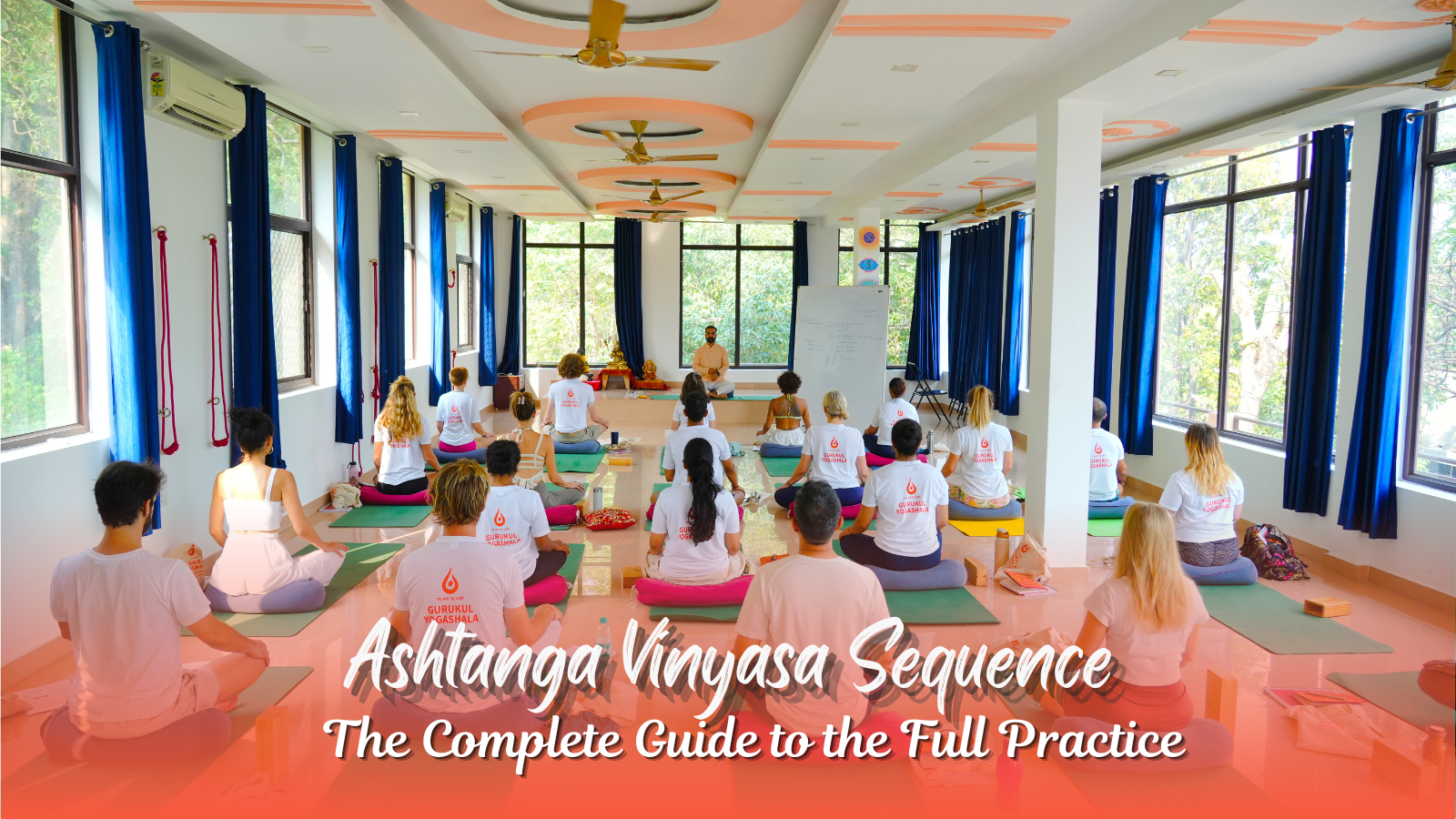
One can enter an Ashtanga facility early in the morning, and straight away, one can see the constant repetition of the Ashtanga movements – not that it appears to be too tense, but rather because everything is carried out with great reliability. Very few people are left wondering what happens next. The jumping-back stages and every inhalation are defined by centuries of traditions. This precision is what the entire Ashtanga Vinyasa sequence is focused on – a style where breath and exercise are perfectly combined for perfect meditation. Coming from the experience we gained while teaching at Gurukul Yogashala, this guide will explore what the vinyasa sequence is and how it works in practice.
What Does “Vinyasa” Mean in Ashtanga Yoga?
The term “vinyasa,” in modern yoga, is often misused, yet when one refers to Ashtanga yoga, the term carries a precise interpretation. Vinyasa also refers to those series of breath-and-body movements linking one asana to the next, such as jump back, Chaturanga, Upward-Facing Dog, and Downward-Facing Dog, as well as others. Practitioners use vinyasa to enter and exit each Ashtanga vinyasa yoga sequence, and every movement is related to a certain breath – which means that one move corresponds to one inhale or exhale.
The concept of “vinyasa krama” is derived from the teachings of Tirumalai Krishnamacharya – the founder of modern yoga – who first introduced this system of movement related to the breath. Later on, one of his students, K. Pattabhi Jois, integrated this teaching into the classical method of Ashtanga yoga at his shala located in Mysore, India.
The Structure of the Full Ashtanga Vinyasa Sequence
Unlike free-flow vinyasa classes, which vary their order of poses daily, the Ashtanga yoga vinyasa sequence comprises fixed steps. Each class follows the same plan of action:
Opening chant – usual Sanskrit chant to announce the beginning of a class
- Sun Salutations A – 5 rounds of Surya Namaskara A followed by 3-5 rounds of Surya Namaskara B to create heat
- Standing series – as the name suggests, this series uses standing poses to strengthen and enhance the balance and flexibility in the hips, hamstrings, and spine.
- Seated sequence – series-related postures that vary depending on the series
- Finishing sequence – backbends, inversions, and meditation. This last sequence is identical for all six series.
Since the ending and opening sequences are fixed, only the middle sequence differs from series to series. This is what makes the Ashtanga vinyasa sequences – Primary, Intermediate, and four Advanced variants of Ashtanga vinyasa sequences – share a common principle while still being challenging in different ways.
Ashtanga vs. Vinyasa: What’s Actually Different?
This is a common point of confusion among students, so it’s important to clarify it. The main distinguishing feature of vinyasa yoga (the major difference between vinyasa yoga and ashtanga yoga fixed sequence) is predictability. Ashtanga practice is built around one fixed sequence of postures that is repeated in every class so that it’s possible to measure an individual’s progress in many months or years of regular practice. Vinyasa yoga, however, utilizes the principle of combining movement and breathing, just like Ashtanga yoga does, but gives freedom to the instructor to create a new sequence of moves for every class. As far as gene food (genetic code) is concerned, both types of yoga have similar characteristics (synchronized flow based on the principle of breathing), but only the Ashtanga vinyasa flow sequence is characterized by the use of the same series of poses in all classes.
The Vinyasa Count: Why Every Breath Is Numbered
One thing that catches many new practitioners off guard is that Ashtanga Vinyasa Yoga’s primary series sequence is more than just a Path. The sequence is to be counted, since each yoga position has its own number of breaths, called vinyasa count. The number of breaths in any position is fixed and therefore begins and ends at Samasthiti (standing position). Old-school teachers, like Pattabhi Jois and his grandson Sharath Jois, used to count the positions out loud in the Sanskrit language during classes. Thus, every motion has a corresponding number in the sequence. So learning the counting is about being able to calculate the count, rather than simply memorizing the number of breaths required for each of the positions.
Why Is Breath Synchronized With Movement in Ashtanga Vinyasa?
The breath-movement connection is not merely a matter of tradition; existing scientific evidence shows that this connection has a measurable physiological impact. In 2023, a randomized crossover study published in PLOS ONE reported cardiovascular and autonomic responses to a one-hour session of vinyasa yoga compared with prolonged sitting in healthy adults. It was found that systolic blood pressure decreased by 8.14 mmHg five minutes after the yoga session when compared to the sitting control. In addition, heart rate remained elevated at 5 and 65 minutes after the session, which indicates that vinyasa yoga is a moderate-intensity activity rather than a purely relaxing practice. Thus, the findings confirm what practitioners have been reporting for a long time, namely, that continuous movement in Ashtanga yoga coupled with controlled breathing is an effective way to develop cardiovascular capacity while experiencing calming and concentration-enhancing effects of breathing exercises.
How Many Series Are There in Ashtanga Vinyasa Yoga?
There exists a total of six series – the Primary Series (Yoga Chikitsa, that means yoga therapy), the Intermediate Series (Nadi Shodhana, which serves the purpose of cleaning the nervous system), and four Advanced Series (Sthira Bhaga A-D) for those who have reached the highest level of yoga practice. None of the students and only a few teachers in the whole world have finished the Advanced series, and their progress through the whole system has always been purposely slow and careful, as Yoga Journal records that the new postures can be offered only after the previous ones become stable. As it is told in the archives of Yoga Journal, the fascinating and exhausting style of Ashtanga, which was taught by Pattabhi Jois, was famous years ago for its ability to change the lives of those who were brave enough to do it.
What Is the Correct Order of the Ashtanga Vinyasa Sequence?
The sequence is fixed and cannot be changed in any series, and it always consists of the same steps: chants for the opening of the practice, the Sun Salutations A and B, the standing poses, the series of the seated postures, and the final sequence of backbends inverted.
Is Ashtanga Vinyasa Suitable for Beginners?
Certainly, along with good instruction. Although the whole sequence may seem difficult, beginners won’t be able to do it from the very first try anyway. Mysore-style instructors, as well as ours, teach a few poses at a time sequentially, and that’s why this method has been working for ages, allowing newcomers to try yoga in practice despite its complexity.
A Printable Reference: The Sequence in PDF Form
Many students are looking for an Ashtanga Vinyasa Yoga sequence PDF file to understand how to proceed with the asanas, names, and number of postures from one lesson to another. There are downloadable charts that can help you once you’ve already mastered the sequence from a trainer. But this method can never be a substitute for an actual lesson. Certain postures and transitions can be done incorrectly without proper instruction and the help of an instructor, so any PDF chart should be viewed as an additional tool for learning rather than the main source of information.
Where to Learn the Full Ashtanga Vinyasa Sequence
For those who truly wish to go beyond their self-taught home practice and want to delve deep into anatomy, breathing techniques, and the history of the sequence, formal yoga training in India is the best option, which is what our courses at Gurukul Yogashala are focused on. We have a 200-hour yoga teacher training in Rishikesh that qualifies students for certification and a 100-hour yoga teacher training in Rishikesh for those ready for a less intense and demanding experience. In case you are particularly interested in Ashtanga, our Ashtanga Yoga Teacher Training in Rishikesh will meet your needs.
For those who don’t want to get into a serious certification program, a yoga retreat in Rishikesh would be an easier way to explore yoga through proper practice, breathing exercises, and philosophical studies, without worrying about exams. Rishikesh, situated on the bank of the Ganges River and at the foot of the Himalayas, is one of the centers of yoga in the world, and this is why yoga training Rishikesh attracts numerous students every year from all corners of the planet.
Final Thoughts
Patience is more important than flexibility in the ashtanga vinyasa sequence. This is a practice that develops over years, not months, and what initially feels like restriction takes on a new meaning as one becomes able to see their progress and trace how they have developed. The underlying principle remains the same, whether one learns the sequence through a home printout of the chart or in a yoga school: the sequence proceeds a breath at a time.
Frequently Asked Questions
What does “vinyasa” mean in Ashtanga yoga?
According to the tradition of Ashtanga yoga, vinyasa describes the detailed movement coordinated with breathing – usually, these are the transitions between poses that include the jump back, Chaturanga, Upward Dog, and Downward Dog postures.
What is the difference between Ashtanga and Vinyasa yoga?
While Ashtanga involves only one specific permanent sequence, in Vinyasa yoga the instructor can alter the sequence because the teaching philosophy is the same.
What is the standard vinyasa count between poses?
All postures have a certain number of breaths, also called the vinyasa count; the motion and the end of the count being the Samasthiti pose.
How many series are there in Ashtanga Vinyasa yoga?
There are six series in total: Primary Series, Intermediate Series, and 4 Advanced Series.
What is the correct order of the Ashtanga Vinyasa sequence?
The Ashtanga Vinyasa sequence includes the opening chant, both the Sun Salutations A & B, all standing postures, the seated series postures, and a final sequence including backbends, inversions, and relaxation.
Why is breath synchronized with movement in Ashtanga Vinyasa?
The synchronization of breath and movement assists in controlling the pace of practice, helps regulate the nervous system, and has been found in various studies to produce discernible cardiovascular and autonomic responses in addition to contributing towards a better ability to concentrate and generate internal heat.
Is Ashtanga Vinyasa suitable for beginners?
Yes, it is. The students are taught a few postures first with the aid of a teacher instead of being expected to learn the full sequence immediately.