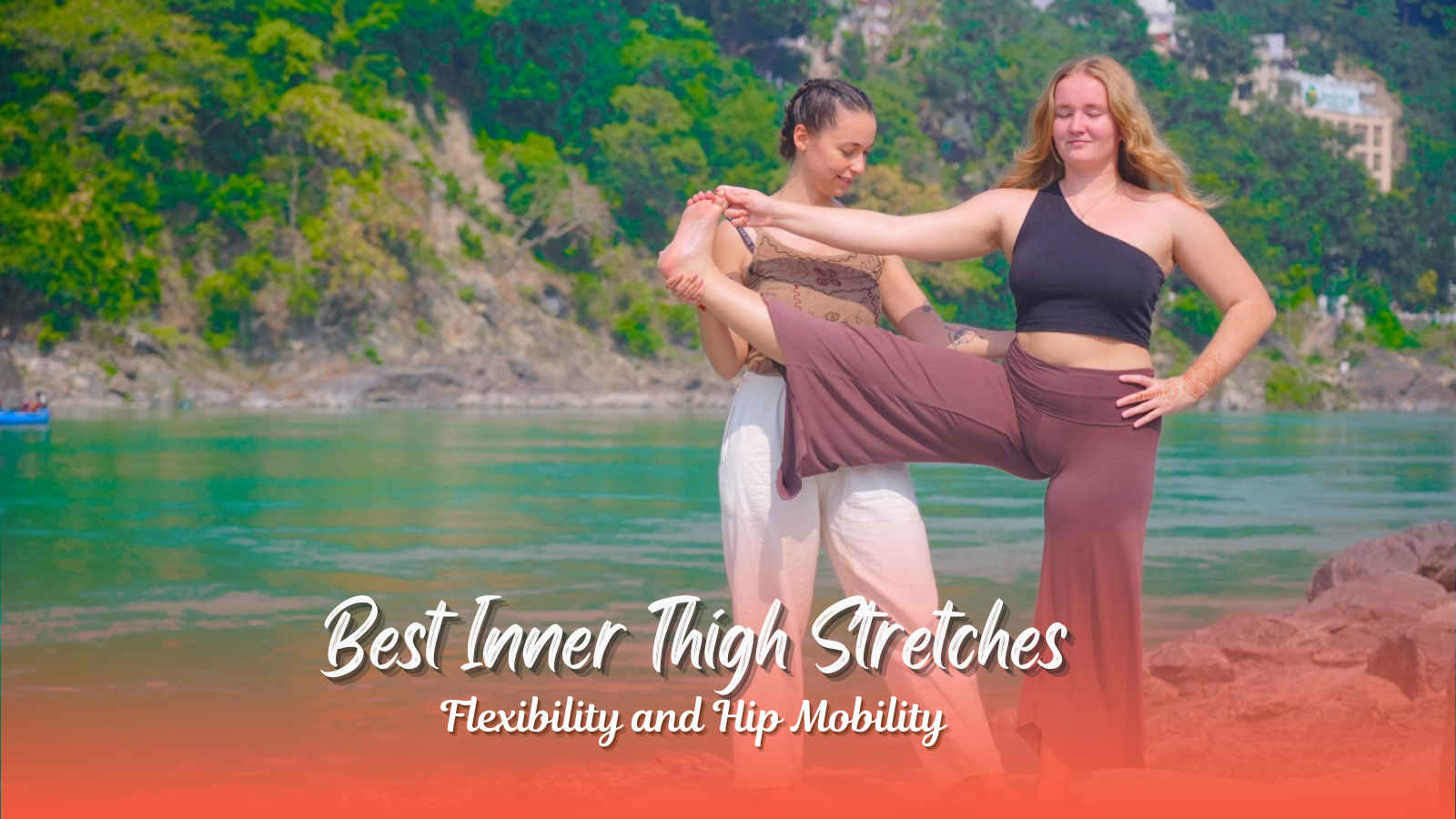
Flexibility and Hip Mobility

10 Best Inner Thigh Stretches for Flexibility and Hip Mobility

Tension in the inner thighs is one of the most ignored factors that can lead to hip stiffness, poor squatting, or lingering pain after a whole day of sitting. In Gurukul Yogashala, this is frequently observed among those who are new to yoga – people pay close attention to their quadriceps and hamstrings while neglecting adductors, the muscles on the inner thighs, which end up being tight and not stretched for a long time. Knowing how to stretch the inner thighs in an effective manner can prove to be one of the best remedies for improving the mobility of the hips, pelvis, and low back.

This guide shows how to perform ten of the most efficient inner thigh stretches; it explains why stretching is crucial for hip mobility and how to incorporate this into yoga practice – this is the basis of our Yoga School in Rishikesh. 

Why the Inner Thighs Matter for Hip Mobility

The adductor longus, brevis, magnus, and gracilis muscles work to draw the legs in toward the midline of the body and are active to some extent throughout walking, squatting, and balance training. Unfortunately, when these muscles are tight, the corresponding effects are not limited to the inner thigh region. Stiffness of adductors is also known to lower the hip abduction range, limit squat depth, cause lower back strain, and contribute to susceptibility to groin injury, which is one of the most prevalent injuries in sports.

Since the inner thigh muscles link the hip and knee joints, a good stretching exercise of the inner thigh muscles can bring relief not only to the specific site of tension but also to the entire lower limb system. In this regard, a carefully selected stretching exercise for the inner thigh can make the pelvic and knee joints less tense, and therefore mobility exercises are an inseparable part of the yoga therapy program provided by our Rishikesh School. 

10 Best Inner Thigh Stretches for Flexibility and Hip Mobility

Make sure you go into each inside thigh stretch gradually, take deep breaths, and stop stretching when you feel moderate tension or discomfort rather than a sharp pain. No matter if you are only doing this one stretch or others along with it, almost all of these exercises can be practiced on a yoga mat without any special accessories.

1. Butterfly Pose (Baddha Konasana)

Sit down and place your feet together with knees bent to the sides. Hold onto the ankles and try to pull your feet close to your groin area. For an even better stretch, lean down, keeping your back straight.

2. Wide-Legged Seated Forward Fold (Upavistha Konasana)

Sit down with your legs opened wide and toes up. Then lean forward while keeping your back straight. This is a great way of stretching the inside thigh running along the adductor and hamstring muscles as one. 

3. Frog Pose (Mandukasana)

Start from a hands-and-knees position and move your knees to the sides, with your shins lying flat on the floor. If you’re relaxed enough, you can drop down to your forearms. While this movement is very intense for the inner leg stretch, it’s better to start doing it after you have warmed your body up and not cold-start from the position.

4. Standing Side Lunge (Skater Stretch)

Legs should be wide apart, and legs should stay straight on the side opposite the one on which the weight is shifted. The stretching exercise that includes this transitional body movement is a practical answer to how to stretch inner thighs before activity and achieve enhanced hip mobility.

5. Malasana (Garland Pose / Deep Squat)

Squatting means that your feet stand slightly wider than your hips (depending on your flexibility) and your heels are ideally flat on the ground. Your palms should be put against your chest, and you need to press your elbows against the inner sides of your knees. This exercise is extremely popular and suitable for situations when you need to stretch your inner thighs without enough space on the surface. 

6. Reclining Bound Angle Pose (Supta Baddha Konasana)

Lie down on your back with the bottoms of your feet touching and let your knees open to the sides, towards the ground. Here, gravity will help you in this easy and restorative posture for the inner thigh, suitable at the end of a long day or after a workout.

7. Standing Wide-Legged Forward Fold (Prasarita Padottanasana)

Step your feet wide apart, hinge forward from the hips, and let your head hang, hands resting on the floor or a block. This pose is a classic demonstration of how to stretch inside of thigh muscles while simultaneously lengthening the hamstrings and easing tension along the spine.

8. Goddess Pose (Utkata Konasana)

Stand wide apart, then fold forward, allowing your head to drop and arms to touch down on the ground or a block. This particular pose shows how to stretch the inner thighs while also lengthening the hamstrings and relieving the back.

9. Half Split with Turned-Out Toes

From a low lunge, straighten your front leg and push your hips back over the back leg while turning the front your front toes slightly outwards so that the emphasis is on the inside thigh rather than the hamstrings. This variation is one of the more precise ways of addressing how you stretch the inside of your thigh without losing hamstring engagement altogether.

10. Standing Adductor Stretch

Stand vertically, step one leg out wide, and play with the weight on top of the bent knee while keeping the leg straight on the extended foot. Hold it and switch sides, and it’s one of the easiest forms of performing an inside thigh stretch that you can do anywhere, even if it’s in an office or hallway. 

How to Build a Consistent Inner Thigh Stretching Routine

One-time inside thigh stretching process shouldn’t be treated as the ultimate solution; positive changes observed will highly depend on a weekly system of practices rather than one session.

Always prepare for stretching – Cold adductors are hard to stretch, especially in deeper poses like Frog Pose, thus risking unnecessary stretching. Simple-moving preparations will help a lot in this regard.

Stay in the asanas within 15 to 30 seconds – This time is enough to provide a meaningful lengthening of muscles without spending too much time in asanas.

Perform the stretches two-four times on each side –It is considered that accumulated time spent in the asanas is more significant than a few minutes spent in one pose.

Required every day – If the flexibility exercise is finished, all gains will be lost.

Do a gradual progression – If one stretches forcibly, instead of immediately moving to the highest positions, one should take it easy.

If one is interested in structured learning of these techniques, the 100 Hour Yoga Teacher Training in Rishikesh provides information about asanas and safe stretching for those who haven’t done it before, while the 200 Hour Yoga Teacher Training in Rishikesh gives a much more detailed overview of anatomy and alignment postures.

What the Research Says

The evidence relating to stretching and flexibility is more complex than simply saying, “stretch to become looser.” The 2023 systematic review and meta-analysis that appeared in Sports Medicine – Open in 2023 investigates a total of 47 studies focusing on the immediate impact of stretching on several muscle groups, indicating that the improvement of mobility could be measured after completing just one stretching session, evidenced by the effect on the sit-and-reach test, hamstrings, and calves, but there was no significant effect on the hip adductor test. 

This does not indicate that stretching for inner thighs is inefficient. Instead, it shows that adductor muscles react better to regular practice for weeks than to a single session of the stretching exercise, according to what many of the instructors suggest.

As for the timing and technique, according to Harvard Health, the American College of Sports Medicine claims that a static stretch must last from 10 to 30 seconds; studies show that the most significant changes in muscle length occur at around 30 seconds, while consistency throughout the week is more important than the intensity of a particular session. 

Practising Mindful Flexibility the Traditional Way

The practice of flexibility in yoga tradition is closely related to the practice of breathing. Holding a body position while breathing mindfully gives an even better chance to relax than just deep stretching. This principle is applied in all our asana classes in our ashram by the Ganges River. In case you are interested in developing your own practice, the 300 Hour Yoga Teacher Training program in Rishikesh will be good for those who have already completed a 200 Hour training course and would like to improve their knowledge of anatomy and sequencing used in yoga. If you are especially interested in long-lasting flexibility, you might consider our Yin Yoga in rishikesh, which mainly covers this topic as well.

If you want to try daily guided asana practice and mobility training, our 7 Days Yoga Retreat in rishikesh is a gentle opportunity for you to connect with yourself and experience yoga and meditation, and you can find out more about our yoga school and us. 

FAQs

What is the best yoga pose for stretching the inner thighs? 

The two postures that are typically taught are the Butterfly Pose and the Wide-Leg Forward Fold due to their direct effect on the adductor muscles while still being suited for various flexibility levels. The Frog Pose is another alternative to try while the body has warmed up.

How often should I stretch my inner thighs to see results? 

General recommendations suggest performing stretches three to five times a week to start seeing changes. As a result, since a single session of stretching has very little effect on adductor muscle flexibility, continuous stretching practice over weeks is more beneficial than doing a single session of intensive stretches.

Why do my inner thighs feel tight even though I stretch regularly? 

Tightness may be caused by different reasons such as spending prolonged hours sitting, a weak adductor muscle group, or compensatory habits in the pelvis and lower back area. Sometimes you just need to incorporate more stretches into your routine in order to become flexible. If the problem persists no matter how many times you stretch, you should contact a physiotherapist. 

Can tight inner thighs cause hip or lower back pain? 

Yes. The adductors help control pelvic position and hip joint mechanics. Because of this, chronic tightness in this area may interfere with hip and lower back function by causing compensatory tension in those systems.

Is it normal to feel tightness or mild pain during inner thigh stretches? 

It is completely normal to feel mild tension when doing inner thigh stretching. However, if sharp or radiating pain occurs, then this means it is time to stop stretching and contact a specialist.

How long should I hold an inner thigh stretch for best results? 

Generally, it is recommended to hold the position for about 15-30 seconds and repeat it 2-4 times for each side, rather than holding extremely long stretches.

What’s the difference between static and dynamic inner thigh stretches? 

Static stretches, for example, in the Butterfly position, require the practitioner to keep still; on the contrary, dynamic stretches such as the Standing Side Lunge involve controlled movements. Dynamic stretching is advisable before exercising, while static stretches are better used at the end of a workout. 
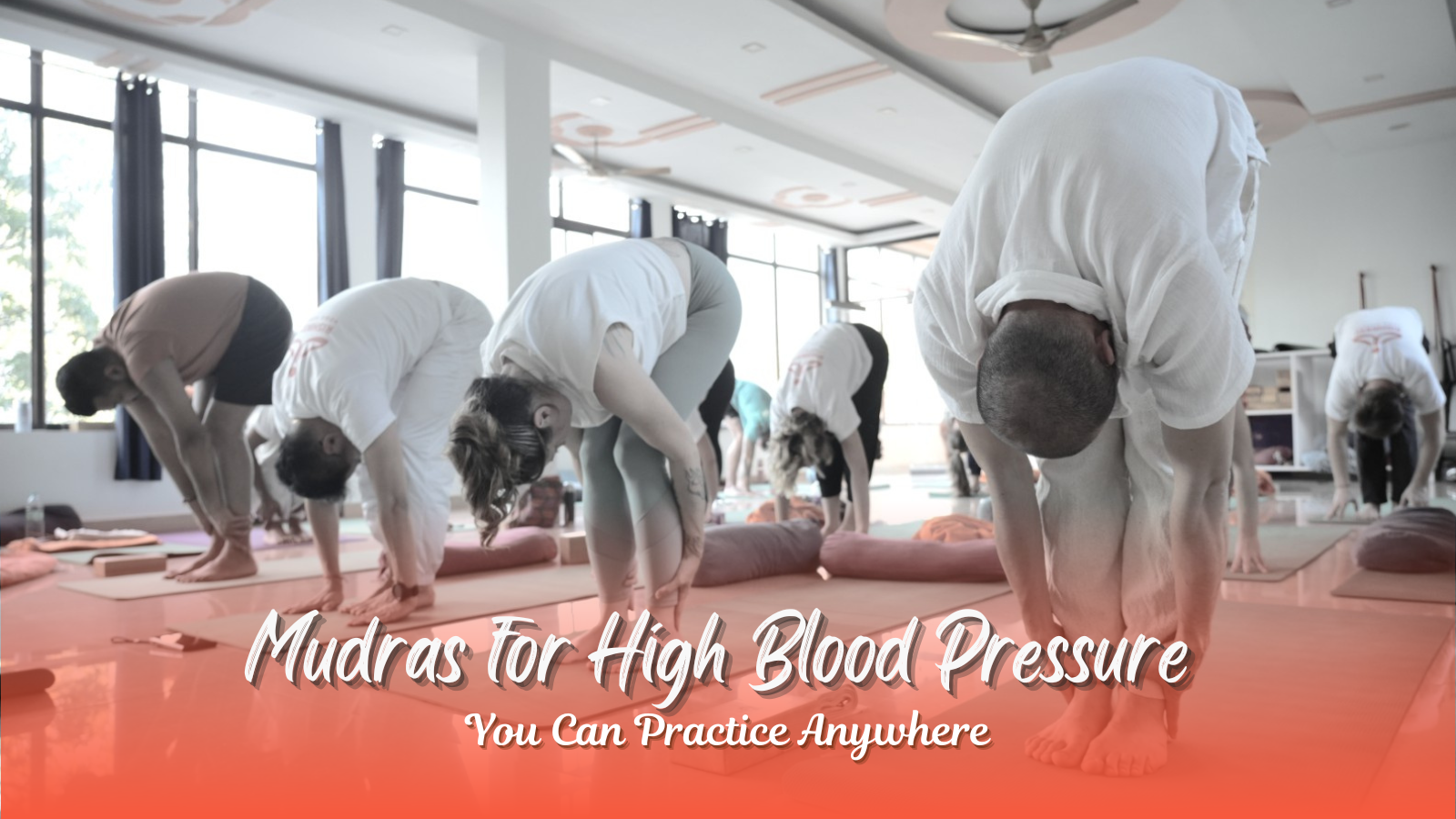
Mudras for High Blood Pressure

5 Mudras for High Blood Pressure You Can Practice Anywhere

At Gurukul Yogashala, we teach our students that healing is achieved not by complex equipment but often by simply using your two hands and a few minutes of silence. This is the secret behind mudras for high blood pressure: the gestures, derived from the ancient yogic tradition of the Himalayan region, can be performed while you are standing in a queue, working at your office desk, or sitting on a train. The mudras cannot substitute for the doctor’s treatment, but act as effective and inexpensive adjuncts in the daily lives of anyone who cares about their heart health.

In this guide, the author describes five simple mudras as well as tells about the meaning and the scientific evidence supporting their use and examples of their application in daily life – the same way we teach them to students at our Yoga School in Rishikesh.

What Is a Mudra, and Why Does It Matter for Blood Pressure?

Mudra refers to a specific arrangement of the fingers and hands utilized in yoga and meditation to control the subtle energy flow of the body (i.e., prana). According to classical principles of yoga and traditional Ayurveda, each finger represents one of the five elements (earth, water, fire, air, and ether). When two fingers come together, they may even restore the balance of these elements within your body.

From a contemporary viewpoint, however, a mudra for BP may not have such an instantaneous effect as flipping a switch. Rather, mudra leads to the automatic slowing down of breathing, relaxation of shoulders, and concentrating the mind – all in all, the three factors that are known to reduce the action of the sympathetic system in stress conditions. This is what defines our approach to teaching mudras in praxis yoga to reduce high BP, as combined with pranayama and meditation practices instead of presenting mudras in isolation. 

5 Mudras for High Blood Pressure You Can Practice Anywhere

All the aforementioned gestures can be practised while sitting in a chair, cross-legged, or even when standing in a queue. It is important to breathe slowly during the entire process – breathing conveys much more than the positioning of the hands itself. 

1. Gyan Mudra (Gesture of Knowledge)

Bring the tip of your thumb in contact with the tip of the index finger. The other three fingers should be left relaxed in the position. Place your hands on your knees with palms facing upwards.

Gyan Mudra is the world’s greatest among the mudras for high blood pressure because of its association with relaxing the mind. In calming down the ongoing thoughts and relaxing the face and jaw, it allows one to breathe properly, which is essential for getting the nervous system into a relaxed state. 

2. Apana Vayu Mudra (The Heart-Supporting Gesture)

The second mudra is Apana Vayu Mudra (meaning ‘the Heart-supporting Mudra’’). Fold the index finger such that it points the tip of the finger towards the base of the thumb. Position the tips of the middle and ring fingers to touch the tip of the thumb, and leave the little finger straight. The pose can be practiced on both hands. 

This mudra for hypertension is also known as the “life-saving gesture” in yoga texts. According to the teachings of the yoga philosophy, this mudra is the most precise one for high blood pressure as it works on reducing the pressure in the heart and speeding up the blood circulation process. For that reason, trainers combine this mudra with slow and deep breathing.

3. Varun Mudra (Water Gesture)

The next mudra is Varun Mudra (meaning ‘ ‘water gesture’’). Touch the tip of your little finger to the tip of your thumb while keeping the other fingers extended and relaxed.

According to the yoga philosophy, Varun Mudra helps restore the water element in the body. In Ayurveda, it is said to help reduce excessive Pitta (fire) – the dosha associated with heat, aggravation, and high blood pressure. Many students find it a soothing high blood pressure mudra to hold during an evening wind-down practice.

4. Prana Mudra (Gesture of Life Force)

Touch your little finger’s and ring finger’s tips with your thumb, while your index finger and middle finger remain stretched out.

According to tradition, performing Prana Mudra is said to help activate the life force and reinforce the energy center referred to by yogis as the root chakra, which they relate to groundedness and stability. Yogis often turn to this as a mudra for high BP because an earthbound nervous system is better able to interpret signals for relaxation.

5. Rudra Mudra (Gesture of Stability)

Bring your thumb, index finger, and ring finger together, keeping your middle finger and pinky finger outstretched. 

The Rudra Mudra has long been associated with the earth element and stability in body and mind. It is a very comfortable gesture to maintain in meditation for longer periods, so people often perform it at the end of a pranayama session when they notice that their breathing is becoming deeper and slower. 

How to Practise Mudras for High Blood Pressure Effectively

Achieving consistency is more important than being intense about it. We coach the following practices at our 200 Hour Yoga Teacher Training in Rishikesh:

  • Sit comfortably – Whether it is a cross-legged pose, in a chair, or leaning on a chair – it is important to make sure that your spine and shoulders are relaxed.
  • Eliminate distractions in the process – Inhale slowly and evenly, and exhale just a little bit longer – here, the hand gesture is good for maintaining concentration during this time.
  • Set the timer for 10 to 20 minutes – While many sources recommend longer periods of time, practicing even for a few minutes regularly will be more effective than sitting for a long time occasionally.
  • Find the right time for your practice – It’s better to start the process at the same time, which helps your nervous system to get used to the practice.
  • Control your progress – Using an automatic blood pressure monitor is the only effective way to monitor the overall effectiveness of your routine. 

The Science: What Research Says About Mudras for High Blood Pressure

It is important to be clear about how things are as far as the evidence is concerned. Research that looks exclusively at hand mudras has been a sparse field, even though results so far look hopeful… One of the studies published in the Research Journal of Recent Sciences focused on blood pressure and heart rate measurements in hypertensive and normotensive patients before and after practicing yoga and mudras, revealing a significant decrease in both systolic and diastolic blood pressure.

In a larger sense, the scope of research on yoga-related breathing and relaxation practices is much more impressive as indicated in the Mayo Clinic Proceedings paper by University of Connecticut researchers who looked at nearly 50 studies and provided evidence that yoga practices, which involve relaxation and breathing techniques, can lower blood pressure to the same extent or more than aerobic training, but are supposed to be used as an adjunct to antihypertensive treatment.

Summing up, it can be implied that mudras can be effective as a part of relaxation and breathing practices, but not as an independent application. 

Learning Mudras and Pranayama the Traditional Way

In our ashram that is located on the banks of the river Ganges, mudras are never taught separately from the art of yoga and pranayama as well as yoga philosophy, all of which have been passed on from generation to generation through the Himalayan teachers.

In case you are interested in learning extensively about mudras and pranayama, we recommend our 200 Hour Yoga Teacher Training Program, which gives a full understanding of those topics to those who are already familiar with yoga. If you are simply looking for a proper program and a good experience in the field of yogic philosophy and its methodologies, we recommend you take part in our 7 days yoga retreat in rishikesh that will provide you with knowledge and practice of meditation, pranayama, and mudras.

Being among the most well-known yoga schools in India that provides authentic teaching of Himalayan results of yoga practice through mudras, we know that techniques that help people deal with stress, like mudras, are extremely effective only provided that they are learned in the right manner and used as a part of a credal yogic lifestyle rather than a quick solution for the situation. 

FAQs

Which mudra is best for high blood pressure? 

Apana Vayu Mudra is associated with supporting the heart and blood circulation according to ancient texts; however, one should not forget about Gyan Mudra and Varun Mudra, both additional styles that are often recommended for high blood pressure control by trainers. Most trainers prefer using frequent combinations of mudras while treating high blood pressure, instead of relying on one of them.

How long should I hold a mudra for it to help with blood pressure? 

Most of the specialists recommend the duration of sustaining a mudra for 10 to 20 minutes and combining it with slow breathing. For a start, a beginner can sustain the position of the mudra for only 5 minutes, and gradually increase the duration.

Can mudras replace blood pressure medication? 

Not at all. Mudras and pranayama can be considered as a complementary practice, which should not substitute the treatment prescribed by doctors. Always remember to seek a doctor before changing your blood pressure therapy, including stopping or changing your medication.

Are there any mudras I should avoid if I have high blood pressure? 

Traditional approaches advise against the use of mudras and pranayama techniques that involve holding the breath and/or quick breathing (like Kapalbhati or Bhastrika) as they might increase the blood pressure, albeit temporarily. Use slow and gentle hand gestures in conjunction with soft breathing instead. 

How often should I practice mudras for hypertension – daily, or a few times a week? 

Daily practice, even in short term hits, is more effective than long but hardly practiced sessions. 

Can mudras help with blood pressure caused by stress or anxiety specifically? 

Mudras are particularly effective in calming the nervous system because they work primarily by calming the autonomic system and helping regulate the rate of breathing. As a result, they may help avoid spikes in blood pressure related to stress.

Is there scientific evidence that mudras lower blood pressure? 

Several studies, including one published in the Research Journal of Recent Sciences, have observed that mudras make it possible for an individual to achieve real drops in blood pressure during practice. However, the evidence in favor of yoga practices, which include mudras, is more substantial. 

200-Hour TTC in India

Yoga Alliance Certified 200-Hour TTC in India: What It Actually Means for Your Career

The term “Yoga Alliance certified” shows up on many course brochures, but few students dare to ask what it really stands for. When you’re considering a 200-hour Yoga Teacher Training in Rishikesh, it makes sense to know the ins and outs of the title – what the certification implies, what it really covers & how much it’s worth in terms of teaching opportunities back home. All of that is covered in this guide based on our observations of our graduates from Gurukul Yogashala. 

What Does “Yoga Alliance Certified” Actually Mean?

Yoga Alliance is a nonprofit that operates out of the United States and sets standards for yoga schools’ curricula. It keeps a public registry of schools and teachers that meet those standards, but it does not accredit or license anybody legally in the way that the state does. Knowing this difference is helpful when it comes to choosing a good 200-hour yoga TTC in India, because the certification is more of an indicator of the program’s quality rather than a government-approved license. A school that offers its 200-hour yoga teacher training in India according to Yoga Alliance standards can call itself an RYS 200 (Registered Yoga School) and its graduates – RYT 200 (Registered Yoga Teachers). 

This means that the curriculum of the school has been analyzed to see how many hours are specified for the learning of different methods and techniques, teaching methods, anatomy and physiology, and yoga philosophy and ethics. This is helpful information for prospective students and is often used as a minimum qualification for hiring teachers in studios and gyms. 

What You Actually Learn in a 200 Hour Yoga TTC in India

A good 200-hour yoga teacher training course in India can last anywhere from three to four weeks and cover much more than just practice of asanas. At Gurukul Yogashala, our 22-day course has:

  • Asana practice in several styles like Hatha, Ashtanga, and Vinyasa so that our graduates can teach different class formats
  • Pranayama and meditation, which include techniques of breathing and seated practices both in theory and practice
  • Anatomy and physiology as the science of movement, as well as the places of injury
  • Yoga philosophy concerning the Yoga Sutras, the eight limbs and the ethical code of practice
  • Teaching methodology, which comprises cueing, sequencing, hands-on adjustments, and running the class effectively.

This is the aspect that distinguishes a program from a yoga retreat. It is the methodology that allows one to find a job as a teacher rather than merely be a good practitioner. 

Why Train in India Specifically?

India remains the most imaginative choice for this type of education, and Rishikesh is the town that has turned itself into its own identity. Picking a standard 200-hour yoga TTC in Rishikesh is synonymous with doing the studies nearly side by side with the Ganges and the foothills of the Himalayas, being part of a living culture, not practicing in studio settings. Many students are on the lookout for the unique opportunity to undergo 200-hour yoga teacher training in India because this kind of approach – life, study, and practice – can speed up the process of learning as no other program can do.

Nevertheless, we should not forget about the fact that even though India is the most attractive choice, it is not the only choice. Students who may not want to go straight for the 200-hour certificate may get started with 100-hour yoga teacher training India instead. 

Does It Actually Help Your Career?

Here’s a straightforward answer: certification provides opportunities, but it doesn’t guarantee success. As per Yoga Journal’s own research regarding novice yogis, most of the instructors earn per class rather than get a fixed salary. It may also take a long time to establish solid income, considering one would have to accept many gigs, substitute for many classes, and work on a side hustle such as corporate wellness consultations. According to one experienced instructor, yoga teachers do not usually have fixed salaries, health insurance, or pension plans. Nevertheless, this is not a reason to skip the certification process – one should regard it as an entry-type qualification rather than a final one. 

The training most effectively leads to gains in one’s personal and professional development. The results of a peer-reviewed observational study of a long-term yoga teaching training program indicated significant progress of the participants in terms of psychosocial prosperity. The authors of the study concluded that the results of the test measuring human flourishing have changed considerably more than the overall scores of psychosocial states of the participants. However, no significant shifts have been recorded in perceived social support, quality of life, and self-efficacy of the participants after three months since the completion of the program. 

Where to Train: Choosing Your Program

If you are ready to dive in, then the 200-hour yoga training in India program is created according to the outline mentioned above, consisting of, among other things,multi-style asana and philosophy, anatomy, as well as hands-on teaching practice in a residential environment on the riverbank of the Ganges. Those who prefer to take baby steps may find the 100-hour yoga teacher training India course a more convenient way of starting to develop their practice.

For those who are not ready to get certified yet, a yoga retreat Rishikesh program offers a similar daily routine including practice, meditation, and theory without tests and teaching practice – a good idea to try out yoga training in Rishikesh before deciding if certification is right for them. 

Final Thoughts

While a 200-hour yoga TTC in India accredited by Yoga Alliance cannot guarantee you a job, it will still provide you with something even better: an actual course, a valid qualification as well as extensive experience that is hard to match with evening lessons offered at home. What you will achieve after that will depend on you. Please invite you to join us at the Gurukul Yogashala in Rishikesh, where you will have an opportunity to study with authentic yoga practitioners. 

Frequently Asked Questions

What is the eligibility to join a 200-hour yoga TTC in India?

Generally, schools such as ours do not ask for previous teaching experience or academic qualifications before you can join a 200-hour yoga teacher training in India. After a few months of practicing yoga at home, you will be ready to enroll. Age restrictions usually apply (the minimum age is usually 18); however, the program itself will help you begin your practice from an adequate starting point. 

How much does a 200-hour yoga teacher training in India cost?

The price of a 200-hour yoga TTC in India is determined by several parameters, including the place of training and living arrangements. For example, at Gurukul Yogashala, the 22-day course costs somewhere between USD 649 for a shared room and USD 1,349 for a single room. Overall, prices for courses in India are more affordable than for the same courses in North America and Europe because of the lower cost of living.

Is a 200-hour YTT certification from India recognized internationally?

Yes, provided that the yoga school is registered with Yoga Alliance as an RYS. If you pass the 200-hour yoga teacher training course at the RYS, you will get the RYT 200 qualification recognized by studios, gyms, and wellness centers worldwide, since Yoga Alliance’s standards are applied consistently regardless of where the school is located.

Do I need a visa to attend yoga teacher training in India?

Indeed. The majority of students travelling to India will use e-Tourist Visas as these are available to any applicants planning on attending a short-term yoga course at any yoga school. The specifics of the visa depend on the student’s destination country and the exact duration of their yoga program of choice. According to the official Indian government e-Visa website, attending a short-term yoga course is one of the many purposes of participation in the e-Visa program. We recommend that you check the specific requirements for entry into India relating to your particular nationality before booking your flight.

What’s the difference between a 200-hour and 300-hour yoga TTC?

The 200-hour course is the basis of the yoga teaching certification. The 300-hour course, on the other hand, is the advanced program designed for students who have completed their 200-hour course and are already RYT 200 certified. This course covers advanced topics and gives aspiring yoga teachers greater teaching skills.

Can a complete beginner join a 200-hour yoga TTC?

While it is possible for complete newbies to join the course, usually the first week is designed to help them create a solid basis for learning. 

What’s included in the course fee – accommodation, meals, and excursions?

At Gurukul Yogashala, the price of the course is calculated taking into account accommodation, meals, and learning assistance. Cultural tours are also expected to be conducted, but tourists must find out details before they book.

Ashtanga Vinyasa Sequence: The Complete Guide to the Full Practice

Ashtanga Vinyasa Sequence: The Complete Guide to the Full Practice

One can enter an Ashtanga facility early in the morning, and straight away, one can see the constant repetition of the Ashtanga movements – not that it appears to be too tense, but rather because everything is carried out with great reliability. Very few people are left wondering what happens next. The jumping-back stages and every inhalation are defined by centuries of traditions. This precision is what the entire Ashtanga Vinyasa sequence is focused on – a style where breath and exercise are perfectly combined for perfect meditation. Coming from the experience we gained while teaching at Gurukul Yogashala, this guide will explore what the vinyasa sequence is and how it works in practice. 

What Does “Vinyasa” Mean in Ashtanga Yoga?

The term “vinyasa,” in modern yoga, is often misused, yet when one refers to Ashtanga yoga, the term carries a precise interpretation. Vinyasa also refers to those series of breath-and-body movements linking one asana to the next, such as jump back, Chaturanga, Upward-Facing Dog, and Downward-Facing Dog, as well as others. Practitioners use vinyasa to enter and exit each Ashtanga vinyasa yoga sequence, and every movement is related to a certain breath – which means that one move corresponds to one inhale or exhale.

The concept of “vinyasa krama” is derived from the teachings of Tirumalai Krishnamacharya – the founder of modern yoga – who first introduced this system of movement related to the breath. Later on, one of his students, K. Pattabhi Jois, integrated this teaching into the classical method of Ashtanga yoga at his shala located in Mysore, India. 

The Structure of the Full Ashtanga Vinyasa Sequence

Unlike free-flow vinyasa classes, which vary their order of poses daily, the Ashtanga yoga vinyasa sequence comprises fixed steps. Each class follows the same plan of action:

Opening chant – usual Sanskrit chant to announce the beginning of a class

  • Sun Salutations A – 5 rounds of Surya Namaskara A followed by 3-5 rounds of Surya Namaskara B to create heat
  • Standing series – as the name suggests, this series uses standing poses to strengthen and enhance the balance and flexibility in the hips, hamstrings, and spine.
  • Seated sequence –  series-related postures that vary depending on the series
  • Finishing sequence – backbends, inversions, and meditation. This last sequence is identical for all six series.

Since the ending and opening sequences are fixed, only the middle sequence differs from series to series. This is what makes the Ashtanga vinyasa sequences – Primary, Intermediate, and four Advanced variants of Ashtanga vinyasa sequences – share a common principle while still being challenging in different ways.

Ashtanga vs. Vinyasa: What’s Actually Different?

This is a common point of confusion among students, so it’s important to clarify it. The main distinguishing feature of vinyasa yoga (the major difference between vinyasa yoga and ashtanga yoga fixed sequence) is predictability. Ashtanga practice is built around one fixed sequence of postures that is repeated in every class so that it’s possible to measure an individual’s progress in many months or years of regular practice. Vinyasa yoga, however, utilizes the principle of combining movement and breathing, just like Ashtanga yoga does, but gives freedom to the instructor to create a new sequence of moves for every class. As far as gene food (genetic code) is concerned, both types of yoga have similar characteristics (synchronized flow based on the principle of breathing), but only the Ashtanga vinyasa flow sequence is characterized by the use of the same series of poses in all classes. 

The Vinyasa Count: Why Every Breath Is Numbered

One thing that catches many new practitioners off guard is that Ashtanga Vinyasa Yoga’s primary series sequence is more than just a Path. The sequence is to be counted, since each yoga position has its own number of breaths, called vinyasa count. The number of breaths in any position is fixed and therefore begins and ends at Samasthiti (standing position). Old-school teachers, like Pattabhi Jois and his grandson Sharath Jois, used to count the positions out loud in the Sanskrit language during classes. Thus, every motion has a corresponding number in the sequence. So learning the counting is about being able to calculate the count, rather than simply memorizing the number of breaths required for each of the positions. 

Why Is Breath Synchronized With Movement in Ashtanga Vinyasa?

The breath-movement connection is not merely a matter of tradition; existing scientific evidence shows that this connection has a measurable physiological impact. In 2023, a randomized crossover study published in PLOS ONE reported cardiovascular and autonomic responses to a one-hour session of vinyasa yoga compared with prolonged sitting in healthy adults. It was found that systolic blood pressure decreased by 8.14 mmHg five minutes after the yoga session when compared to the sitting control. In addition, heart rate remained elevated at 5 and 65 minutes after the session, which indicates that vinyasa yoga is a moderate-intensity activity rather than a purely relaxing practice. Thus, the findings confirm what practitioners have been reporting for a long time, namely, that continuous movement in Ashtanga yoga coupled with controlled breathing is an effective way to develop cardiovascular capacity while experiencing calming and concentration-enhancing effects of breathing exercises. 

How Many Series Are There in Ashtanga Vinyasa Yoga?

There exists a total of six series – the Primary Series (Yoga Chikitsa, that means yoga therapy), the Intermediate Series (Nadi Shodhana, which serves the purpose of cleaning the nervous system), and four Advanced Series (Sthira Bhaga A-D) for those who have reached the highest level of yoga practice. None of the students and only a few teachers in the whole world have finished the Advanced series, and their progress through the whole system has always been purposely slow and careful, as Yoga Journal records that the new postures can be offered only after the previous ones become stable. As it is told in the archives of Yoga Journal, the fascinating and exhausting style of Ashtanga, which was taught by Pattabhi Jois, was famous years ago for its ability to change the lives of those who were brave enough to do it.

What Is the Correct Order of the Ashtanga Vinyasa Sequence?

The sequence is fixed and cannot be changed in any series, and it always consists of the same steps: chants for the opening of the practice, the Sun Salutations A and B, the standing poses, the series of the seated postures, and the final sequence of backbends inverted.

Is Ashtanga Vinyasa Suitable for Beginners?

Certainly, along with good instruction. Although the whole sequence may seem difficult, beginners won’t be able to do it from the very first try anyway. Mysore-style instructors, as well as ours, teach a few poses at a time sequentially, and that’s why this method has been working for ages, allowing newcomers to try yoga in practice despite its complexity. 

A Printable Reference: The Sequence in PDF Form

Many students are looking for an Ashtanga Vinyasa Yoga sequence PDF file to understand how to proceed with the asanas, names, and number of postures from one lesson to another. There are downloadable charts that can help you once you’ve already mastered the sequence from a trainer. But this method can never be a substitute for an actual lesson. Certain postures and transitions can be done incorrectly without proper instruction and the help of an instructor, so any PDF chart should be viewed as an additional tool for learning rather than the main source of information. 

Where to Learn the Full Ashtanga Vinyasa Sequence

For those who truly wish to go beyond their self-taught home practice and want to delve deep into anatomy, breathing techniques, and the history of the sequence, formal yoga training in India is the best option, which is what our courses at Gurukul Yogashala are focused on. We have a 200-hour yoga teacher training in Rishikesh that qualifies students for certification and a 100-hour yoga teacher training in Rishikesh for those ready for a less intense and demanding experience. In case you are particularly interested in Ashtanga, our Ashtanga Yoga Teacher Training in Rishikesh will meet your needs.

For those who don’t want to get into a serious certification program, a yoga retreat in Rishikesh would be an easier way to explore yoga through proper practice, breathing exercises, and philosophical studies, without worrying about exams. Rishikesh, situated on the bank of the Ganges River and at the foot of the Himalayas, is one of the centers of yoga in the world, and this is why yoga training Rishikesh attracts numerous students every year from all corners of the planet. 

Final Thoughts

Patience is more important than flexibility in the ashtanga vinyasa sequence. This is a practice that develops over years, not months, and what initially feels like restriction takes on a new meaning as one becomes able to see their progress and trace how they have developed. The underlying principle remains the same, whether one learns the sequence through a home printout of the chart or in a yoga school: the sequence proceeds a breath at a time. 

Frequently Asked Questions

What does “vinyasa” mean in Ashtanga yoga? 

According to the tradition of Ashtanga yoga, vinyasa describes the detailed movement coordinated with breathing – usually, these are the transitions between poses that include the jump back, Chaturanga, Upward Dog, and Downward Dog postures.

What is the difference between Ashtanga and Vinyasa yoga? 

While Ashtanga involves only one specific permanent sequence, in Vinyasa yoga the instructor can alter the sequence because the teaching philosophy is the same.

What is the standard vinyasa count between poses? 

All postures have a certain number of breaths, also called the vinyasa count; the motion and the end of the count being the Samasthiti pose.

How many series are there in Ashtanga Vinyasa yoga? 

There are six series in total: Primary Series, Intermediate Series, and 4 Advanced Series. 

What is the correct order of the Ashtanga Vinyasa sequence? 

The Ashtanga Vinyasa sequence includes the opening chant, both the Sun Salutations A & B, all standing postures, the seated series postures, and a final sequence including backbends, inversions, and relaxation.

Why is breath synchronized with movement in Ashtanga Vinyasa? 

The synchronization of breath and movement assists in controlling the pace of practice, helps regulate the nervous system, and has been found in various studies to produce discernible cardiovascular and autonomic responses in addition to contributing towards a better ability to concentrate and generate internal heat.

Is Ashtanga Vinyasa suitable for beginners? 

Yes, it is. The students are taught a few postures first with the aid of a teacher instead of being expected to learn the full sequence immediately. 

Ashtanga Primary Series

Ashtanga Primary Series: The Complete Beginner’s Guide to Yoga Chikitsa

If you have stepped into one of our Mysore-style rooms at 6 in the morning and watched rows of students perform the same sequence almost silently while breathing nearly identically, then you got to observe this fixed sequence in action. It is considered one of the most rigid, misunderstood, yet transformative practices in contemporary yoga. From the entrance, it may even appear rather daunting for a beginner. The content of this guide, created based on the knowledge that we impart to students at Gurukul Yogashala, will give you the answer to the question of what the Ashtanga Primary Series means, why it is called Yoga Chikitsa, how to perform it, and how to start your journey of mastering this practice.

What Is the Ashtanga Primary Series?

 Ashtanga Primary Series is the first sequence out of six within the Ashtanga Vinyasa system – a system of yoga that was defined in Mysore, India, by the famous K. Pattabhi Jois in the 20th century, following the teachings of his own guru Krishnamacharya. Unlike many modern yoga classes, during which the sequence is changed every day, the Ashtanga primary series is not variable, meaning that the same postures are performed every day.

The fixed system is not arbitrary in nature. Every pose used in the primary series of Ashtanga Vinyasa Yoga is meant for the preparation of the body for the next pose in the series. This allows heat to build in the body and the hips and hamstrings to be released while slowly progressing through the spine in a typical series of movements, including forward bends, back bends, and twists. Some students also know the sequence by its search-friendly nicknames – primary series Ashtanga or  Ashtanga Primary Series -, but it’s all the same set of postures underneath the spelling variations.

What Is Yoga Chikitsa, and Why Is the Primary Series Called That?

In the Sanskrit language, “Chikitsa” signifies “therapy” or “healing” in English, meaning Yoga Chikitsa represents “yoga therapy.” This name has been derived from the ability of this series to detoxify the body, the effects of which are also taught in detail in our residential programs. The structure of the series, along with its combination of the deep forward bends, twists, and heat produced in the body, enables the body to flush out the stagnant energy and also bring about the correction of postural problems that have accumulated over time. 

It is important to keep in mind that “therapeutic” should not be confused with “easy.” In fact, many experienced practitioners will affirm the irony that it is one of the six series that requires a lot of commitment and energy, for it asks the body to transform itself by stimulating the hamstrings, making the spine more agile, and enduring stressful moments for at least 90 minutes.

How Many Poses Are in the Ashtanga Primary Series?

In terms of the number of asanas in the complete sequence of Ashtanga yoga, traditional references suggest that the number of asanas can be pegged around 41; that said, the actual figure may differ based on how transitional postures are counted in the calculation and whether you consider one side of an asymmetrical pose. The Ashtanga poses in the primary series have specific features.

Among the mentioned poses, we can identify:

  • The opening sequence and the Sun Salutations – five sets of Surya Namaskara A and three to five sets of Surya Namaskara B to warm up
  • Seated postures including Trikonasana, Parsvakonasana, Prasarita Padottasana, and balancing poses like Utthita Hasta Padangusthasana
  • Seated postures which have a greater number than the mentioned ones, including sitting forward bends with Paschimottanasana, various twisting poses, hip openers, and the pose in which the legs are behind your head
  • The closing poses include backbends, inverted poses like Sarvangasana, and the final meditation sitting down.
  • All parts of the Ashtanga yoga primary series are connected with vinyasa.

The Role of Breath, Bandha, and Drishti

Three components unite the entire Ashtanga Primary Series. It is important to know about these three elements rather than learn the sequence of all postures.

  1. Ujjayi breathing is a type of breathing that is produced such that it resembles ocean waves, helps calm the nervous system, and regulates the tempo.
  2. Bandhas are the name of the muscle locks, which include mainly the Mula Bandha (the pelvic floor) and the Uddiyana Bandha (the abdomen). This element helps support the spinal column and creates inner heat.
  3. Dristhi is the point you focus on while performing each posture. It also helps in learning how to concentrate.

All in all, these three elements integrate the idea of doing a physical workout and meditating at the same time. No wonder our teachers always tell us how useful this practice is for the body and mind.

Benefits of Practicing the Primary Series

In addition to conventional claims about yoga therapy, there is now a vast number of studies confirming its healing properties. According to the National Center for Complementary and Integrative Health, many studies find evidence that yoga is useful for stress relief. For example, a 2020 review article looking at many studies on yoga indicates that each of the twelve studies examined confirms that yoga practice leads to improvement in perception of stress.

Other reviews point to the relationship between yoga and improvement in mental wellness and resilience. The findings of a 2020 review of twelve research papers on all kinds of yoga for healthy adults prove that every study supports the idea that yoga is efficient in improving perception of stress. In addition, findings of a 2018 review focusing on yoga and positive effects on mental health show that yoga improves resilience of an individual and improves mental welfare. 

Is the Ashtanga Primary Series Good for Beginners?

Yes – if you have the right mindset. The name is a bit misleading. In this context, “Primary” does not mean “easy” but rather “the first in the sequence.” However, beginners are encouraged to attend primary classes, and most Mysore-style teachers (including ours) only give some asanas at a time and introduce new ones as soon as your body and breathing allow. You should not expect to complete the full series on your very first day (or even in the very first months). The method is supposed to be learned gradually with the help of instructors. 

Led Class vs. Mysore-Style Class: What’s the Difference?

  • Led class: In this style of yoga practice, the instructor guides the students through the poses and counts aloud. This approach is beneficial for beginners because it simplifies the learning of the sequence and counting system (traditionally in Sanskrit) in a group environment.
  • Mysore-style class: In this style of yoga practice, the student practices independently at their own pace and is given individualized attention by the instructor. This approach allows for personal development without the hindrance of group practice.

Most practitioners at our school choose to do Mysore-style yoga for their daily practice and go to take a led class once a week, usually on a Friday or Saturday, to keep in touch with the counting system. 

How Often Should You Practice the Primary Series Each Week?

Ashtanga Yoga usually involves training five times a week, with weekends resting, as well as on the day that comes with an optional led class. However, for a beginner, it’s neither a comfortable nor a practical routine to stick to. Ideal practice sessions will take place at the rate of approximately 3-4 per week, which will leave some time for recovery after training. 

Where to Learn: Yoga Teacher Training in India

If you want to move beyond practicing yoga at home and actually grasp the theory of anatomy, philosophy, and teaching methodology concerning it, formal yoga teacher training in India remains the best option – which is exactly what Gurukul Yogashala provides in its programs. It offers a 200-hour yoga training in India for people who wish to receive full certification or the 100-hour yoga teacher training India program for those who just want to start learning yoga but are not ready for a full commitment. If your main interest is Ashtanga, you can sign up for our Ashtanga Yoga teacher training in Rishikesh that is based entirely on this tradition.

India remains the most immersive place where this tradition can be actually lived out, and especially Rishikesh. A yoga retreat rishikesh program combines a daily practice of pranayama, meditation, and Vedic philosophy, all amid the breathtaking scenery of the Himalayan foothills and the Ganges – the very place where our ashram is situated on Laxman Jhula Road. Rishikesh is well-known around the globe for being the center of yoga, having attracted yogis, sadhus, and spiritual seekers over the ages. 

The famous band The Beatles popularized the little town of Rishikesh in 1968 with their visit to the ashram of Maharishi Mahesh Yogi. Recently, this sacred city on the banks of the Ganges has also become renowned for its outdoor recreation. Presently, yoga training in Rishikesh provides everything from short retreats to advanced certification courses, making it a famous tourist destination for people who want to practice yoga more seriously. 

Ashtanga Primary Series PDF: Should You Use One?

A downloadable printable chart is an excellent resource to refer to when you already know yoga practices. This can help you to double-check the order of poses before practicing at home or remind you of the names in Sanskrit. An Ashtanga Yoga Primary Series PDF is the first thing a beginner usually looks for, but it should never be considered as an alternative to practice with a teacher in the beginning stages. Indeed, some poses, for example, Marichyasana D and Supta Kurmasana, can be difficult to perform correctly without an instructor overseeing you. We give our students an Ashtanga primary series PDF after they have completed training with a teacher. 

Final Thoughts

Practicing yoga requires one to be patient. This is a sequence that doesn’t give results quickly. You won’t master this practice in a month or even a year. The practice progresses into a routine, posture by posture and breath by breath. It begins with something you have never tried, but gradually turns into something that you already know. It becomes a kind of routine you can come back to at any moment, be it in good or bad times. You can learn yoga in a local studio, during a certified 200-hour yoga teacher training course, or even during dedicated yoga retreats. The principle remains the same: come, breathe, and let the practice do its magic. 

If you are serious about mastering yoga the right way with true yoga professionals, feel free to visit Gurukul Yogashala in Rishikesh

Frequently Asked Questions

What is the Ashtanga Primary Series? 

It is considered the first of six series in the Ashtanga Vinyasa sequence, which consists of the Sun Salutation A and B, the standing postures, the seated postures, and a final sequence of poses, which are practiced in an ordered manner.

How long does it take to learn the full Primary Series? 

This could differ a lot from student to student. In general, it would take individuals one to three years to work through the whole Primary Series. New poses can only be learned when one has mastered the previous ones.

What is Yoga Chikitsa and why is the Primary Series called that? 

The term ‘Yoga Chikitsa’ means ‘yoga treatment’ in Sanskrit. The title is given to the series because a variety of poses help to detoxify and restore the body.

How many poses (asanas) are in the Ashtanga Primary Series? 

Normally, the Primary Series consists of about 41 asanas, including the Sun Salutations, the standing poses, the sitting postures, and the closing poses.

Is the Ashtanga Primary Series good for beginners? 

Yes. Beginners start here by design, typically learning a few postures at a time under teacher guidance rather than attempting the full sequence immediately.

What’s the difference between a led class and a Mysore-style class? 

In a led yoga class, students follow their instructor, who tells them what to do. Conversely, in a Mysore class, although the instructor teaches the class, students practice independently based on their preferences.

How often should you practice the Primary Series each week? 

It is recommended to practice every day except on moon days, although beginners might start with three to four times a week and build their practice thereafter.

14 Days Yoga Retreat in Rishikesh

Are Ganga Aarti, Himalayan excursions, and spiritual activities included in a 14 Days Yoga Retreat in Rishikesh?

Have you ever thought about taking some time away from the constant beeping of your phone for notifications, the hustle and bustle of your daily commute, and the chaos of mental activity? Imagine yourself waking up in the morning to the sounds of flowing Ganga River, breathing in crisp air from the Himalayas, and participating in 14 Days Yoga Retreat in Rishikesh that brings awareness to your mind and body.

If this is exactly what you feel you need for your nervous system, you may be thinking about going on a wellness getaway. When we travel halfway around the world for a retreat/Yoga trip, we often ask ourselves the same question: Are there amazing spiritual and cultural experiences included (like Ganga Aarti or excursions to the Himalayas, as well as deeper spiritual opportunities/cultural experiences)?

At Gurukul Yogashala, we understand that authentic yoga cannot be practiced on a yoga mat; true yoga is a way of life. Let’s take a closer look at what to expect when you take part in a vibrant 14 Days Yoga Retreat in Rishikesh, how the ancient teachings of yoga are merged with contemporary science, and what you will receive for your investment in this life-changing experience. 

The Anatomy of a 14-Day Retreat: What’s Included?

A two-week immersion is hailed by many as the best time frame for a wellness reset. It is long enough to change stress-induced behaviours and short enough to fit into most standard vacations.

The best yoga school in Rishikesh, India has a premier program that does not regard excursions and spiritual activities as “hidden add-ons” but as essential to your growth along your journey of exploration. The following are ways these sacred experiences are incorporated into your journey.

1. Ganga Aarti (The Sacred Ganges)

The Ganges Aarti is an amazing experience-a ritual of fire, light and chant held along the banks of the Holy Ganges River. At Gurukul Yogashala, this is one of the group excursions included in the schedule. Instead of just participating in this as a tourist, our teachers will guide you through the significance of this sacred ritual. This will provide a sense of immersion into Indian culture as well as help you release emotions.

2. Excursions into The Himalayas

Rishikesh is known as the gateway to the spectacular Himalayas. This means that outdoor excursions will be arranged for you into the Himalayas as part of your fourteen-day retreat. These excursions will allow you to explore ancient caves where sages have meditated for centuries, hidden waterfalls, and temples at high altitudes, which offer you a balanced mix of physical activity and inner peace. 

3. Deep Spiritual Practices

Some of these activities take place off the yoga mat through deeply spiritual practices. Fire ceremonies (Havan), philosophical discussions (Satsang), chanting mantras and sound healing therapies are performed daily throughout your stay.  For example: During the course of the day, you may practice Sunrise Pranayama & Asana, eat Sattvic Brunch, learn about Yoga Philosophy & Sound Healing, go on either a Himalayan Trek or attend Ganga Aarti, and enjoy Dinner & Satsang. 

The Science of a 14-Day Reset: Why It Works

These extremely powerful excursions not only create a sense of magical illusion, but they are also scientifically proven to provide measurable benefits to your biology. To highlight this point, current scientific research has begun to catch up with 2000 years of education from Himalayan Yogis.

Nature Therapy in the Himalayas

Spending time outside in the fresh air, completely immersed in the natural beauty of the Himalayas, allows you to conduct what scientists refer to as Earth Therapy/Forest Bathing; as we spend intentional time in pure nature we will experience a complete reduction of cortisol (the stress hormone) and the decrease of sympathetic nervous system activity (fight or flight response).

A study conducted by The National Institute of Health regarding the therapeutic effects of yoga indicates the significant effect that mind-body interventions have on the body’s autonomic, regulatory mechanisms and their ability to assist in managing chronic stress, anxiety and fatigue. 

The Neurobiology of Ritual and Chanting

The experience of participating in the Ganga Aarti and chanting mantras while doing spiritual rituals is more than just a cultural experience; it actually changes the brain chemistry of those who participate. The vagus nerve is activated by rhythmic chanting and communal rituals, triggering the body’s parasympathetic nervous system (the “rest and digest” part of the nervous system).

According to clinical research compiled by Johns Hopkins Medicine, regular immersions in mindfulness practices (such as yoga) drastically reduce inflammation, decrease blood pressure, and improve cardiovascular health by moving that body out of its chronic survival mode. 

Why Choose a 14-Day Retreat vs. Longer Programs?

If you’re looking for a dramatic shift in your life or to work towards certification, a 21-Day Retreat in Rishikesh, India, or a full 200-hour Yoga Teacher Training program will give you total immersion into the mechanics of yogic living and anatomy.

However, a 14-Day Yoga Retreat in Rishikesh, India, is ideal for you if your main objectives are:

1. Resetting Your Nervous System: Reducing levels of toxic stress and eliminating burnout.

2. Getting a Structured Foundation: Learning authentic yoga from its traditional roots without feeling overwhelmed.

3. Holistic Healing: Enjoying daily yoga classes, seeing beautiful sights, shopping in local markets, and eating delicious, clean Sattvic (vegetarian and pure) food. 

Choosing the Right Guide for Your Journey

With hundreds of yoga schools in Rishikesh, the undisputed Yoga Capital of the World, it is necessary to ensure your experiences are safe, authentic, and truly inclusive by studying with an accredited institution.

Gurukul Yogashala is a well-reviewed, accredited academy registered with the Yoga Alliance. The combination of ancient ashram discipline with the comforts required for a truly relaxing experience makes this academy stand out. Your entire experience has been planned by an experienced management team so you can concentrate completely on your own internal healing through guided walks at local markets, meditation sessions while overlooking the mountains, and more. 

Conclusion

The Ganga Aarti, trips into the Himalayas, and many other traditional spiritual practices are all included in an integrated wellness program for 14 days. These activities are not distractions; they will provide the basis for uplifting your yoga practice from the mat and into your spirit.

If you are ready to discover the true essence of living yoga at the best yoga school in Rishikesh, India, both your mat and the mountains await you. 

Frequently Asked Questions

1. Do I need to be an advanced yogi to join a 14-day retreat?

No experience required! Our Gurukul Yogashala Retreats are planned so that everyone, from first-time yogis to seasoned practitioners, will find their place here, as the emphasis is on gentle, supportive classes that create opportunities for you to relax and be at ease, not for you to master the physical process of yoga in a confined manner. 

2. Are the Himalayan treks physically demanding?

The treks will be arranged so that as many people as possible, regardless of their current physical capabilities or fitness levels, can fully appreciate the natural beauty of the region and its historical importance from a spiritual perspective. Additionally, there will be appropriate modes of transportation and expert guides available for all of the excursions.

3. What kind of food is provided during the retreat?

Your meals will consist of three completely fresh, handmade, and locally sourced, Sattvic vegetarian meals each day. Traditional Indian dishes are included to assist in building up your physical body, helping not only with the overall process of cleansing your digestive system but also in providing you with the energy needed to carry out your daily routines. 

4. Is accommodation included in the package price?

All accommodations for each guest at the ashram are provided in either private or shared occupancy, with private restrooms available, and views of either the lofty mountains surrounding you or the lush and grassy gardens; all accommodations are tidy, relaxing, and peaceful living areas. 

5. What is the main difference between a 14-day and a 21 Days Yoga Retreat in Rishikesh India?

The primary focus of the 14-day yoga retreat is to relax, balance the nervous system, and participate in cultural immersion. The focus of the 21-day yoga retreat is more intense and will include extensive study of advanced philosophy, anatomy, and intense meditation for longer term change in lifestyle by consuming more of the available yoga philosophies.

6. Are there hidden costs for the Ganga Aarti or temple visits?

No. All scheduled group excursions listed in your original reservation package, including transportation to Ganga Aarti, local ashram tours, and temple visits that are part of the official curriculum, will be included in your reservation price.

7. How do spiritual activities like sound healing help with stress?

Sound healing therapies specifically use certain vibrational frequencies to change the brain’s wave frequencies to deep theta/delta waves. By inducing a state of deep physical relaxation, sound healing releases any emotional tension as well as assisting the individual in restoring balance to any sleeplessness caused by prolonged chronic anxiety due to stressors. 

Prepare for 200 Hour Yoga Teacher Training TTC in Rishikesh India | Gurukul Yogashala

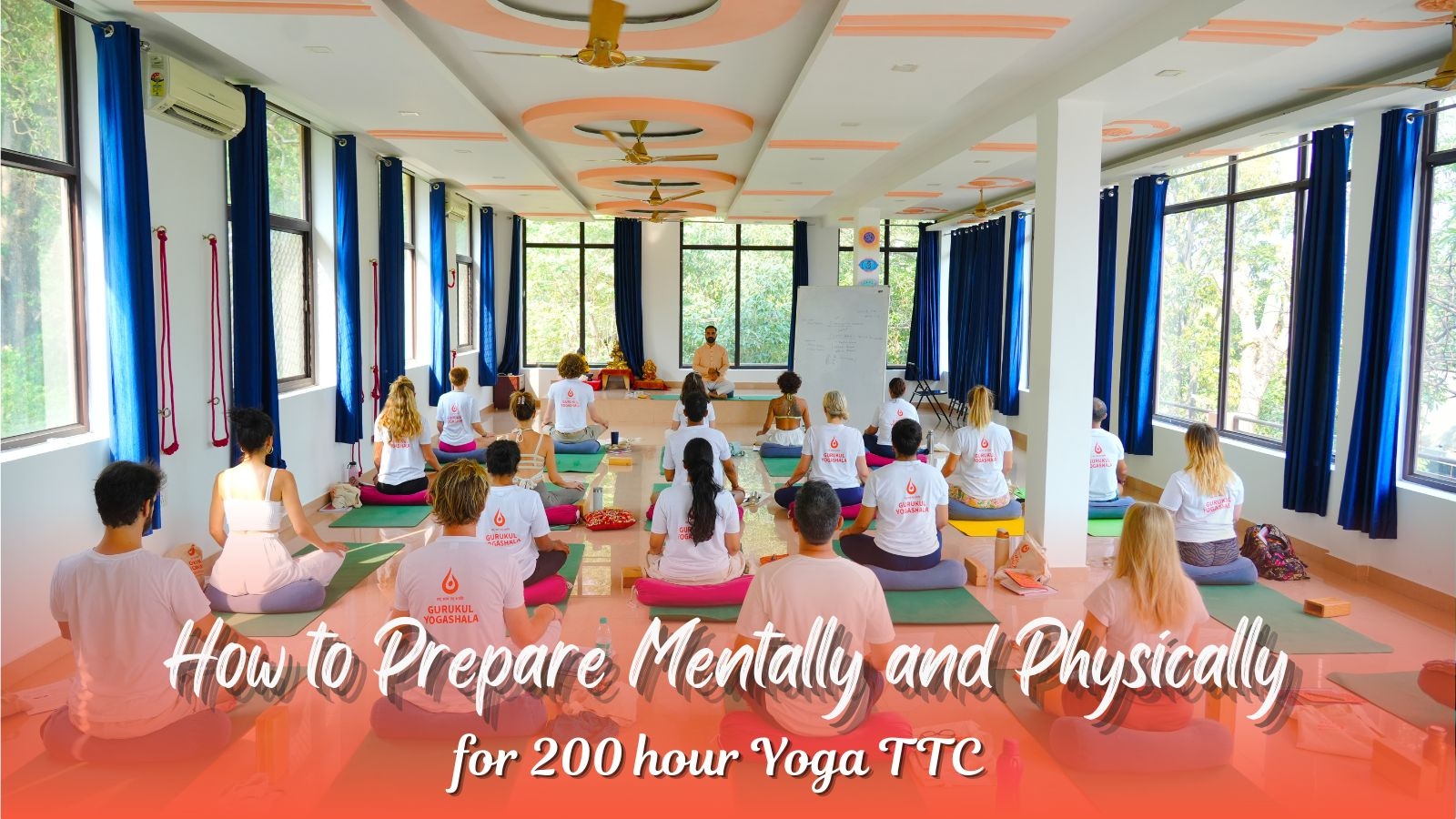
How to Prepare Mentally and Physically for a 200 Hour Yoga TTC

You have booked your place for 200 hour yoga ttc or at least are very close to clicking that button, but you might still ask yourself, “How do I prepare?” The 200-Hour Yoga Teacher Training Course in Rishikesh consists of 22 days (over the span of 4-5 weeks) of structured immersion – early mornings, full days of training, deep philosophical studies, lots of physical exertion and more self-reflection than most would probably anticipate. Properly preparing makes a significant difference in not only your overall performance but also in relation to how much you enjoy & absorb from the experience. Below you will find some practical & honest tips for getting your Body, Mind and all else in between ready to go!

Physical Preparation: Get Your Body Ready to Learn

Start a Consistent Practice Now

You do not need a lot of experience; however, you do have to establish some level of ongoing practice. Currently only practising 1 time/week? Focus on working yourself up to 4-5 times/week prior to your training. If your body is not used to moving regularly, the amount of physical activity during a TTC can be quite physically demanding for you. Even practising at home for 30 minutes counts! In this way, you can make your way through the Sun Salutations, the Standing Poses, Forward Folds and Seated Stretches just to help your body get acclimated to moving regularly. 

Work on Breath Awareness

Pranayama (breathing exercises) is a significant part of any 200-hour yoga teacher training in Rishikesh.  However, taking the time to sit and concentrate on how you breathe in the morning prior to training will help you learn the techniques of pranayama more easily. There are many methods you can use to learn how to breathe effectively, such as deep belly breathing or the 4-7-8 method.

Sleep Well and Eat Well Before You Go

While it may seem easy, many students arrive exhausted due to finishing work, relocating their homes, and travelling. In the weeks before arriving at the ashram, make getting rest your number one priority. Limiting alcohol consumption (if you drink), eating cleanly and trying to synchronise your sleeping hours with those at the ashram (where many students start their day before or around sunrise) will aid you in giving your body a head start on the first day of training. 

Prepare for Reduced Screen Time

Many reputable yoga schools discourage the use of smartphones and social media during yoga teacher training. If you are accustomed to consistently being connected to a smartphone and/or social media, the transition can be overwhelming. Therefore, you should make a conscious effort to practice small forms of digital detoxification before you travel. You could choose to spend one hour of your morning without looking at your phone; you could choose to have a no-electronics night one day before leaving…Either way, it will allow your nervous system time to adjust to the stillness of your life ahead. 

Mental Preparation: Get Your Mind Ready to Open

Let Go of the Need to Be Perfect

It is important to realise that your training isn’t a performance, so you might lose your balance within poses, struggle with concepts and have journey days where everything seems to go completely awry; this doesn’t mean you’ve failed—it just means you learned. 

The teachers at the best Yoga Schools in Rishikesh are not there to judge your progress. They’re there to guide it.

Start a Simple Journaling Practice

Your TTC will create a lot of internal changes; therefore, it is important to develop a habit of journaling those changes. You can spend around 5 minutes before your bedtime journaling your thoughts/feelings, etc. You don’t have to be a writer; even writing a few words daily builds a connection to you as an increased sense of self-awareness is ultimately what yoga is about. 

Read a Little About Yoga Philosophy

While you won’t be evaluated on yoga philosophy before attending the TTC, knowing the basic definitions of the Eight Limbs of Yoga, the Yamas/Niyamas and who Patanjali is will provide a perspective for the lessons, creating a larger impact when we delve deep into the philosophical classes. 

Get Comfortable with Discomfort

A Yoga Teacher Training Course in Rishikesh will help you grow physically and mentally. Throughout the program, you may experience emotional discomfort, physical fatigue from using new muscle groups every day and mental confusion as you learn new things. One of the best ways to prepare yourself to be able to sit with discomfort, rather than run away from it, is to develop your mindfulness practice, even just five minutes each day. 

Practical Preparation: The Logistics That Matter

Pack lightly but considerately. Bring simple, comfortable, modest clothes for yoga practice. Consider bringing a good quality yoga mat if you have one (yoga teacher training schools have mats). You should also bring a personal journal, plus any personal medications.

Rishikesh is a very spiritual city. You will be expected to wear modest clothing while walking around Rishikesh outside of the ashram, so plan accordingly. If possible, arrive at least a day in advance. Take time to readjust to the time zone you’re in, orient yourself in relation to Rishikesh and obtain a sense of calm from sitting by the Ganga River before your yoga teacher training begins. If you do not, you will enter your first class with a scattered mind. 

The Right School Makes All the Difference

The environment surrounding your training is an essential part of your Yoga Teacher Training in Rishikesh. The Gurukul Yogashala school offers a supportive environment for every student, starting with their first morning in the 200-hour yoga teacher training workshops or programs. Gurukul Yogashala teachers are well-versed in the authentic Himalayan tradition. The small class sizes allow teachers ample opportunity to provide personalised attention. Students are provided organic sattvic (pure) meals during their stay at Gurukul Yogashala, and the curriculum covers an extensive range of information relating to yoga, including philosophy, anatomy, Ayurveda, and meditation, as well as the postures themselves.

For those who finish the 200-hour yoga ttc in Rishikesh and want to continue with their training, the Gurukul Yogashala also offers a 300-hour yoga teacher training in Rishikesh that is focused on deepening their existing knowledge and skills, and a 500-hour yoga teacher training in Rishikesh for those ready to enter into an enriched and complete mastery program.

To date, over 1000+ students from around the world have completed training at Gurukul Yogashala, and for most of these students, the time they spent enrolled at the school was beyond comparison. Students describe the time at Gurukul Yogashala as one of, if not the, most growth-producing experiences they’ve had because most had come to the experience underprepared but fully present within the process, and therefore it enabled many to undergo tremendous transformation through their experiences.

A mat awaits you… Prepare yourself to meet yourself.

Frequently Asked Questions (FAQs)

Q1. How fit do I need to be before joining a 200-hour yoga teacher training in Rishikesh? 

The only requirement is to be somewhat physically fit and ideally for you to have been doing some yoga for, say, at least a couple of months. Your willingness to show up consistently and work with your body where it is today is more important than your physical ability. The teachers at Gurukul Yogashala will assist with modifications and offer personal guidance for your practice throughout YTT. 

Q2. How many weeks before the course should I start preparing? 

Four to six weeks before YTT is the ideal time for you to consciously prepare for your commitment to YTT by developing a daily ritual of yoga, adjusting your sleeping habits, cleaning up your diet/nutrition, and starting a journaling or meditative practice. Even two or three weeks of intentional preparation will give you a noticeably smoother transition into training. 

Q3. Can I go straight into the 300-hour or 500-hour programs without doing the 200-hour first? 

The 300-hour program of yoga teacher training from Gurukul Yogashala (Rishikesh) requires that applicants have completed a 200-hour certification before being eligible to apply for the program. You can apply directly to the 500-hour program of yoga teacher training (Rishikesh) without having to complete the 200-hour course prior, since this is an independent 50-day program encompassing both levels of training. 

Q4. What should I bring to the training? 

Bring yoga pants or shorts that are comfortable and allow for lots of movement, a yoga mat if you’d like one, a journal, sunscreen (if needed), any personal hygiene items you think you will need, and any medications you take on a regular basis. If you forget something, you can find almost everything you need in town here in Rishikesh. When packing for this program, pack with less is more in mind — the less you carry with you, the more present you will be. 

Q5. What makes Gurukul Yogashala one of the best Yoga Schools in Rishikesh for a 200-hour TTC? 

Gurukul Yogashala is set apart from other schools as it offers an authentic, traditional approach to the curriculum, well-trained teachers who come from strong yogic backgrounds, small batch sizes, which allow for more individualised attention, the quality/quantity of food provided (sattvic meals), and its 4.7 rating based on the experience of nearly 1000+ students globally. This school is also fully accredited by the Yoga Alliance, meaning your certification will be recognised worldwide. And, the location of the YS being on Laxman Jhula Road places you directly in an area that has the highest level of spiritual energy in/around the town of Rishikesh. The process of completing this course is truly a life-changing experience that provides participants with a totally immersive environment for real growth. 

7-14-21 days yoga retreat in Rishikesh India v/s yoga teacher training in Rishikesh | Gurukul Yogashala

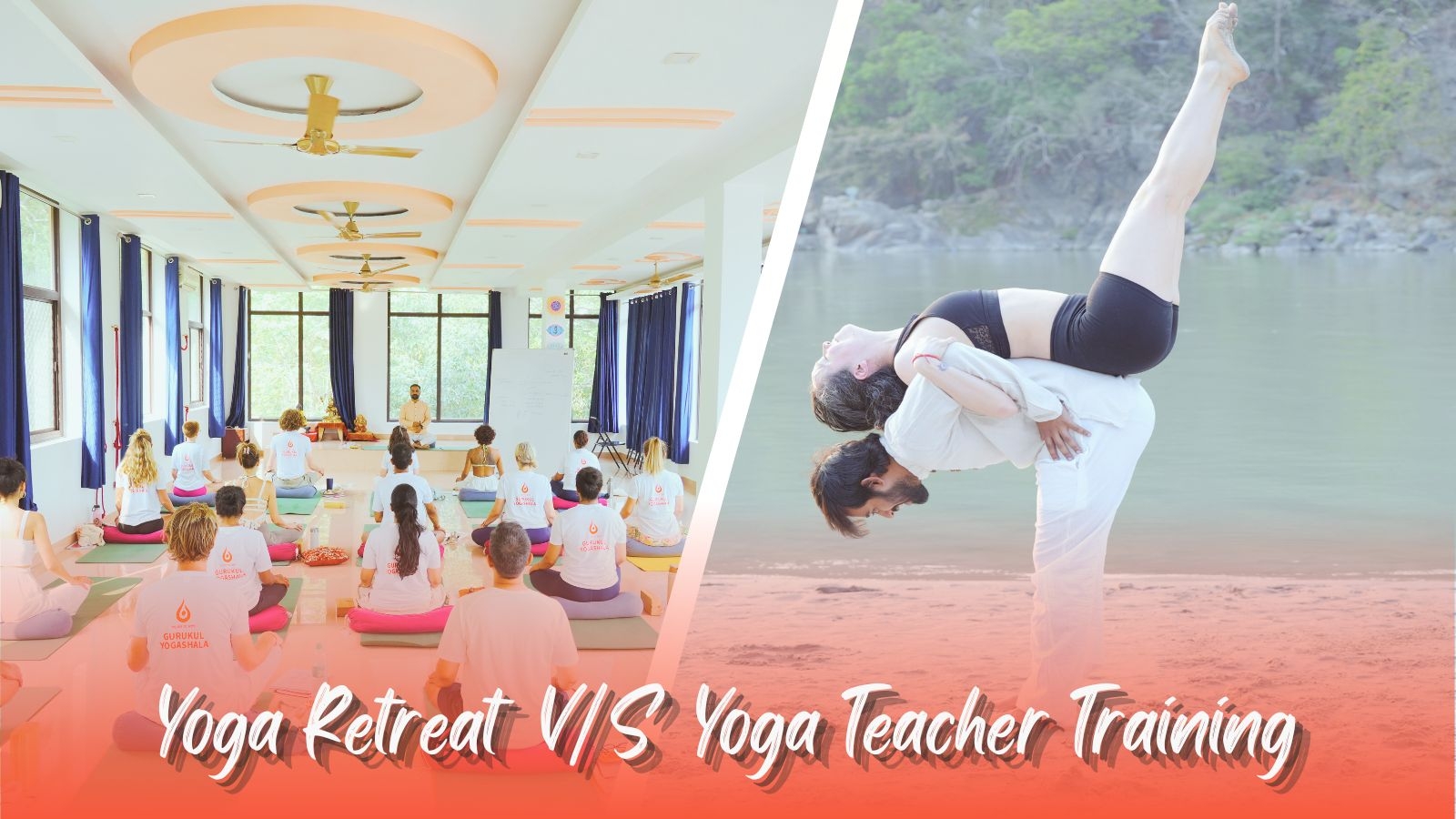
What Is the Difference Between a Yoga Retreat and Yoga Teacher Training?

If you’ve been considering coming to Rishikesh to enhance your yoga, you have likely been introduced to two options: a yoga retreat or a yoga teacher training. Both are amazing. Both are set in one of the holiest places on earth. However, there is a significant difference between the two and choosing the wrong program can leave you feeling either overwhelmed or under-challenged.

This blog will give you an idea of what each choice offers, who it is really for, and how one can decide which one makes sense today.

What Is a Yoga Retreat?

A yoga retreat will happen typically a week or a few weeks, where you take a break from your usual routine, slow down, and reconnect with yourself through yoga, meditation, nourishing food, and peace. 

There are no exams. No homework. No stress to excel or justify oneself. Simply show up, practice, relax, and depart feeling lighter than when you entered. 

At Gurukul Yogashala, retreats are offered in three lengths to suit different schedules and intentions:

7 Days Yoga Retreat in Rishikesh – One week is enough to completely shift your energy. By creating the daily rhythm of morning yoga, meditation, pranayama, and sattvic meals into your schedule, you create a gentle and harmonious lifestyle. You will experience a reduction in the noise of your mind over time and leave feeling more refreshed and focused than when you arrived. A 7-day Yoga Retreat in Rishikesh is a great experience for anyone who has limited time to take a break from their regular life. 

14 Days Yoga Retreat in Rishikesh – Two weeks provide ample opportunity for a deeper experience. After a few days of settling in, the second week allows for naturalness in practice, improved sleep quality, and a deeper understanding of yoga through teachings. You’ll have time to explore Rishikesh, visit temples, stroll along the Ganga River, and experience the culture of the area. The 14-Day Yoga Retreat in Rishikesh is ideal for individuals who wish to “reset” themselves, rather than just taking a quick break from their daily routine.

21 Days Yoga Retreat in Rishikesh – Three full weeks is a genuine transformation. You’ll come to understand yoga as more than just an exercise form; it will become part of how you live daily. Daily yoga practice will evolve into a habit. The philosophical aspects of yoga will be practical experiences in everyday life. You will connect with other like-minded individuals from around the world. The 21-Day Yoga Retreat in Rishikesh is perfect for anyone looking for an immersive, meaningful experience that generates long-term changes without providing the structure of a formal certification program.  

7-14-21 days yoga retreat in Rishikesh India v/s yoga teacher training in Rishikesh | Gurukul Yogashala

What Is Yoga Teacher Training?

The Yoga teacher training course is a formalised and certified course that is more demanding than the average yoga practice. However, the focus of this training programme is not only to restore the practitioner (as many yoga classes do) but also to develop the practitioner into an instructor.

Yoga teacher training courses require their participants to rise early, attend two yoga classes each day, and participate in classes focusing on anatomy, history, philosophy, Ayurveda, and teaching methodology. Participants learn in-depth techniques and skills on how to properly adjust yoga posture (and correct alignment), how to sequence/structure a class, and how to facilitate a safe environment that can accommodate a wide variety of ability levels in students. The participant will be assessed and, upon successful completion of the course, will be certified by the Yoga Alliance to legally teach yoga anywhere in the world.

At Gurukul Yogashala, the yoga teacher training in Rishikesh is offered across four levels, each building on the last:

100 Hour Yoga Teacher Training in Rishikesh – The 100-hour level is a 12-day introductory training programme. This programme offers a unique opportunity to experience yoga teacher training without overwhelming the beginner with large amounts of information. During the 100-hour YTT, the participant will learn and practice basic asanas, pranayama, and meditation; introductory yoga philosophy; and find the instructor training programme to be a wonderful way to begin the journey of exploring the possibility of teaching yoga and becoming a certified yoga teacher. Many wellness professionals also favour the 100-hour YTT to add yoga fundamentals to their existing practice. 

200 Hour Yoga Teacher Training in Rishikesh – The globally recognised standard of certification that is needed to become a certified yoga teacher is through completing this training program. The course is designed to provide a comprehensive understanding of the different styles of yoga: Hatha, Ashtanga, and Vinyasa. You will also learn about anatomy, philosophy, alignment, and practical training for teaching. Many studios and gyms require a 200 Hour Certification before hiring instructors, and they often describe their experience of completing the training as one of the most profound transformational experiences of their lives. Because of this, the 200 Hour Yoga Teacher Training Course in Rishikesh is the most popular program at Gurukul Yogashala. 

300 Hour Yoga Teacher Training in Rishikesh – Advanced students interested in learning how to deepen their practice and understanding of yoga through the advanced-level 300-hour program. During the 28-day program, students will dive deeper into more complex yoga poses, utilise therapeutic adjustments using Iyengar, study refined philosophy and dive deeper into Ayurveda. Upon completion of the 300 Hour program, you will qualify for the full 500 Hour Yoga Alliance Certification when it is combined with the 200 Hour program. The course is designed for dedicated practitioners who want to elevate their teaching to the next level of professionalism. 

500 Hour Yoga Teacher Training in Rishikesh – Rishikesh offers the highest available certification for yoga with its 500-hour program. You can complete the 500 hour course in one of two ways: as a 58-day consecutive course of training, or through the combined 200 hour – plus 300 hour program. Upon graduation from both methods, you will have earned a credential (that is accepted internationally) that few others possess, as well as an incredible depth of knowledge in yoga. 

So Which One Is Right for You?

Here’s a simple way to think about it:

Select a retreat if you are:

  • Burnt out and need to rest and recover
  • Not sure whether or not to take part in a yoga program, and just want to see what yoga is like
  • Interested in being in Rishikesh and finding out about living a yogic lifestyle without pressure
  • At a major life turning point and require some peace to help you reflect before making decisions

Select the teacher training if you:

  • Are committed to being a professional yoga instructor (e.g., through a studio, online, or independently)
  • Are committed to being very intensive for a period of 12 to 50 days
  • Want to receive an internationally recognised qualification rather than just having experienced yoga for your own personal benefit.
  • Have been practising for some time, but have been pulled toward something much deeper. 

It’s also important to recognise that many people will go on a retreat first to determine if Rishikesh is right for them before they return for teacher training courses; while others come for their teacher training and then decide to return for yearly retreats. 

These are not two competing paths; rather, they complement each other.

Both Lead to the Same Place

If you come for a 7-day retreat or a 500-hour teacher training in Rishikesh, you are stepping into an environment based around one belief: That you are growing into who you believe you are.

Our Yoga teachers have lineages that span many generations. The Ganges River is very close to our Gurukul Yogashala school. The Himalayas are always quietly looking over you while you are here. No matter what you are seeking through your time at Gurukul (rejuvenation, knowledge, credentials, or a complete lifestyle change), there’s a good chance you’ll receive what you have sought after.

The only question to ask is, what are you ready to move on from right now? Explore yoga retreats and yoga teacher training programs at Gurukul Yogashala and find the experience that fits exactly where you are.

Complete Guide to the 7 Chakras Symbols: Meaning, Energy & Healing Explained | Gurukul Yogashala | Best Yoga Teacher Training School in Rishikesh

Complete Guide to the 7 Chakras Symbols: Meaning, Energy & Healing Explained

Have you ever felt stuck – physically, emotionally, or mentally – but have struggled to explain why? Maybe you went to a yoga class and the instructor mentioned “the chakras,” and you nodded your head along but were secretly asking yourself, “What the heck are the chakras?!”

You’re not by yourself if that’s how you feel. The chakras are probably the most discussed reference in yoga and wellness, yet they also continue to be one of the most misunderstood ideas out there. However, once you truly comprehend the chakras – meaning you get what they are and what they represent – they’ll no longer appear to be an abstract notion but will instead become one that is uniquely yours.

The purpose of this guide is to take you step-by-step through each of the seven chakra symbols, explain to you what they represent, how they affect your energy system, and ultimately, show you ways you can incorporate the chakras into your everyday life.

What Are Chakras?

The term “chakra” is derived from the word “chakra” in the ancient language of Sanskrit, meaning “wheel” or “cycle.” Chakras are the rotating centers or vortices of power (or energy) along the axis of the body – from the base of the spinal column (root) to the top of the head (crown). The chakra system contains 7 major energy centers with their own corresponding emotional, physical, and sensory properties.

While most people think of chakras as a new concept that has only recently emerged within our modern society, in fact, the chakra system has been utilized in some form for over 3,000 years as part of India’s ancient spiritual philosophies (the Vedas, the Upanishads). 

When your energies (chakras) are open and balanced, your life force (qi, prana, ether, etc.) flows smoothly through both your physical and subtle bodies; you will experience health and happiness as a result of having a balanced system of energy flowing through both your physical body and your subtle body. Conversely, if one or more of your chakras is either blocked or overly active, there will be a disruption in the flow of energy throughout your body (i.e. you may feel anxious, suffer from persistent physical pain, have difficulties in relationships, lack self-confidence, or feel disconnected from who you are).

Let’s connect!

1. Muladhara – The Root Chakra

Location: Base of the spine 

Color: Red 

Symbol: A four-petalled lotus with a square and downward-pointing triangle at the center

The root chakras is your foundation and represents your sense of safety, stability, belonging, and basic needs for survival (food, shelter, financial security, etc.), and the assurance that you have the right to exist and the space to take up in this world.

When you are in balance, you will feel grounded, secure, and calm (even in times of uncertainty). When you are blocked, fear, anxiety, and an overall feeling of instability will most likely prevail. 

Signs of imbalance: chronic anxiety, financial issues, pain in the lower back, and feeling disconnected from the body. 

How to activate it: through foot contact with the earth, grounding in yoga positions, using the seed mantra LAM, and using a red stick are good ways to balance your root chakra. 

2. Svadhisthana – The Sacral Chakra

Location: Lower abdomen, just below the navel 

Color: Orange 

Symbol: A six-petalled lotus with a crescent moon inside

This chakra is responsible for your creativity, pleasure, emotions and relationships. It governs the way in which you connect to others, experience joy, and relate to your own feelings and desires.

When the sacral chakra is open and balanced, your life feels ‘juicy;’ you create freely, connect easily with others and emotionally flow. Conversely, when it’s blocked you may feel emotionally numb, creatively stuck or experience mood swings between extreme ends of the emotional spectrum.

Signs of imbalance: low libido; creative blocks; emotional rigidity; tightness in your hips; or feeling guilty about enjoying pleasure. 

How to activate it: doing hip-opening poses like Baddha Konasana; dancing; expressing your creativity; using water; chanting the seed mantra for the sacral chakra which is “VAM”; and surrounding yourself with orange. 

3. Manipura – The Solar Plexus Chakra

Location: Upper abdomen, stomach area 

Color: Yellow 

Symbol: A ten-petalled lotus with a downward-pointing triangle

Manipura means ‘place for storing jewelry’. It is where you find your personal strength (will), self-belief (confidence), discipline, and sense of self. It is the heat in your belly (inner fire).

When it is in balance, you can pursue your goals with clarity and confidence. However, if it is in a depleted state, you may feel powerless, overly controlled by others or become domineering and controlling. 

Signs of imbalance: low self-esteem, digestive problems, excessive desire to please others or controlling/aggressive behaviours. 

How to activate it: Trying yoga poses focusing on strengthening your core, complete and active Kapalabhati breathing, chanting ‘RAM’ as a seed mantra, eating foods that are yellow (e.g., bananas, turmeric), and getting outside in natural sunlight.

4. Anahata – The Heart Chakra

Location: Center of the chest 

Color: Green 

Symbol: A twelve-petalled lotus with two overlapping triangles forming a six-pointed star

The term “Anahata” means “unstruck sound,” which denotes the creation of sound before all things have been created.

The Heart Chakra is the gateway between the three lower: 1) Base, 2) Sacral; and 3) Solar Plexus chakras and the three upper: 4) Throat; 5) Third Eye; and 6) Crown chakras. When the Heart Chakra functions at its highest potential, you are able to love fully (self and others) without becoming lost in the process. When it becomes blocked, it may feel like a wall around the chest, an inability to trust, or anguish that will not move. 

Signs of imbalance: feeling lonely; having difficulty forgiving; becoming co-dependent on others for love; tightness in the chest and shallow breathing. 

How to activate it: performing back-starting/heart-opening poses, such as Ustrasana and Bhujangasana, meditating using “loving-kindness” techniques, using YAM as a seed sound; and spending time outdoors in places that are rich in green plants and trees 

5. Vishuddha – The Throat Chakra

Location: Throat 

Color: Blue 

Symbol: A sixteen-petalled lotus with a downward-pointing triangle and circle inside

The concept of Vishuddha means “purity,” representing the expression of one’s truthful communication with self and others while also being able to listen fully during discussions or conversations.

When your throat chakra is open, you have the ability to express yourself with genuine words and emotions. You are capable of following through with your convictions, saying “yes” to what you truly want, and remaining silent when you have no desire to speak. 

Signs of imbalance: difficulty speaking your truth, feeling fear of being judged, and talking too much or too little. 

How to activate it: you can chant, journal, perform Jalandhara Bandha (throat lock), use the seed mantra “HAM,” or talk openly and truthfully.

6. Ajna – The Third Eye Chakra

Location: Between the eyebrows 

Color: Indigo 

Symbol: A two-petalled lotus with an inverted triangle and the Om symbol inside

This chakra represents the concept of “command” and “perception.” In addition to being associated with intuition, inner wisdom, clarity, and insight, this is also your ability to understand those things that are beyond the capability of the logical mind; that still small voice within that you often refer to as intuition and usually leads you to a correct conclusion.

When balanced and functioning correctly, you are able to trust your intuition, see things as they really are, and feel confident in your own decisions based on solid intuition. When you are in a state of imbalance, typically you may find yourself confused, overthinking everything, and unable to trust what your inner voice is telling you.

Signs of imbalance: headaches, indecision, inability to focus, ignoring gut feelings and/or relying too heavily on the opinions of other people.

How to activate it: engage in trataka (candle gazing), practice silent meditation, work with yoga nidra, use the seed sound mantra (OM), and limit their use of electronic devices to create space for yourself mentally. 

7. Sahasrara – The Crown Chakra

Location: Top of the head 

Color: Violet or white 

Symbol: A thousand-petalled lotus

The Sahasrara Chakra represents pure consciousness, spiritual connection, and a sense of being part of something larger than yourself. While it is not religion-based, it is the feeling that life is meaningful and that you are not separate from it.

When your Sahasrara is open, it provides you with a sense of peace that does not rely on external conditions. When your Sahasrara is blocked, you may feel that there is no meaning in your life, that you are disconnected, or that your life is mechanical. 

Signs of imbalance: Spiritual disconnection, a cynical outlook on life, feeling empty all the time, or having an excessive attachment to material possessions. 

How to activate it: Deep meditation, silence, spending time outdoors, using breathwork techniques, and practicing surrender – letting go of control over everything 

Complete Guide to the 7 Chakras Symbols: Meaning, Energy & Healing Explained | Gurukul Yogashala | Best Yoga Teacher Training School in Rishikesh

Going Deeper – Learning Chakras Through Yoga Teacher Training

Gaining information about chakras is nice, but in reality, real knowledge of chakras, experiencing them yourself, teaching them to others, involves a different level of working with the information.

This is precisely the kind of knowledge that can be gained during a residential yoga teacher training in Rishikesh. Because not only is it taught through reading and studying, but also by way of experience through the daily yoga and meditation practice and the energy of one of the most spiritual cities in the world.

Chakra philosophy, pranayama and meditation are integrated into all levels of training at the Gurukul Yogashala. The  200 hour yoga teacher training in Rishikesh gives you the complete system of chakras along with asana, anatomy and yogic philosophy – promoting a well-rounded and strong grounding. For those interested in delving further into energy anatomy, subtle body work and the all-encompassing yogic tradition the 200 hour yoga teacher training in Rishikesh leads to the 300 hour yoga teacher training in Rishikesh.

If you are destined to walk the entire professional path with all the trimmings and trappings from the get-go, the 500 hour yoga teacher training in Rishikesh condenses everything -from root to crown- in one all-encompassing, life-altering experience.

And if you have ever been in a yoga class and felt something change in your chest during a heart-opening pose and thought, What just happened – then the Yoga Teacher Training in Rishikesh is for you.

Final Thoughts

You do not need to memorize the seven chakras as they are not merely concepts but a living, breathing representation of your inner world. All your emotions and physical sensations, the recurring patterns of your relationships, and all other aspects of your life have a spot on the map that the chakras represent, so they are a roadmap of your inner world.

To work with the chakra symbols is not to become a spiritual being out in the ether but to be more honest about yourself, more aware, and to embody your wholeness. You will find the chakra that you are experiencing the most resonance with and sit in front of its symbol, breathe in the area where it resides within you, and observe what you notice.

The journey inward is the most significant journey that one will take, and it starts at the place you are now.

Frequently Asked Questions

1. What are the 7 chakra symbols and what do they represent? 

The seven chakras are Muladhara, Svadhisthana, Manipura, Anahata, Vishuddha, Ajna, and Sahasrara. Each chakra has a name, a symbol, a color, a location on the body, and an area of life that the chakra regulates (from basic survival and safety to spiritual consciousness). 

2. What is the meaning of each chakra symbol? 

There are seven chakra symbols, which are all lotus blossoms with a different number of petals; each symbol also has different geometry that corresponds to the vibrational frequency of the energy center it represents, and each chakra symbol has letters written in Sanskrit that represent the vibrational frequency of the energy center. For example, the root chakra symbol (Muladhara) has the square shape because it corresponds to the earth and/or the stability associated with that location; whereas, the heart chakra symbol (Anahata) has the six-pointed star shape because it corresponds to the union between earth and heaven. 

3. How do chakra symbols affect energy and healing? 

Chakra symbols are used as visual tools for meditation and intention; focusing on a specific chakra symbol helps you draw awareness towards that energy center, thereby activating it, and supporting the clear removal of blockages that may be present. Once you focus on that energy center for a long time period (with breathwork and movement) it creates measurable changes in both your physical and emotional feelings. 

4. How can I activate or balance my chakras? 

You can activate the energy in your chakras through yoga asana, pranayama, meditation, chanting seed mantras, visualization, sound healing, and nature. Each energy center has a corresponding color, sound, food and other practices, so chakra work is very personal and can be tailored to the individual. 

5. What are the signs of blocked chakras? 

Each chakra has different symptoms of being blocked. Common symptoms are chronic anxiety or fear (root), creative block (sacral), low self-confidence (solar plexus), unable to express love or forgive (heart), trouble communicating the truth (throat), over-analysis or numb to your intuition (third eye) and disconnected from your spiritual self or lack of spirit (crown). 

6. Why are chakra symbols used in meditation? 

Chakra symbols act as yantras (a form of concentration tool). You can focus on them while meditating in order to help still the mind that is scattered and create an inward flow of the energy to the different centres of the body using higher frequencies than those found in the outer world. By using visual symbols of an energetic nature the mind has something tangible to focus on while practicing. 

7. What colors are associated with each chakra symbol? 

Root – Red

Sacral – Orange

Solar Plexus – Yellow

Heart – Green

Throat – Blue

Third Eye – Indigo

Crown – Violet or White

These colours correlate to the vibrational frequencies associated with each of the chakras and can be used to create a visualisation, wear as clothing, use crystals or incorporate as part of your environment to achieve balance. 

8. Can chakra symbols really help with emotional healing? 

Yes – if they are used on a consistent basis and with intention. Working through your chakras provides a framework for understanding the emotional patterns that reside in your body, and how to address them. The combination of chakra work with yoga and meditation is an extremely powerful method of processing the feelings of grief, anxiety, anger, and disconnection in a grounded and embodied manner. 

9. How do beginners start working with chakra symbols? 

The best way to start is to keep it simple. Gather the information about the location and color of all of your chakras, and then select one chakra with which you feel connected to your current emotional state. Sit still, put your hand on the area of the body where that chakra resides, breathe deeply and visualize the color and symbol for that chakra. Doing this just five times a week for five minutes will create awareness and change the energy in a particular area of your body over time. 

How to Become a Certified Yoga Teacher - Instructor | Gurukul Yogashala | Best Yoga Teacher Training School in Rishikesh

How to Become a Certified Yoga Teacher: A Complete Guide

If you love yoga, and you have been doing it for some time now; you have probably had the same thought over and over again…what if I could teach yoga? Well, this thought is very valid.

Becoming a certified yoga instructor offers many rewards personally, such as deepening your practice, changing how you look at/feel about yourself and learning to help others through yoga (by teaching them). These things make becoming a Certified Yoga Instructor very rewarding.

So now what? How do you get started? What does it mean to be certified? What type of certification is right for me? You can find all the answers you need in this guide, which is designed to be straightforward and helpful.

Why Yoga Teacher Certification Matters

First, let’s talk about the significance of being a certified yoga teacher.

The roots of yoga go back thousands of years, but in today’s world, when a student enters the yoga studio, they have the right to know that their instructor has completed appropriate training. Health and fitness certifications provide an established standard to the student, the studio, and the employer, giving everyone the confidence that the teacher is knowledgeable about the subject matter.

A fact worth considering is that there are over 100,000 yoga teachers around the world who are presently registered with Yoga Alliance, and the demand for certified yoga instructors continues to grow every year. The global yoga industry is estimated to be worth an estimated $80 billion and continues to grow. Becoming certified will not only create a stronger foundation for your practice, but it will also create long-term, legitimate career opportunities.

Step 1 – Build Your Personal Practice First

You need to have solid personal practice before you start teaching. While this may seem obvious, many teachers overlook this fact.

Building up a substantial personal practice is essential to having awareness in your body, being disciplined and having an actual understanding of what it feels like to do yoga from the inside out. It’s not important to be perfect at each pose; actually, teachers that have had challenges and worked through them tend to relate better to students than those who have found everything easy.

Most teacher training programs require that you have practiced at least six months to a year before going through the program. Some programs do require this. Regardless, it is on the mat where the journey begins.

Step 2 – Understand the Certification Levels

There are varying levels of the yoga alliance teacher training. So being aware of these levels will give you the best idea of how to plan your progression.

200-Hour Yoga Teacher Training – This is where it all starts. It is the minimum needed in order to become registered as a teacher with the Yoga Alliance (RYT 200). This program will introduce you to asanas, pranayama, meditation, anatomy, yoga philosophy and the fundamentals of teaching methodology. Most people start here and many teach successfully at this level for many years.

300-Hour Yoga Teacher Training – This is the next step for teachers who have already taken the 200 hours and are ready for advanced practice. It includes more in depth asana, philosophy, specialization including anatomy and refining teaching skills. You are considered an RYT 500 once you have completed the 200 and 300 hours.

500-Hour Yoga Teacher Training – Other schools have a 500-hour integrated program which combines the 200- and 300-hour levels for a 500-hour journey. This is perfect for those who already know from day one that they want to teach at an advanced level.

Step 3 – Choose the Right School

Many aspiring teachers have difficulty choosing a yoga school. This decision is one of the most important choices an aspiring teacher can make. Here are some things to look for in your choice of yoga school:

1) Accreditation: Make sure that the school you choose is accredited by a governing body called Yoga Alliance. Only institutions with Registered Yoga School (RYS) status can issue certifying transcripts. Verify that this is true prior to registering for any classes.

2) Experience: Look for schools whose instructors have decades of experience with yoga and/or have been practitioners and teachers of other modalities. The quantity of experience possessed by your instructors will determine the level of depth from which you learn.

3) Balance of Curriculum: In a well-rounded teacher training program, you will learn about all aspects of yoga, such as philosophy, anatomy, breathwork, meditation, teaching methods and ethics. If the majority of your course will consist of postures, you should select another place to study.

4) Location and Setting: The location and setting of where you train is important. People typically do not recognize how place impacts their ability to deepen the understanding of the practice.

Which brings us to Rishikesh.

While many aspiring teachers travel to India for an authentic, traditional experience, training abroad isn’t the only path – some students prefer to explore programs closer to home before making their decision. If you’re weighing different options, it may help to compare yoga teacher training courses available through All Yoga Training as part of your research. 

Step 4 – Consider Training in Rishikesh

Rishikesh is truly the pinnacle of serious yoga teacher training courses. Rishikesh is home to many yogis, sages and seekers from around the world, who have been coming there for thousands of years – so, if you are seeking a true “yogic” experience, look no further than Rishikesh. The methodology and philosophy of these teachings are authentic, and the “in the moment” nature of your experience when trained there is often unexplainable. The daily experience of living in an ashram (waking up at 4:30 am, eating sattvic food, listening to evening satsangs, being exposed to the natural healing powers of the sacred Ganga River, etc.) provides a foundation of support for the development of a true yoga teacher’s journey.

At Gurukul Yogashala (a top-rated yoga school in Rishikesh, India), you will have the exact type of yogic experience that was mentioned above. Gurukul Yogashala has over 30 years of combined experience in the field and is rooted in the Vedic tradition, and they currently provide training in multiple disciplines and levels of yoga.

The Gurukul Yogashala offers a 200 hour yoga teacher training in Rishikesh that lasts 22 days and provides participants a comprehensive view of disciplines such as Hatha Yoga, Ashtanga, Vinyasa, Yin Yoga, and Ayurvedic practices along with yogic philosophy as well. This course will give future teachers an excellent foundation to begin teaching with confidence.

In case you are looking to take your practice to the next level, the Gurukul Yogashala provides a  300 hour yoga teacher training in Rishikesh  that is 28 days long. This program offers an advanced course (taught in accordance with Iyengar Yoga principles) that builds on the foundation developed during the 200-hour course and includes advanced techniques in Hatha Yoga, Vinyasa, and deeper Ayurvedic practices. This program is specifically designed for those who are already certified as teachers and want to take their practice to a higher-level.

The Gurukul Yogashala also offers a 500 hour yoga teacher training in Rishikesh which is an all-inclusive course that supports you from beginning fundamentals through to advanced mastery allowing you to learn everything you need to become a complete professional.

Step 5 – Know What You Will Learn

Learning the poses of yoga is only one aspect of a high-quality Teacher Training Program. A comprehensive Teacher Training Program will include the following core components: 

  • Safe Asana Practice and Mastery – Safe alignment, effective adjustment & modification, and how to effectively sequence different bodies and levels (Anatomy & Physiology) 
  • Pranayama Techniques/Uses – How breathing techniques affect our nervous system; breed breath techniques are used in the form of teaching breathing techniques. 
  • Various Forms of Meditation – Types of meditation, guidance in meditation for others and associated science around stillness. 
  • Anatomy & Physiology of Movement – Movement of bones, where and how injuries occur and how to ensure students are safe when practicing yoga. 
  • Teaching Methodology – Sequencing classes, using your voice, giving proper adjustment, organizing a room, and developing a relationship with students.

Step 6 – Register and Start Teaching

After finishing a program that is certified by the Yoga Alliance, you can sign up as a Registered Yoga Teacher (RYT) on their site, and this is your global certification that is accepted by studios, gyms, wellness centres, retreats and other companies that support wellness.

After getting registered, the rest of your journey is up to you to take it wherever you want. Many teachers initially are offering classes to friends and family, or volunteering at community centres or maybe helping out at the school they completed their training in. Building an active teaching practice takes time but the base of quality training will help you to build on that base. 

How to Become a Certified Yoga Instructor: The Short Version

For those people skimming, the following is the fast overview of the process. Practice consistently for 6 to 12 months. Choose a school with Yoga Alliance accreditation. Complete 200 hours of teacher training and consider if you want to take 300/500 hours of training. Register with the Yoga Alliance. Start teaching and continue with your education.

Yoga Teacher Training in Rishikesh remains as one of the best and most respected places in the world to become certified, with a very good reason, as the level of pure tradition, the quality of instructors, and the experience in the area are all very difficult to find anywhere else. 

Final Thoughts

Choosing to become a yoga instructor will affect everything about how you live your life… Where you live, how you move through your days, and the way that you connect with your community.

At Gurukul Yogashala, Rishikesh, we will assist with this transformation. Our teachers are trained in the authentic lineage of yoga and facilitate your learning beyond receiving a certificate; they will provide you with a blueprint for life-long practice. This is your classroom; the mountains, the river, and the thousands of years of history associated with them are your teachers.

Answer the call and begin your journey.

Frequently Asked Questions

1. What qualifications do I need to become a certified yoga teacher? 

In order to become certified as a yoga instructor, you do not need to have any type of college degree; however, you must have a continuous personal yoga practice, an honest motivation for teaching the practice of yoga, and to enroll in an accredited teacher training program through Yoga Alliance. Most teacher training programs will take applicants from any background. 

2. How long does it take to become a certified yoga instructor? 

The time it takes for you to complete your training depends on whether you are taking an intensive or part & parcel approach. A 200 hr course typically takes between 22 & 28 days in an intensive residential programme or several months in a part time programme. The 300 hour advanced course typically takes another 28 days or longer to complete. You can factor in the timing of your final level and type of training when you are thinking about your time-line. 

3. What is the best certification for yoga teachers? 

The most recognized yoga certification for teachers around the world is from the Yoga Alliance (USA). When choosing a school, you want to ensure they are registered as a RYS200 or RYS300 (Registered Yoga School). A Yoga Alliance certification can be used in any studio or gym or other wellness facility in most countries in the world. 

4. Can beginners become yoga teachers? 

Yes, but you will need to plan ahead! Most schools recommend having an established personal practice for at least six to twelve months prior to enrolling in their teacher training course to give you a sense of body awareness and a base foundation of experience to help you understand the training you will receive more fully and completely. 

5. How much does yoga teacher training cost? 

Courses for teacher training vary depending on the location and level of the programme. A 200 hr yoga teacher training programme in India (specifically in Rishikesh) that is residential and includes accommodation and food will range from $700-$1500 (USD) which is much less expensive than in most parts of the world.

6. Is online yoga teacher training valid? 

Online teacher training has been accepted by the Yoga Alliance, but many people who want to learn the most possible, especially through hands-on adjustments, the sense of community, and the immersion into the training, would do better to go to an in-person residential training program, such as one in Rishikesh, India – an experience that cannot be duplicated with online teacher training. 

7. What will I learn in a yoga teacher training course? 

The types of things you will learn in the course are: physical yoga asanas and how to align your body while doing the asanas, pranayama, meditation, your physical anatomy and physiology as it relates to yoga, yoga philosophy, how to teach, how to sequence classes, how to do hands-on adjustments, and how to behave as a yoga teacher according to the ethical guidelines of a yoga teacher. A full training program covers both the physical and the philosophical aspects of yoga. 

8. Can I teach yoga immediately after certification? 

You can begin teaching yoga as soon as you have completed the (200-hour) RYT 200 yoga teacher training and have registered with Yoga Alliance. Many new teachers will teach to small groups in the community, do private sessions, and/or assist more seasoned teachers while gaining confidence and experience. 

9. How much do certified yoga teachers earn? 

Earnings depend on where you teach, in which format and your experience. In India, the salary of yoga teachers ranges from 30,000 – 1,00,000 per month. In western countries a studio yoga teacher usually earns between 30$ – 100$ per class while private teachers and retreat instructors earn much more. Many seasoned teachers also make online courses, retreats and teacher training courses.