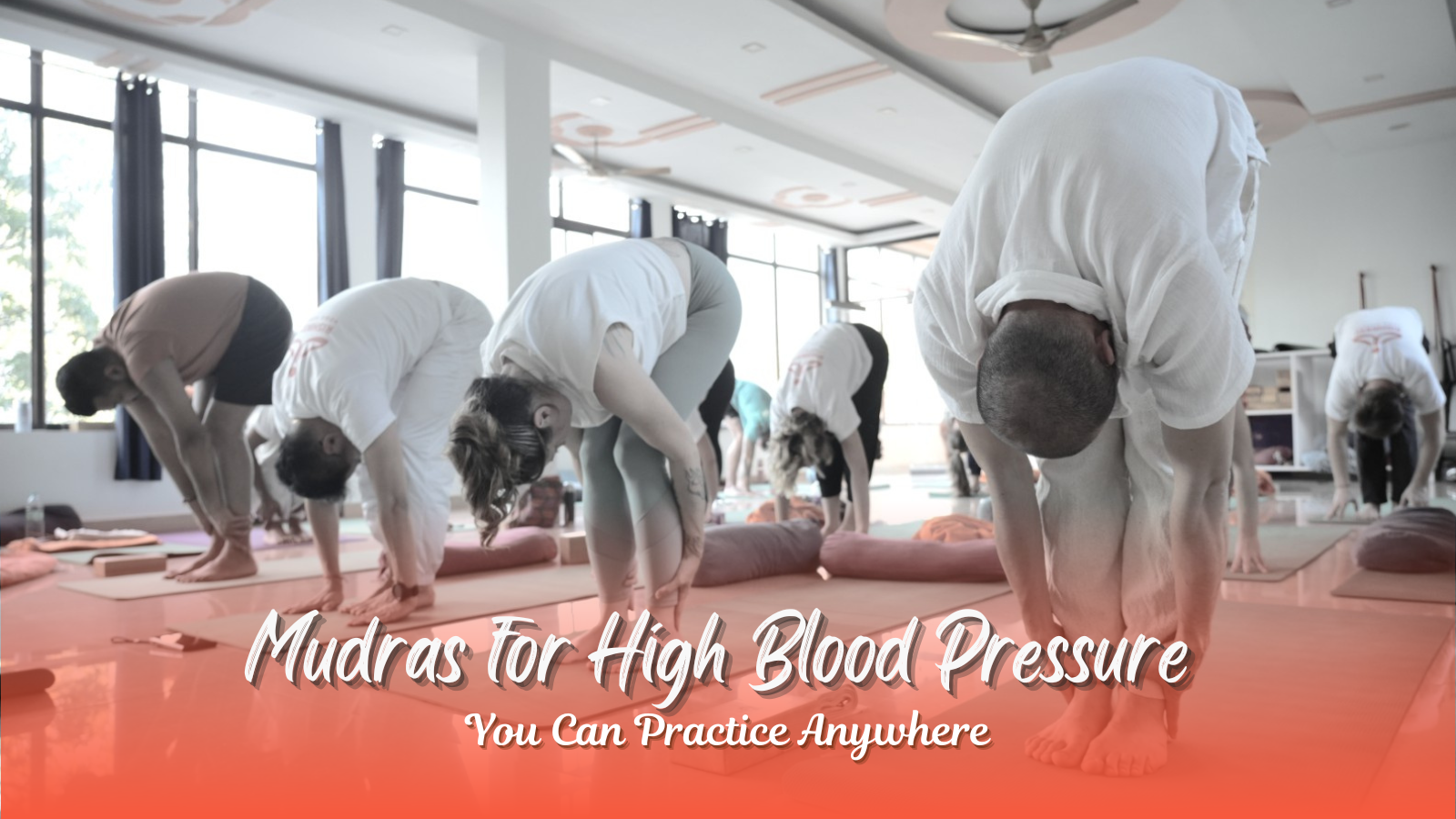
Mudras for High Blood Pressure

5 Mudras for High Blood Pressure You Can Practice Anywhere

At Gurukul Yogashala, we teach our students that healing is achieved not by complex equipment but often by simply using your two hands and a few minutes of silence. This is the secret behind mudras for high blood pressure: the gestures, derived from the ancient yogic tradition of the Himalayan region, can be performed while you are standing in a queue, working at your office desk, or sitting on a train. The mudras cannot substitute for the doctor’s treatment, but act as effective and inexpensive adjuncts in the daily lives of anyone who cares about their heart health.

In this guide, the author describes five simple mudras as well as tells about the meaning and the scientific evidence supporting their use and examples of their application in daily life – the same way we teach them to students at our Yoga School in Rishikesh.

What Is a Mudra, and Why Does It Matter for Blood Pressure?

Mudra refers to a specific arrangement of the fingers and hands utilized in yoga and meditation to control the subtle energy flow of the body (i.e., prana). According to classical principles of yoga and traditional Ayurveda, each finger represents one of the five elements (earth, water, fire, air, and ether). When two fingers come together, they may even restore the balance of these elements within your body.

From a contemporary viewpoint, however, a mudra for BP may not have such an instantaneous effect as flipping a switch. Rather, mudra leads to the automatic slowing down of breathing, relaxation of shoulders, and concentrating the mind – all in all, the three factors that are known to reduce the action of the sympathetic system in stress conditions. This is what defines our approach to teaching mudras in praxis yoga to reduce high BP, as combined with pranayama and meditation practices instead of presenting mudras in isolation. 

5 Mudras for High Blood Pressure You Can Practice Anywhere

All the aforementioned gestures can be practised while sitting in a chair, cross-legged, or even when standing in a queue. It is important to breathe slowly during the entire process – breathing conveys much more than the positioning of the hands itself. 

1. Gyan Mudra (Gesture of Knowledge)

Bring the tip of your thumb in contact with the tip of the index finger. The other three fingers should be left relaxed in the position. Place your hands on your knees with palms facing upwards.

Gyan Mudra is the world’s greatest among the mudras for high blood pressure because of its association with relaxing the mind. In calming down the ongoing thoughts and relaxing the face and jaw, it allows one to breathe properly, which is essential for getting the nervous system into a relaxed state. 

2. Apana Vayu Mudra (The Heart-Supporting Gesture)

The second mudra is Apana Vayu Mudra (meaning ‘the Heart-supporting Mudra’’). Fold the index finger such that it points the tip of the finger towards the base of the thumb. Position the tips of the middle and ring fingers to touch the tip of the thumb, and leave the little finger straight. The pose can be practiced on both hands. 

This mudra for hypertension is also known as the “life-saving gesture” in yoga texts. According to the teachings of the yoga philosophy, this mudra is the most precise one for high blood pressure as it works on reducing the pressure in the heart and speeding up the blood circulation process. For that reason, trainers combine this mudra with slow and deep breathing.

3. Varun Mudra (Water Gesture)

The next mudra is Varun Mudra (meaning ‘ ‘water gesture’’). Touch the tip of your little finger to the tip of your thumb while keeping the other fingers extended and relaxed.

According to the yoga philosophy, Varun Mudra helps restore the water element in the body. In Ayurveda, it is said to help reduce excessive Pitta (fire) – the dosha associated with heat, aggravation, and high blood pressure. Many students find it a soothing high blood pressure mudra to hold during an evening wind-down practice.

4. Prana Mudra (Gesture of Life Force)

Touch your little finger’s and ring finger’s tips with your thumb, while your index finger and middle finger remain stretched out.

According to tradition, performing Prana Mudra is said to help activate the life force and reinforce the energy center referred to by yogis as the root chakra, which they relate to groundedness and stability. Yogis often turn to this as a mudra for high BP because an earthbound nervous system is better able to interpret signals for relaxation.

5. Rudra Mudra (Gesture of Stability)

Bring your thumb, index finger, and ring finger together, keeping your middle finger and pinky finger outstretched. 

The Rudra Mudra has long been associated with the earth element and stability in body and mind. It is a very comfortable gesture to maintain in meditation for longer periods, so people often perform it at the end of a pranayama session when they notice that their breathing is becoming deeper and slower. 

How to Practise Mudras for High Blood Pressure Effectively

Achieving consistency is more important than being intense about it. We coach the following practices at our 200 Hour Yoga Teacher Training in Rishikesh:

  • Sit comfortably – Whether it is a cross-legged pose, in a chair, or leaning on a chair – it is important to make sure that your spine and shoulders are relaxed.
  • Eliminate distractions in the process – Inhale slowly and evenly, and exhale just a little bit longer – here, the hand gesture is good for maintaining concentration during this time.
  • Set the timer for 10 to 20 minutes – While many sources recommend longer periods of time, practicing even for a few minutes regularly will be more effective than sitting for a long time occasionally.
  • Find the right time for your practice – It’s better to start the process at the same time, which helps your nervous system to get used to the practice.
  • Control your progress – Using an automatic blood pressure monitor is the only effective way to monitor the overall effectiveness of your routine. 

The Science: What Research Says About Mudras for High Blood Pressure

It is important to be clear about how things are as far as the evidence is concerned. Research that looks exclusively at hand mudras has been a sparse field, even though results so far look hopeful… One of the studies published in the Research Journal of Recent Sciences focused on blood pressure and heart rate measurements in hypertensive and normotensive patients before and after practicing yoga and mudras, revealing a significant decrease in both systolic and diastolic blood pressure.

In a larger sense, the scope of research on yoga-related breathing and relaxation practices is much more impressive as indicated in the Mayo Clinic Proceedings paper by University of Connecticut researchers who looked at nearly 50 studies and provided evidence that yoga practices, which involve relaxation and breathing techniques, can lower blood pressure to the same extent or more than aerobic training, but are supposed to be used as an adjunct to antihypertensive treatment.

Summing up, it can be implied that mudras can be effective as a part of relaxation and breathing practices, but not as an independent application. 

Learning Mudras and Pranayama the Traditional Way

In our ashram that is located on the banks of the river Ganges, mudras are never taught separately from the art of yoga and pranayama as well as yoga philosophy, all of which have been passed on from generation to generation through the Himalayan teachers.

In case you are interested in learning extensively about mudras and pranayama, we recommend our 200 Hour Yoga Teacher Training Program, which gives a full understanding of those topics to those who are already familiar with yoga. If you are simply looking for a proper program and a good experience in the field of yogic philosophy and its methodologies, we recommend you take part in our 7 days yoga retreat in rishikesh that will provide you with knowledge and practice of meditation, pranayama, and mudras.

Being among the most well-known yoga schools in India that provides authentic teaching of Himalayan results of yoga practice through mudras, we know that techniques that help people deal with stress, like mudras, are extremely effective only provided that they are learned in the right manner and used as a part of a credal yogic lifestyle rather than a quick solution for the situation. 

FAQs

Which mudra is best for high blood pressure? 

Apana Vayu Mudra is associated with supporting the heart and blood circulation according to ancient texts; however, one should not forget about Gyan Mudra and Varun Mudra, both additional styles that are often recommended for high blood pressure control by trainers. Most trainers prefer using frequent combinations of mudras while treating high blood pressure, instead of relying on one of them.

How long should I hold a mudra for it to help with blood pressure? 

Most of the specialists recommend the duration of sustaining a mudra for 10 to 20 minutes and combining it with slow breathing. For a start, a beginner can sustain the position of the mudra for only 5 minutes, and gradually increase the duration.

Can mudras replace blood pressure medication? 

Not at all. Mudras and pranayama can be considered as a complementary practice, which should not substitute the treatment prescribed by doctors. Always remember to seek a doctor before changing your blood pressure therapy, including stopping or changing your medication.

Are there any mudras I should avoid if I have high blood pressure? 

Traditional approaches advise against the use of mudras and pranayama techniques that involve holding the breath and/or quick breathing (like Kapalbhati or Bhastrika) as they might increase the blood pressure, albeit temporarily. Use slow and gentle hand gestures in conjunction with soft breathing instead. 

How often should I practice mudras for hypertension – daily, or a few times a week? 

Daily practice, even in short term hits, is more effective than long but hardly practiced sessions. 

Can mudras help with blood pressure caused by stress or anxiety specifically? 

Mudras are particularly effective in calming the nervous system because they work primarily by calming the autonomic system and helping regulate the rate of breathing. As a result, they may help avoid spikes in blood pressure related to stress.

Is there scientific evidence that mudras lower blood pressure? 

Several studies, including one published in the Research Journal of Recent Sciences, have observed that mudras make it possible for an individual to achieve real drops in blood pressure during practice. However, the evidence in favor of yoga practices, which include mudras, is more substantial. 
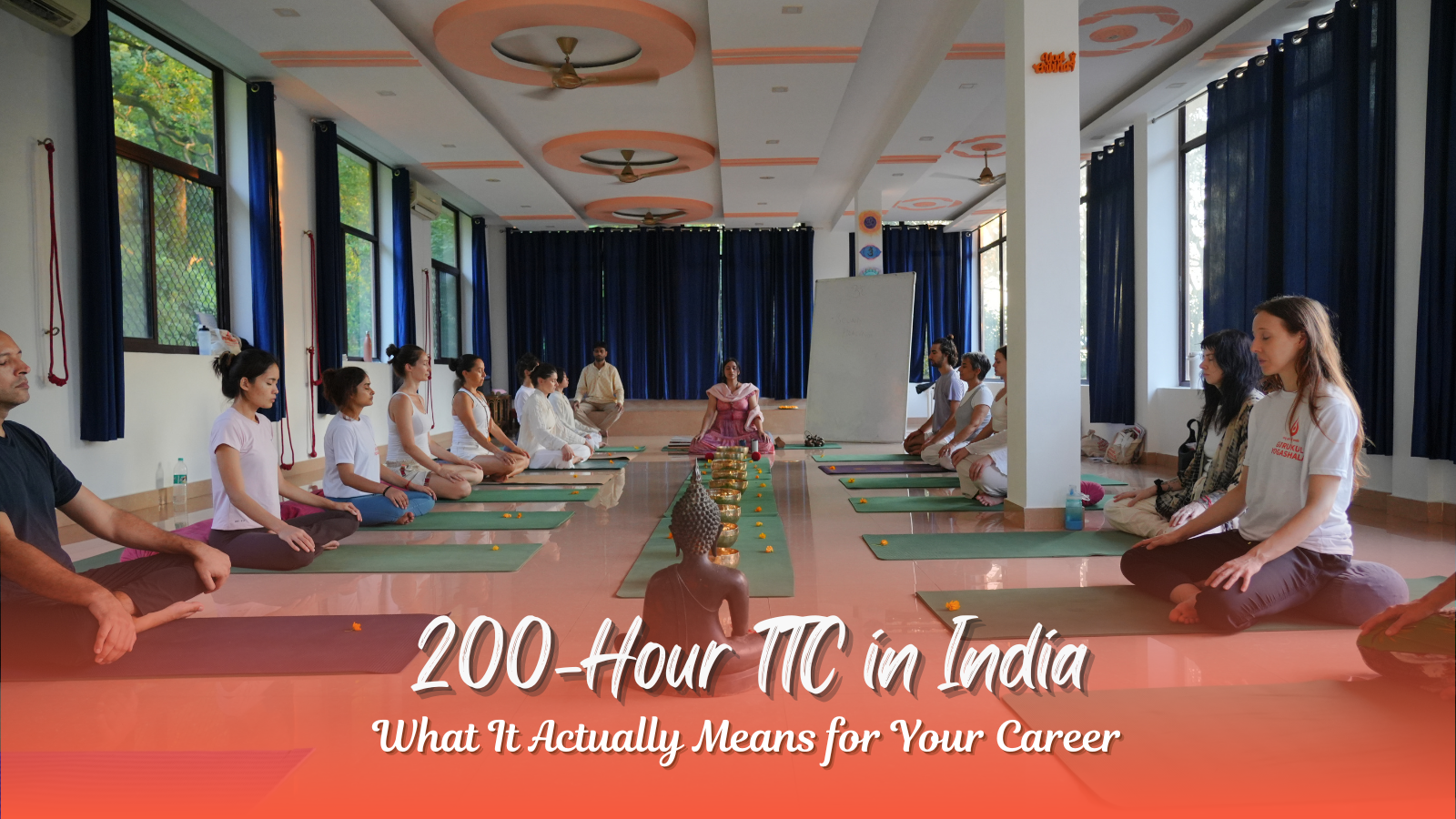
200-Hour TTC in India

Yoga Alliance Certified 200-Hour TTC in India: What It Actually Means for Your Career

The term “Yoga Alliance certified” shows up on many course brochures, but few students dare to ask what it really stands for. When you’re considering a 200-hour Yoga Teacher Training in Rishikesh, it makes sense to know the ins and outs of the title – what the certification implies, what it really covers & how much it’s worth in terms of teaching opportunities back home. All of that is covered in this guide based on our observations of our graduates from Gurukul Yogashala. 

What Does “Yoga Alliance Certified” Actually Mean?

Yoga Alliance is a nonprofit that operates out of the United States and sets standards for yoga schools’ curricula. It keeps a public registry of schools and teachers that meet those standards, but it does not accredit or license anybody legally in the way that the state does. Knowing this difference is helpful when it comes to choosing a good 200-hour yoga TTC in India, because the certification is more of an indicator of the program’s quality rather than a government-approved license. A school that offers its 200-hour yoga teacher training in India according to Yoga Alliance standards can call itself an RYS 200 (Registered Yoga School) and its graduates – RYT 200 (Registered Yoga Teachers). 

This means that the curriculum of the school has been analyzed to see how many hours are specified for the learning of different methods and techniques, teaching methods, anatomy and physiology, and yoga philosophy and ethics. This is helpful information for prospective students and is often used as a minimum qualification for hiring teachers in studios and gyms. 

What You Actually Learn in a 200 Hour Yoga TTC in India

A good 200-hour yoga teacher training course in India can last anywhere from three to four weeks and cover much more than just practice of asanas. At Gurukul Yogashala, our 22-day course has:

  • Asana practice in several styles like Hatha, Ashtanga, and Vinyasa so that our graduates can teach different class formats
  • Pranayama and meditation, which include techniques of breathing and seated practices both in theory and practice
  • Anatomy and physiology as the science of movement, as well as the places of injury
  • Yoga philosophy concerning the Yoga Sutras, the eight limbs and the ethical code of practice
  • Teaching methodology, which comprises cueing, sequencing, hands-on adjustments, and running the class effectively.

This is the aspect that distinguishes a program from a yoga retreat. It is the methodology that allows one to find a job as a teacher rather than merely be a good practitioner. 

Why Train in India Specifically?

India remains the most imaginative choice for this type of education, and Rishikesh is the town that has turned itself into its own identity. Picking a standard 200-hour yoga TTC in Rishikesh is synonymous with doing the studies nearly side by side with the Ganges and the foothills of the Himalayas, being part of a living culture, not practicing in studio settings. Many students are on the lookout for the unique opportunity to undergo 200-hour yoga teacher training in India because this kind of approach – life, study, and practice – can speed up the process of learning as no other program can do.

Nevertheless, we should not forget about the fact that even though India is the most attractive choice, it is not the only choice. Students who may not want to go straight for the 200-hour certificate may get started with 100-hour yoga teacher training India instead. 

Does It Actually Help Your Career?

Here’s a straightforward answer: certification provides opportunities, but it doesn’t guarantee success. As per Yoga Journal’s own research regarding novice yogis, most of the instructors earn per class rather than get a fixed salary. It may also take a long time to establish solid income, considering one would have to accept many gigs, substitute for many classes, and work on a side hustle such as corporate wellness consultations. According to one experienced instructor, yoga teachers do not usually have fixed salaries, health insurance, or pension plans. Nevertheless, this is not a reason to skip the certification process – one should regard it as an entry-type qualification rather than a final one. 

The training most effectively leads to gains in one’s personal and professional development. The results of a peer-reviewed observational study of a long-term yoga teaching training program indicated significant progress of the participants in terms of psychosocial prosperity. The authors of the study concluded that the results of the test measuring human flourishing have changed considerably more than the overall scores of psychosocial states of the participants. However, no significant shifts have been recorded in perceived social support, quality of life, and self-efficacy of the participants after three months since the completion of the program. 

Where to Train: Choosing Your Program

If you are ready to dive in, then the 200-hour yoga training in India program is created according to the outline mentioned above, consisting of, among other things,multi-style asana and philosophy, anatomy, as well as hands-on teaching practice in a residential environment on the riverbank of the Ganges. Those who prefer to take baby steps may find the 100-hour yoga teacher training India course a more convenient way of starting to develop their practice.

For those who are not ready to get certified yet, a yoga retreat Rishikesh program offers a similar daily routine including practice, meditation, and theory without tests and teaching practice – a good idea to try out yoga training in Rishikesh before deciding if certification is right for them. 

Final Thoughts

While a 200-hour yoga TTC in India accredited by Yoga Alliance cannot guarantee you a job, it will still provide you with something even better: an actual course, a valid qualification as well as extensive experience that is hard to match with evening lessons offered at home. What you will achieve after that will depend on you. Please invite you to join us at the Gurukul Yogashala in Rishikesh, where you will have an opportunity to study with authentic yoga practitioners. 

Frequently Asked Questions

What is the eligibility to join a 200-hour yoga TTC in India?

Generally, schools such as ours do not ask for previous teaching experience or academic qualifications before you can join a 200-hour yoga teacher training in India. After a few months of practicing yoga at home, you will be ready to enroll. Age restrictions usually apply (the minimum age is usually 18); however, the program itself will help you begin your practice from an adequate starting point. 

How much does a 200-hour yoga teacher training in India cost?

The price of a 200-hour yoga TTC in India is determined by several parameters, including the place of training and living arrangements. For example, at Gurukul Yogashala, the 22-day course costs somewhere between USD 649 for a shared room and USD 1,349 for a single room. Overall, prices for courses in India are more affordable than for the same courses in North America and Europe because of the lower cost of living.

Is a 200-hour YTT certification from India recognized internationally?

Yes, provided that the yoga school is registered with Yoga Alliance as an RYS. If you pass the 200-hour yoga teacher training course at the RYS, you will get the RYT 200 qualification recognized by studios, gyms, and wellness centers worldwide, since Yoga Alliance’s standards are applied consistently regardless of where the school is located.

Do I need a visa to attend yoga teacher training in India?

Indeed. The majority of students travelling to India will use e-Tourist Visas as these are available to any applicants planning on attending a short-term yoga course at any yoga school. The specifics of the visa depend on the student’s destination country and the exact duration of their yoga program of choice. According to the official Indian government e-Visa website, attending a short-term yoga course is one of the many purposes of participation in the e-Visa program. We recommend that you check the specific requirements for entry into India relating to your particular nationality before booking your flight.

What’s the difference between a 200-hour and 300-hour yoga TTC?

The 200-hour course is the basis of the yoga teaching certification. The 300-hour course, on the other hand, is the advanced program designed for students who have completed their 200-hour course and are already RYT 200 certified. This course covers advanced topics and gives aspiring yoga teachers greater teaching skills.

Can a complete beginner join a 200-hour yoga TTC?

While it is possible for complete newbies to join the course, usually the first week is designed to help them create a solid basis for learning. 

What’s included in the course fee – accommodation, meals, and excursions?

At Gurukul Yogashala, the price of the course is calculated taking into account accommodation, meals, and learning assistance. Cultural tours are also expected to be conducted, but tourists must find out details before they book.

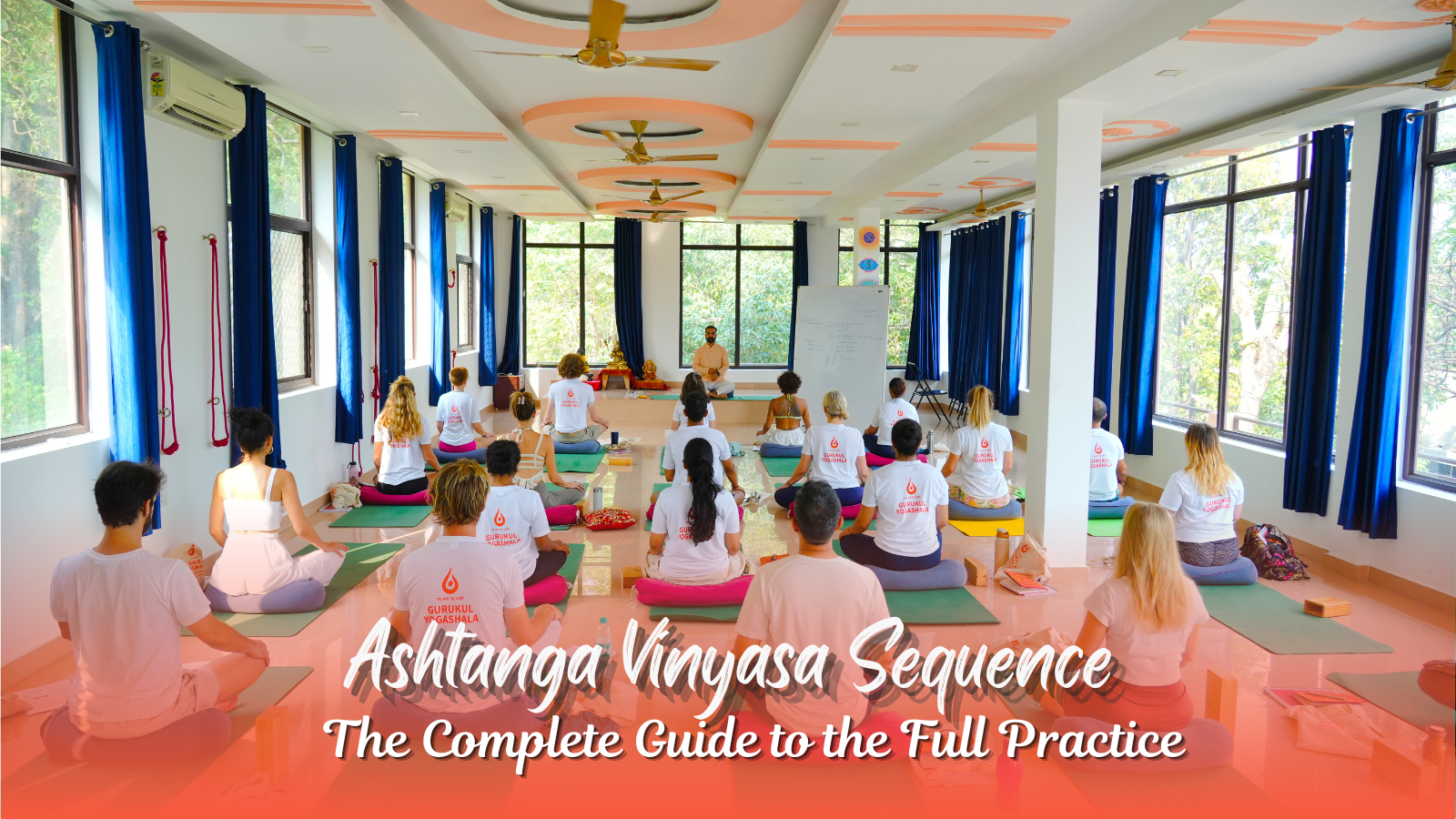
Ashtanga Vinyasa Sequence: The Complete Guide to the Full Practice

Ashtanga Vinyasa Sequence: The Complete Guide to the Full Practice

One can enter an Ashtanga facility early in the morning, and straight away, one can see the constant repetition of the Ashtanga movements – not that it appears to be too tense, but rather because everything is carried out with great reliability. Very few people are left wondering what happens next. The jumping-back stages and every inhalation are defined by centuries of traditions. This precision is what the entire Ashtanga Vinyasa sequence is focused on – a style where breath and exercise are perfectly combined for perfect meditation. Coming from the experience we gained while teaching at Gurukul Yogashala, this guide will explore what the vinyasa sequence is and how it works in practice. 

What Does “Vinyasa” Mean in Ashtanga Yoga?

The term “vinyasa,” in modern yoga, is often misused, yet when one refers to Ashtanga yoga, the term carries a precise interpretation. Vinyasa also refers to those series of breath-and-body movements linking one asana to the next, such as jump back, Chaturanga, Upward-Facing Dog, and Downward-Facing Dog, as well as others. Practitioners use vinyasa to enter and exit each Ashtanga vinyasa yoga sequence, and every movement is related to a certain breath – which means that one move corresponds to one inhale or exhale.

The concept of “vinyasa krama” is derived from the teachings of Tirumalai Krishnamacharya – the founder of modern yoga – who first introduced this system of movement related to the breath. Later on, one of his students, K. Pattabhi Jois, integrated this teaching into the classical method of Ashtanga yoga at his shala located in Mysore, India. 

The Structure of the Full Ashtanga Vinyasa Sequence

Unlike free-flow vinyasa classes, which vary their order of poses daily, the Ashtanga yoga vinyasa sequence comprises fixed steps. Each class follows the same plan of action:

Opening chant – usual Sanskrit chant to announce the beginning of a class

  • Sun Salutations A – 5 rounds of Surya Namaskara A followed by 3-5 rounds of Surya Namaskara B to create heat
  • Standing series – as the name suggests, this series uses standing poses to strengthen and enhance the balance and flexibility in the hips, hamstrings, and spine.
  • Seated sequence –  series-related postures that vary depending on the series
  • Finishing sequence – backbends, inversions, and meditation. This last sequence is identical for all six series.

Since the ending and opening sequences are fixed, only the middle sequence differs from series to series. This is what makes the Ashtanga vinyasa sequences – Primary, Intermediate, and four Advanced variants of Ashtanga vinyasa sequences – share a common principle while still being challenging in different ways.

Ashtanga vs. Vinyasa: What’s Actually Different?

This is a common point of confusion among students, so it’s important to clarify it. The main distinguishing feature of vinyasa yoga (the major difference between vinyasa yoga and ashtanga yoga fixed sequence) is predictability. Ashtanga practice is built around one fixed sequence of postures that is repeated in every class so that it’s possible to measure an individual’s progress in many months or years of regular practice. Vinyasa yoga, however, utilizes the principle of combining movement and breathing, just like Ashtanga yoga does, but gives freedom to the instructor to create a new sequence of moves for every class. As far as gene food (genetic code) is concerned, both types of yoga have similar characteristics (synchronized flow based on the principle of breathing), but only the Ashtanga vinyasa flow sequence is characterized by the use of the same series of poses in all classes. 

The Vinyasa Count: Why Every Breath Is Numbered

One thing that catches many new practitioners off guard is that Ashtanga Vinyasa Yoga’s primary series sequence is more than just a Path. The sequence is to be counted, since each yoga position has its own number of breaths, called vinyasa count. The number of breaths in any position is fixed and therefore begins and ends at Samasthiti (standing position). Old-school teachers, like Pattabhi Jois and his grandson Sharath Jois, used to count the positions out loud in the Sanskrit language during classes. Thus, every motion has a corresponding number in the sequence. So learning the counting is about being able to calculate the count, rather than simply memorizing the number of breaths required for each of the positions. 

Why Is Breath Synchronized With Movement in Ashtanga Vinyasa?

The breath-movement connection is not merely a matter of tradition; existing scientific evidence shows that this connection has a measurable physiological impact. In 2023, a randomized crossover study published in PLOS ONE reported cardiovascular and autonomic responses to a one-hour session of vinyasa yoga compared with prolonged sitting in healthy adults. It was found that systolic blood pressure decreased by 8.14 mmHg five minutes after the yoga session when compared to the sitting control. In addition, heart rate remained elevated at 5 and 65 minutes after the session, which indicates that vinyasa yoga is a moderate-intensity activity rather than a purely relaxing practice. Thus, the findings confirm what practitioners have been reporting for a long time, namely, that continuous movement in Ashtanga yoga coupled with controlled breathing is an effective way to develop cardiovascular capacity while experiencing calming and concentration-enhancing effects of breathing exercises. 

How Many Series Are There in Ashtanga Vinyasa Yoga?

There exists a total of six series – the Primary Series (Yoga Chikitsa, that means yoga therapy), the Intermediate Series (Nadi Shodhana, which serves the purpose of cleaning the nervous system), and four Advanced Series (Sthira Bhaga A-D) for those who have reached the highest level of yoga practice. None of the students and only a few teachers in the whole world have finished the Advanced series, and their progress through the whole system has always been purposely slow and careful, as Yoga Journal records that the new postures can be offered only after the previous ones become stable. As it is told in the archives of Yoga Journal, the fascinating and exhausting style of Ashtanga, which was taught by Pattabhi Jois, was famous years ago for its ability to change the lives of those who were brave enough to do it.

What Is the Correct Order of the Ashtanga Vinyasa Sequence?

The sequence is fixed and cannot be changed in any series, and it always consists of the same steps: chants for the opening of the practice, the Sun Salutations A and B, the standing poses, the series of the seated postures, and the final sequence of backbends inverted.

Is Ashtanga Vinyasa Suitable for Beginners?

Certainly, along with good instruction. Although the whole sequence may seem difficult, beginners won’t be able to do it from the very first try anyway. Mysore-style instructors, as well as ours, teach a few poses at a time sequentially, and that’s why this method has been working for ages, allowing newcomers to try yoga in practice despite its complexity. 

A Printable Reference: The Sequence in PDF Form

Many students are looking for an Ashtanga Vinyasa Yoga sequence PDF file to understand how to proceed with the asanas, names, and number of postures from one lesson to another. There are downloadable charts that can help you once you’ve already mastered the sequence from a trainer. But this method can never be a substitute for an actual lesson. Certain postures and transitions can be done incorrectly without proper instruction and the help of an instructor, so any PDF chart should be viewed as an additional tool for learning rather than the main source of information. 

Where to Learn the Full Ashtanga Vinyasa Sequence

For those who truly wish to go beyond their self-taught home practice and want to delve deep into anatomy, breathing techniques, and the history of the sequence, formal yoga training in India is the best option, which is what our courses at Gurukul Yogashala are focused on. We have a 200-hour yoga teacher training in Rishikesh that qualifies students for certification and a 100-hour yoga teacher training in Rishikesh for those ready for a less intense and demanding experience. In case you are particularly interested in Ashtanga, our Ashtanga Yoga Teacher Training in Rishikesh will meet your needs.

For those who don’t want to get into a serious certification program, a yoga retreat in Rishikesh would be an easier way to explore yoga through proper practice, breathing exercises, and philosophical studies, without worrying about exams. Rishikesh, situated on the bank of the Ganges River and at the foot of the Himalayas, is one of the centers of yoga in the world, and this is why yoga training Rishikesh attracts numerous students every year from all corners of the planet. 

Final Thoughts

Patience is more important than flexibility in the ashtanga vinyasa sequence. This is a practice that develops over years, not months, and what initially feels like restriction takes on a new meaning as one becomes able to see their progress and trace how they have developed. The underlying principle remains the same, whether one learns the sequence through a home printout of the chart or in a yoga school: the sequence proceeds a breath at a time. 

Frequently Asked Questions

What does “vinyasa” mean in Ashtanga yoga? 

According to the tradition of Ashtanga yoga, vinyasa describes the detailed movement coordinated with breathing – usually, these are the transitions between poses that include the jump back, Chaturanga, Upward Dog, and Downward Dog postures.

What is the difference between Ashtanga and Vinyasa yoga? 

While Ashtanga involves only one specific permanent sequence, in Vinyasa yoga the instructor can alter the sequence because the teaching philosophy is the same.

What is the standard vinyasa count between poses? 

All postures have a certain number of breaths, also called the vinyasa count; the motion and the end of the count being the Samasthiti pose.

How many series are there in Ashtanga Vinyasa yoga? 

There are six series in total: Primary Series, Intermediate Series, and 4 Advanced Series. 

What is the correct order of the Ashtanga Vinyasa sequence? 

The Ashtanga Vinyasa sequence includes the opening chant, both the Sun Salutations A & B, all standing postures, the seated series postures, and a final sequence including backbends, inversions, and relaxation.

Why is breath synchronized with movement in Ashtanga Vinyasa? 

The synchronization of breath and movement assists in controlling the pace of practice, helps regulate the nervous system, and has been found in various studies to produce discernible cardiovascular and autonomic responses in addition to contributing towards a better ability to concentrate and generate internal heat.

Is Ashtanga Vinyasa suitable for beginners? 

Yes, it is. The students are taught a few postures first with the aid of a teacher instead of being expected to learn the full sequence immediately. 

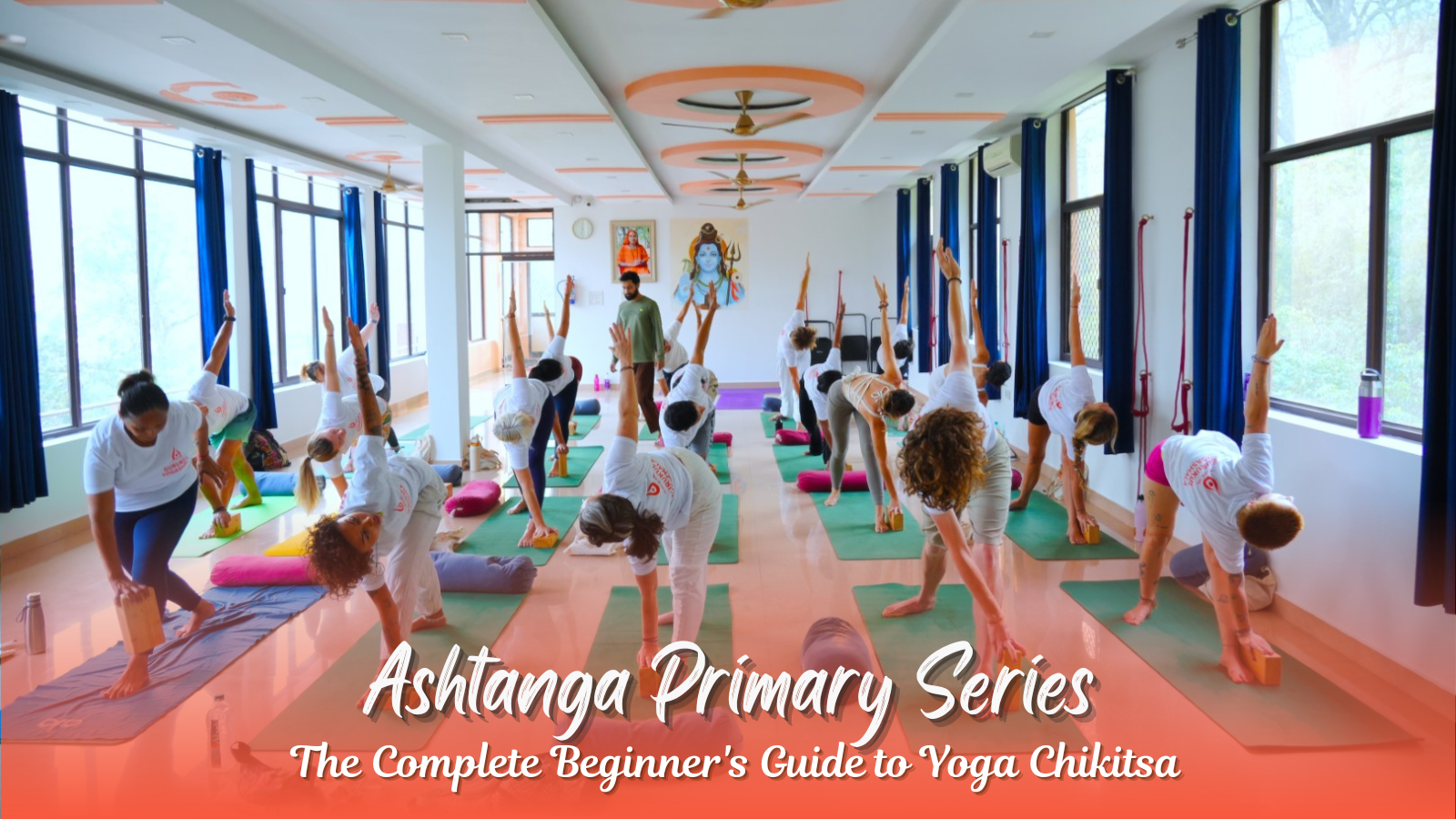
Ashtanga Primary Series

Ashtanga Primary Series: The Complete Beginner’s Guide to Yoga Chikitsa

If you have stepped into one of our Mysore-style rooms at 6 in the morning and watched rows of students perform the same sequence almost silently while breathing nearly identically, then you got to observe this fixed sequence in action. It is considered one of the most rigid, misunderstood, yet transformative practices in contemporary yoga. From the entrance, it may even appear rather daunting for a beginner. The content of this guide, created based on the knowledge that we impart to students at Gurukul Yogashala, will give you the answer to the question of what the Ashtanga Primary Series means, why it is called Yoga Chikitsa, how to perform it, and how to start your journey of mastering this practice.

What Is the Ashtanga Primary Series?

 Ashtanga Primary Series is the first sequence out of six within the Ashtanga Vinyasa system – a system of yoga that was defined in Mysore, India, by the famous K. Pattabhi Jois in the 20th century, following the teachings of his own guru Krishnamacharya. Unlike many modern yoga classes, during which the sequence is changed every day, the Ashtanga primary series is not variable, meaning that the same postures are performed every day.

The fixed system is not arbitrary in nature. Every pose used in the primary series of Ashtanga Vinyasa Yoga is meant for the preparation of the body for the next pose in the series. This allows heat to build in the body and the hips and hamstrings to be released while slowly progressing through the spine in a typical series of movements, including forward bends, back bends, and twists. Some students also know the sequence by its search-friendly nicknames – primary series Ashtanga or  Ashtanga Primary Series -, but it’s all the same set of postures underneath the spelling variations.

What Is Yoga Chikitsa, and Why Is the Primary Series Called That?

In the Sanskrit language, “Chikitsa” signifies “therapy” or “healing” in English, meaning Yoga Chikitsa represents “yoga therapy.” This name has been derived from the ability of this series to detoxify the body, the effects of which are also taught in detail in our residential programs. The structure of the series, along with its combination of the deep forward bends, twists, and heat produced in the body, enables the body to flush out the stagnant energy and also bring about the correction of postural problems that have accumulated over time. 

It is important to keep in mind that “therapeutic” should not be confused with “easy.” In fact, many experienced practitioners will affirm the irony that it is one of the six series that requires a lot of commitment and energy, for it asks the body to transform itself by stimulating the hamstrings, making the spine more agile, and enduring stressful moments for at least 90 minutes.

How Many Poses Are in the Ashtanga Primary Series?

In terms of the number of asanas in the complete sequence of Ashtanga yoga, traditional references suggest that the number of asanas can be pegged around 41; that said, the actual figure may differ based on how transitional postures are counted in the calculation and whether you consider one side of an asymmetrical pose. The Ashtanga poses in the primary series have specific features.

Among the mentioned poses, we can identify:

  • The opening sequence and the Sun Salutations – five sets of Surya Namaskara A and three to five sets of Surya Namaskara B to warm up
  • Seated postures including Trikonasana, Parsvakonasana, Prasarita Padottasana, and balancing poses like Utthita Hasta Padangusthasana
  • Seated postures which have a greater number than the mentioned ones, including sitting forward bends with Paschimottanasana, various twisting poses, hip openers, and the pose in which the legs are behind your head
  • The closing poses include backbends, inverted poses like Sarvangasana, and the final meditation sitting down.
  • All parts of the Ashtanga yoga primary series are connected with vinyasa.

The Role of Breath, Bandha, and Drishti

Three components unite the entire Ashtanga Primary Series. It is important to know about these three elements rather than learn the sequence of all postures.

  1. Ujjayi breathing is a type of breathing that is produced such that it resembles ocean waves, helps calm the nervous system, and regulates the tempo.
  2. Bandhas are the name of the muscle locks, which include mainly the Mula Bandha (the pelvic floor) and the Uddiyana Bandha (the abdomen). This element helps support the spinal column and creates inner heat.
  3. Dristhi is the point you focus on while performing each posture. It also helps in learning how to concentrate.

All in all, these three elements integrate the idea of doing a physical workout and meditating at the same time. No wonder our teachers always tell us how useful this practice is for the body and mind.

Benefits of Practicing the Primary Series

In addition to conventional claims about yoga therapy, there is now a vast number of studies confirming its healing properties. According to the National Center for Complementary and Integrative Health, many studies find evidence that yoga is useful for stress relief. For example, a 2020 review article looking at many studies on yoga indicates that each of the twelve studies examined confirms that yoga practice leads to improvement in perception of stress.

Other reviews point to the relationship between yoga and improvement in mental wellness and resilience. The findings of a 2020 review of twelve research papers on all kinds of yoga for healthy adults prove that every study supports the idea that yoga is efficient in improving perception of stress. In addition, findings of a 2018 review focusing on yoga and positive effects on mental health show that yoga improves resilience of an individual and improves mental welfare. 

Is the Ashtanga Primary Series Good for Beginners?

Yes – if you have the right mindset. The name is a bit misleading. In this context, “Primary” does not mean “easy” but rather “the first in the sequence.” However, beginners are encouraged to attend primary classes, and most Mysore-style teachers (including ours) only give some asanas at a time and introduce new ones as soon as your body and breathing allow. You should not expect to complete the full series on your very first day (or even in the very first months). The method is supposed to be learned gradually with the help of instructors. 

Led Class vs. Mysore-Style Class: What’s the Difference?

  • Led class: In this style of yoga practice, the instructor guides the students through the poses and counts aloud. This approach is beneficial for beginners because it simplifies the learning of the sequence and counting system (traditionally in Sanskrit) in a group environment.
  • Mysore-style class: In this style of yoga practice, the student practices independently at their own pace and is given individualized attention by the instructor. This approach allows for personal development without the hindrance of group practice.

Most practitioners at our school choose to do Mysore-style yoga for their daily practice and go to take a led class once a week, usually on a Friday or Saturday, to keep in touch with the counting system. 

How Often Should You Practice the Primary Series Each Week?

Ashtanga Yoga usually involves training five times a week, with weekends resting, as well as on the day that comes with an optional led class. However, for a beginner, it’s neither a comfortable nor a practical routine to stick to. Ideal practice sessions will take place at the rate of approximately 3-4 per week, which will leave some time for recovery after training. 

Where to Learn: Yoga Teacher Training in India

If you want to move beyond practicing yoga at home and actually grasp the theory of anatomy, philosophy, and teaching methodology concerning it, formal yoga teacher training in India remains the best option – which is exactly what Gurukul Yogashala provides in its programs. It offers a 200-hour yoga training in India for people who wish to receive full certification or the 100-hour yoga teacher training India program for those who just want to start learning yoga but are not ready for a full commitment. If your main interest is Ashtanga, you can sign up for our Ashtanga Yoga teacher training in Rishikesh that is based entirely on this tradition.

India remains the most immersive place where this tradition can be actually lived out, and especially Rishikesh. A yoga retreat rishikesh program combines a daily practice of pranayama, meditation, and Vedic philosophy, all amid the breathtaking scenery of the Himalayan foothills and the Ganges – the very place where our ashram is situated on Laxman Jhula Road. Rishikesh is well-known around the globe for being the center of yoga, having attracted yogis, sadhus, and spiritual seekers over the ages. 

The famous band The Beatles popularized the little town of Rishikesh in 1968 with their visit to the ashram of Maharishi Mahesh Yogi. Recently, this sacred city on the banks of the Ganges has also become renowned for its outdoor recreation. Presently, yoga training in Rishikesh provides everything from short retreats to advanced certification courses, making it a famous tourist destination for people who want to practice yoga more seriously. 

Ashtanga Primary Series PDF: Should You Use One?

A downloadable printable chart is an excellent resource to refer to when you already know yoga practices. This can help you to double-check the order of poses before practicing at home or remind you of the names in Sanskrit. An Ashtanga Yoga Primary Series PDF is the first thing a beginner usually looks for, but it should never be considered as an alternative to practice with a teacher in the beginning stages. Indeed, some poses, for example, Marichyasana D and Supta Kurmasana, can be difficult to perform correctly without an instructor overseeing you. We give our students an Ashtanga primary series PDF after they have completed training with a teacher. 

Final Thoughts

Practicing yoga requires one to be patient. This is a sequence that doesn’t give results quickly. You won’t master this practice in a month or even a year. The practice progresses into a routine, posture by posture and breath by breath. It begins with something you have never tried, but gradually turns into something that you already know. It becomes a kind of routine you can come back to at any moment, be it in good or bad times. You can learn yoga in a local studio, during a certified 200-hour yoga teacher training course, or even during dedicated yoga retreats. The principle remains the same: come, breathe, and let the practice do its magic. 

If you are serious about mastering yoga the right way with true yoga professionals, feel free to visit Gurukul Yogashala in Rishikesh

Frequently Asked Questions

What is the Ashtanga Primary Series? 

It is considered the first of six series in the Ashtanga Vinyasa sequence, which consists of the Sun Salutation A and B, the standing postures, the seated postures, and a final sequence of poses, which are practiced in an ordered manner.

How long does it take to learn the full Primary Series? 

This could differ a lot from student to student. In general, it would take individuals one to three years to work through the whole Primary Series. New poses can only be learned when one has mastered the previous ones.

What is Yoga Chikitsa and why is the Primary Series called that? 

The term ‘Yoga Chikitsa’ means ‘yoga treatment’ in Sanskrit. The title is given to the series because a variety of poses help to detoxify and restore the body.

How many poses (asanas) are in the Ashtanga Primary Series? 

Normally, the Primary Series consists of about 41 asanas, including the Sun Salutations, the standing poses, the sitting postures, and the closing poses.

Is the Ashtanga Primary Series good for beginners? 

Yes. Beginners start here by design, typically learning a few postures at a time under teacher guidance rather than attempting the full sequence immediately.

What’s the difference between a led class and a Mysore-style class? 

In a led yoga class, students follow their instructor, who tells them what to do. Conversely, in a Mysore class, although the instructor teaches the class, students practice independently based on their preferences.

How often should you practice the Primary Series each week? 

It is recommended to practice every day except on moon days, although beginners might start with three to four times a week and build their practice thereafter.

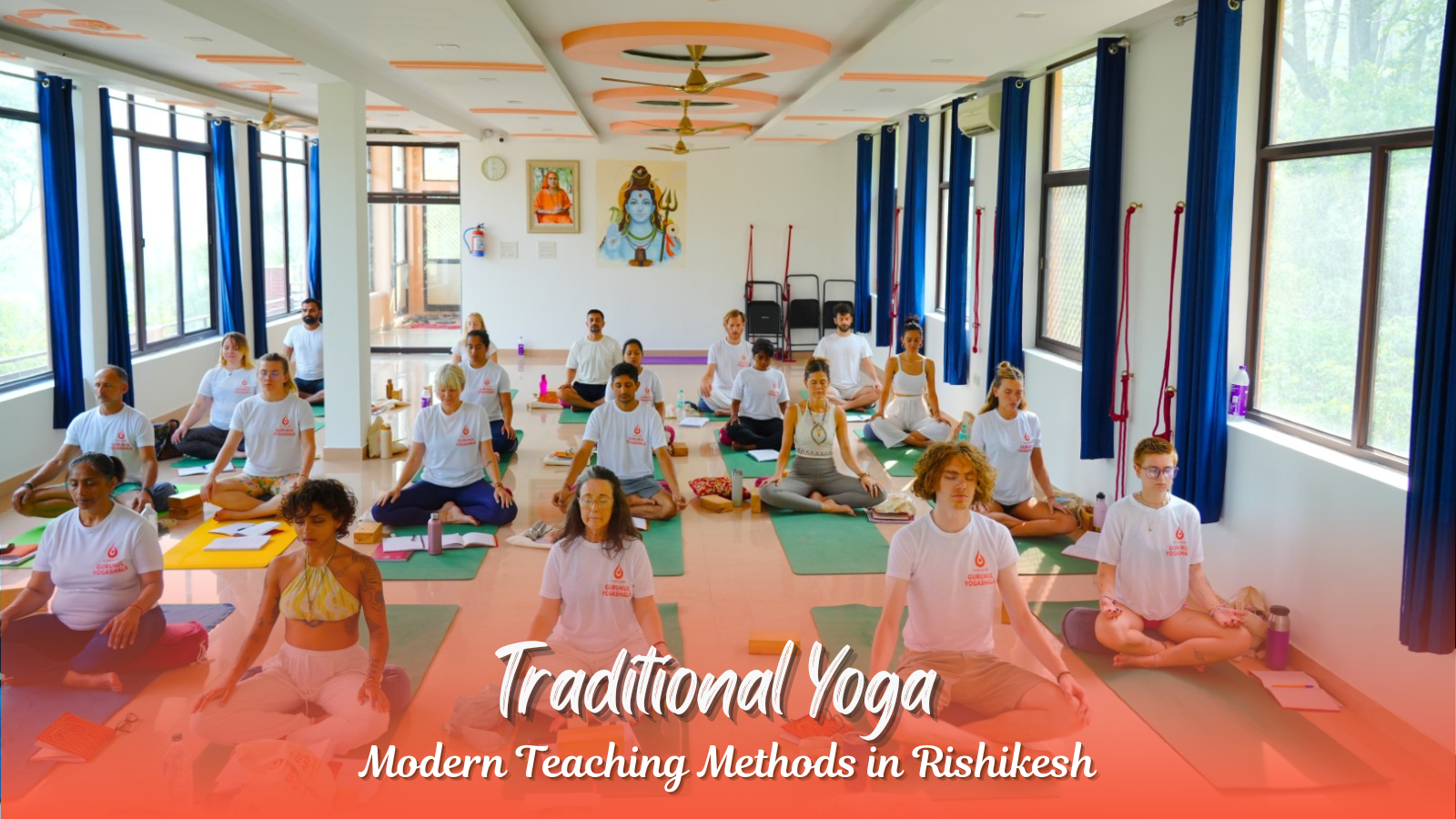
Traditional Yoga and Modern Teaching Methods in Rishikesh

How Does Gurukul Yogashala Combine Traditional Yoga and Modern Teaching Methods in Rishikesh?

When you set out to find a quality school for yourself, one of the most common questions that you will encounter is: “Will I learn yoga at this place or will I simply be going through the motions?” It is a legitimate question, given that there are so many different types of yoga classes and countless locations offering them. The majority of these establishments possess only one element of both ancient wisdom and contemporary knowledge.

At Gurukul Yogashala, located in the center of Rishikesh’s spiritual community, the blending of the two is not merely part of their advertising hype; it is the very premise from which they construct each class, each lecture, and each student’s growth.

With this article, we will take a closer examination of how Gurukul Yogashala offers a combination of these two worlds, and why this combination is essential for anyone interested in learning how to practice yoga correctly. 

What Does “Gurukul” Actually Mean?

Gurukul is made up of 2 Sanskrit words: Guru (teacher) and Kul (family), so a Gurukul was a school, but much more than that; This was a way of life. Students learned in person with their teacher, and through doing things daily, they created actual connections with others and gained knowledge through lived experiences instead of receiving it passively (i.e., by listening). 

The traditional Indian educational system indicates that in a Gurukul, education was complete, and there was no longer a distinction (boundary) between “class time” and “life.” Rather than taking courses, you became another type of person.

The same spirit of the Gurukul tradition is alive and well at Gurukul Yogashala in Rishikesh. Here, yoga is less about being studied as a subject and more about becoming the essence of who you are. 

The Traditional Roots: Why They Matter

In its original Vedic context, yoga has always been much more than just exercise. Yoga was designed to develop all three aspects of a person simultaneously (mind, body, and spirit) as part of an integrated whole. This complete and integrated model of development through yoga was emphasized by the Gurukul system in ancient India.

The Gurukula system of education, which forms the basis for yoga training today, was based on the strong bond between teacher and student. This student-teacher relationship provided the foundation for the development of the student’s mind, body, and spirit, in addition to simply being educated academically. While being trained academically, students also learned how to live a disciplined life. They were taught moral principles and the skills necessary to survive in society, all while practicing yoga as an integral aspect of providing mental clarity, physical well-being, and spiritual growth.

At Gurukul Yogashala, the yoga training offered is based directly on the principles established by the Gurukula system. Hatha Yoga, Ashtanga Yoga, Vinyasa, Pranayama, Meditation, Mantra chanting, and Philosophy of Yoga are taught in an integrated way, totally connected to the practice of yoga – just as they were originally intended to be taught.

Immediately, students will understand that getting up early in the morning to do their practices, eating Sattvic diet in the group, and being consistent with their daily schedule are not obstacles to their learning or personal development- rather, they are key components of their education. The structure is considered the curriculum. 

The Modern Layer: Teaching That Works Today

To honour a tradition is not to deny what we have learned from science, but rather to give an even greater respect for the ancient ways in which yoga has been used based upon the results of modern studies.

Recently published studies in the Journal of the National Institutes of Health and PLOS ONE have shown that persons who participate in a residential Yoga Teacher Training Program demonstrate improvement in the following areas related to Memory and Mindfulness:

1. Observation;

2. Awareness;

3. Non-Reactivity (not reacting to your feelings and emotions).

This suggests that practitioners of yoga develop a more refined skill for paying attention to their own inner experiences through intensive practice.

Also, a study comparing the Gurukula Education System (GES) and modern education (MES) using PubMed as the source demonstrated that students who receive education using GES have demonstrated superior visual and verbal memory scores than those taught under MES; thus validating what teachers of ancient times have taught regarding the process of deep learning. 

Traditional practices are combined thoughtfully with modern teaching tools at Gurukul Yogashala. These include anatomy and physiology sessions that describe the reasons each asana has its effect on the body, methodology classes that teach students about sequencing, cuing, adapting poses for different bodies, and creating a functioning classroom environment, and an evidence-based approach to pranayama in terms of both the Vedic interpretation of breathing techniques and their neurological effects.

Thus, it is not a matter of separating traditional yoga from modern science, but rather a combination of both together. 

How This Shows Up Across Every Programme

100 Hour Yoga Teacher Training in Rishikesh

Yoga Teacher Training in Rishikesh, India is available in a variety of formats: 100 hours, 200 hours, and 300 hours. A 100 Hour Yoga Teacher Training in Rishikesh is an entry-level program that provides an introduction to Yoga according to Gurukul traditions while teaching Asana, Pranayama, and Yoga Philosophy in a structured way.

200 Hour Yoga Teacher Training in Rishikesh India

The 200 Hour Yoga Teacher Training in Rishikesh, India is an internationally recognised course and is designed to provide students with an understanding of how to teach Yoga effectively. It combines traditional styles of Yoga (Hatha and Ashtanga) with modern Anatomy, Teaching Practicum and Professional Development to teach students how to teach Yoga classes. The 200 Hour Yoga Teacher Training is the most popular Yoga certification in India, and for good reason: this is where the immersion, depth and practical readiness come together.

200 Hour Yoga TTC Rishikesh India + Prenatal Combo

The 200 Hour YTTC + Prenatal YTTC in Rishikesh, India Combo is a specially designed course for those who have completed their 200 Hour Yoga Teacher Training and would like to further their studies in Prenatal Yoga. In today’s world, Yoga teachers need to be capable of providing services to different populations.

300 Hour Yoga Teacher Training in Rishikesh

The 300 Hour Yoga Teacher Training in Rishikesh is tailored for you if you have completed your additional 200 hour training program and wish to continue studying Yoga. We study Advanced Asanas, the Subtle Body, and advanced philosophy of yoga, as well as Advanced Teaching Skills. 

500 Hour Yoga Teacher Training in Rishikesh

A definitive path is offered to dedicated students pursuing mastery of all facets. 500 Hour Yoga Teacher Training in Rishikesh is intended to guide you towards your highest potential by providing you with a solid foundation of knowledge and an environment in which to cultivate those principles.

Prenatal-Post Natal Yoga Teacher Training in Rishikesh

A unique combination of traditional yogic principles and contemporary reproductive health concepts will provide you with the resources necessary to support women during eight different kinds of pregnancy and postpartum experiences.

Sound Healing Yoga Teacher Training in Rishikesh

This advanced course takes an old practice, sound, and combines it with current research on vibrational therapy, including how it can affect the nervous system, and provides you with a variety of tools to use in your healing work.

14 Days Yoga Retreat in Rishikesh India

14 Days Yoga Retreat in Rishikesh immersion experience that allows you to relax, recharge, and reconnect to yourself through daily yoga practices (including asana and meditation), philosophy, as well as time spent among like-minded individuals. You will return refreshed with a newfound understanding of yourself and how to integrate the teachings of yoga into your daily life. 

The Role of Rishikesh Itself

Rishikesh is actively involved in the process of learning rather than simply providing a backdrop.

The location of Rishikesh, on the banks of the Ganges and surrounded by the lower Himalayas, has been a source of knowledge about yoga for thousands of years. The sacred landscape and the sound of the river, along with the morning mist and the distant temple bells, combine to create an environment that provides the perfect natural container to facilitate deep learning. This cannot be accomplished inside an urban studio.

Traditional gurukuls were often located in natural settings, such as forests, mountains, or by rivers, as they understood that nature is the ultimate teacher. Therefore, an environment conducive to learning provided students with opportunities to learn by observing directly and to create their own understanding of concepts through direct experience.

Gurukul Yogashala, located on Laxman Jhula Road in Rishikesh, continues in this tradition.

Why the Combination Matters More Than Ever

Modern students enter into yoga after leading very busy lives filled with busy jobs, high stress levels from city life, a lot of time spent looking at screens, and their attention is therefore very scattered as a result. They don’t just need stretching routines but rather what the Gurukul tradition has always provided-an opportunity for students to completely transition/reset themselves from these high-demand lives; the structure required to create a successful learning environment; an opportunity for students to create a supportive teacher-student relationship; and a daily practice that truly transforms one’s ability to think, as well as how they live.

At the same time, they also want to develop practical skills to carry with them out into the world: knowledge about anatomy so they can teach safely; linguistic skills so they can clearly articulate postural instruction to students; confidence required to lead a class of students; and lastly the certification necessary to pursue a career as a yoga instructor.

Gurukul Yogashala embodies both of these truths at once-great depth of experience from the traditional perspective and enormous reach beyond its traditional methods. 

The Bottom Line

When you want to learn yoga, there is only one way to do it: by living it-not just studying it. This has been the Gurukul way for thousands of years and is now supported by modern-day science. At Gurukul Yogashala in Rishikesh, Indian yoga teachers use a combination of traditional knowledge and modern techniques to train people using both methods at once; thus allowing them to combine authentic tradition with contemporary methods of training. 

This allows trainees to experience a complete balance of these two forms of yoga training. No matter whether you are just starting with a 100 hour program; looking for a more challenging 500 hour training series; need assistance with healing techniques through sound; pregnant and wanting to support your developing child; wanting to experience an authentic retreat style training (14 days) or want an opportunity to help you rediscover who you are through this journey-Gurukul’s system will meet you where you are now and take you far beyond where you thought possible. 

Frequently Asked Questions (FAQs)

1. What makes Gurukul Yogashala different from other yoga schools in Rishikesh?

The Gurukul Yogashala combines the traditional Gurukul model of immersive, relational, and holistic instruction with modern structured pedagogy, modern and traditional anatomy science, and a Yoga Alliance-accredited curriculum, providing the deepest traditional and the greatest amount of professional training for any student in a single course.

2. Do I need prior yoga experience to join a course at Gurukul Yogashala? 

Beginner students are welcome to the 100 hour and 200 hour programs, but it is helpful if they can do some physical practice before beginning the course (i.e., commit to learning). When assessing the students, the teachers will determine the appropriate level of support for the student based on where they are when starting.

3. Is the teaching at Gurukul Yogashala Yoga Alliance certified? 

Yes, courses at Gurukul Yogashala are Yoga Alliance accredited (students who complete the program can be registered with the International Yoga Alliance as an RYT) and are therefore available for teaching all over the world.

4. How does the traditional Gurukul method improve learning outcomes? 

 Research has shown that students who learn using the Gurukula Education System show improved retention, attentiveness, and overall well-being compared to those who have learned using the conventional education model. In this way, living the practice and not just studying it leads to greater integration of what was learned into the student’s life.

5. Can I take a short course or retreat if I am not ready for teacher training? 

Yes, you can take a mini course or retreat at Gurukul Yogashala if you are not ready to commit to teacher training yet; a 2-week-long Friday to Sunday yoga retreat is suitable and provides an experience in connection with the teachings of yoga without the same level of commitment as part of a teacher training course. Also available are sound healing and prenatal courses for individuals wishing to train in specialised fields.

6. What is a typical day like at Gurukul Yogashala? 

Typically at Gurukul Yogashala, the day starts with pranayama and morning asana followed by philosophy, anatomy lessons, teaching practicum, meditation, and evening Satsang. The daily rhythm contributes to your training by developing those habits of discipline and consciousness that characterise yogic living.

7. How does Gurukul Yogashala incorporate modern science into its curriculum? 

Gurukul incorporates modern science into its program by offering both traditional texts on anatomy, physiology, and biomechanics (of yoga postures) and the latest evidence-based findings confirming the neurological, physical, and psychological effects of the various techniques taught in all classes, thereby providing a comprehensive understanding of all areas of what is taught in class.

Yoga Teacher Training Course in Rishikesh India | Gurukul Yogashala

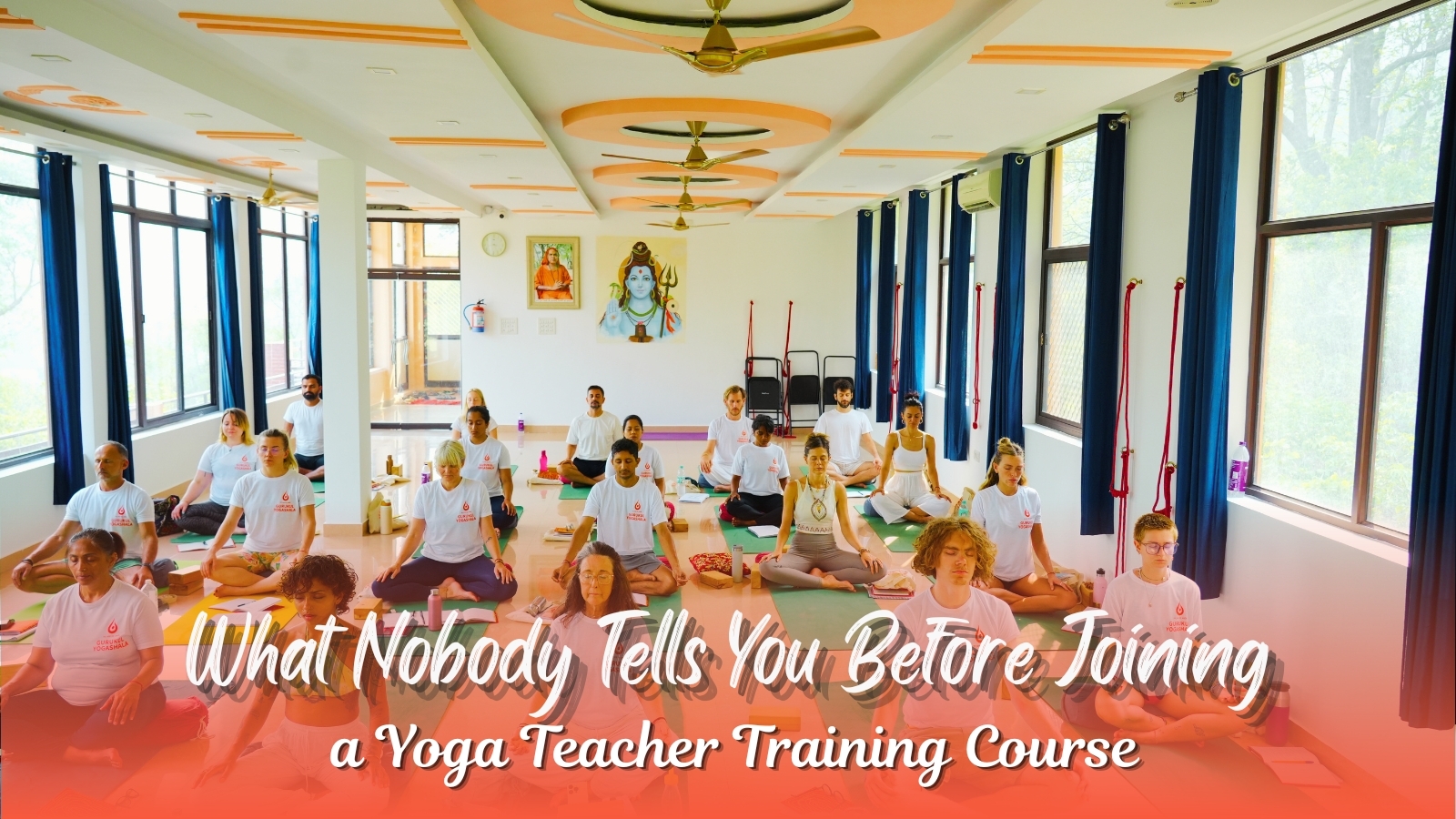
What Nobody Tells You Before Joining a Yoga Teacher Training Course

You’ve done your homework, looked through the yoga schools’ websites, watched some Instagram videos about them, and even had a good talk with yourself about whether this is the appropriate moment. You think you have an idea about what your experience will be like.

The reality is that the majority of all people who complete a yoga teacher training program will all tell you the same thing after finishing their training. “I didn’t realise it would be this way.”

Not in a bad way, rather, in an extremely good way; honest, occasionally uncomfortable and ultimately, life-changing. Here are a few items that you may have heard very little about prior to beginning your training. 

1. You’ll Learn More About Yourself Than About Yoga

While of course you will learn postures, breath control, body function and yoga philosophy, quietly, each of the above also has some other personal aspect which will occur at the same time — resurfacing. Old Patterns will arise, things that you have been avoiding will demand your attention; the peace and the silence that come from being in an ashram will help everything that has been hidden come back to the surface. 

This isn’t a warning; this is one of the most tremendous opportunities you will experience while you are participating in training. However, it may be helpful for you to be mindful of this prior to entering into training. 

2. The Yoga Teacher Training Schedule Is Intense, and That’s the Point

You will have early morning practices, theory lessons, pranayama, and evening meditation. Initially, this may seem overwhelming due to bodily changes and adjustments. The schedule’s layout is on purpose. The use of routine is one of the oldest tools of the yogic tradition, and will ultimately help you transition into thriving through your second week of Teacher Training.

Yoga Teacher Training in Rishikesh is an immersion experience beyond just simple classes; it is a full-time practising lifestyle. 

3. You Don’t Need to Be an Advanced Practitioner

Let me be clear: Many people wait to join because they think they are “not ready.” BothThe 100 hour yoga teacher training in Rishikesh is built for those new to yoga and therefore will offer the most basic yet thorough introduction to asanas, breathing, and philosophy. The 200-hour yoga teacher training in Rishikesh is the most popular global program and has absolutely no prior certification requirements. Simply show up and learn. Simple as that.

4. The Friendships You Make Are Unexpectedly Deep

You immediately develop deep connections with your peers after participating in the program because of the shared experiences of early mornings, having meals together, and sharing your feelings. Students come from all over the world and have diverse life experiences; however, by the end of the program, they frequently refer to their classmates as their most important relationships. Many students will continue to keep in touch long after the end of the program.

5. Philosophy Will Surprise You

Most people expect to improve their flexibility in yoga class, and some people (fewer) expect to fall in love with the Yoga Sutras of Patanjali while becoming inspired by a lecture about the Bhagavad Gita. The philosophy classes taught at the best Yoga Schools in Rishikesh are less about textbook theory and more about living wisdom shared by teachers who have actualised these principles for decades. 

6. You’ll Probably Hit a Wall — and That’s Normal

After around seven or eight days, many students experience a difficult time adjusting to their new routine. The excitement of being in a new place is no longer present, fatigue is beginning to take its toll, and individuals are starting to emotionally process their experiences. Teachers commonly refer to this stage of the program as crisis week, which denotes an opportunity for positive change. If you persevere through the challenges and reach the other side, you’ll likely find that you’re going to experience the best and most profound part of your training. 

7. Not Everyone Comes to Become a Teacher

A large number of participants coming to Rishikesh to take one of the 300-hour yoga teacher training in Rishikesh or the 500-hour yoga teacher training in Rishikesh have no intention of teaching professionally. Many of them want personal growth or to enhance their own practice; some of them want to finally permit themselves to develop their inner selves. Each of these motives is completely legitimate, and all of them will be satisfied by the program. 

8. The Location Does More Work Than You Think

Recognised by many of the most dedicated yogis from all over the world, Rishikesh is known for its sacred river and the calming sound of temple bells in the morning; it is also home to the majestic Himalayas, which in clear weather rise majestically above the city. The venue itself adds to the learning experience. You can study yoga anywhere in the world, but you will have a more profound experience in Rishikesh. 

9. You’ll Leave Knowing How Much More There Is to Learn

Completing a quality teacher training course does not leave one with a feeling of accomplishment, but rather opens a door to a long, beautiful, endless hallway filled with lots of opportunities. Finishing the teacher training program leaves most participants with a desire to continue learning; they want to continue practising and to learn more about the philosophy of yoga. 

10. It Will Change Your Relationship with Your Daily Life

The way you breathe. The way you eat. The way you move through stress and discomfort. The things you notice. All of it shifts. Not dramatically, not overnight — but gradually and permanently.

Where You Learn Shapes What You Learn

Each quality of a great yoga school contributes to both the environment and the experience of each student. One of the most traditional yoga schools in Rishikesh, Gurukul Yogashala, has been training students in the spiritual centre of Rishikesh for more than a decade.

With more than 1500 student graduates and a 4.7 average rating, Gurukul Yogashala is able to provide quality teacher training programs, which are supported by Yoga Alliance certification, in traditional, authentic Himalayan yoga. The school philosophy, “you become who you believe you are”, is evidenced through the transformational experiences of each student and exceeded only by the quality and experience of the school’s faculty.

Whether you are doing the 100-hour yoga teacher training in Rishikesh or the 500-hour program, the real learning will take place in the moments between the classes, such as when sharing sattvic food, within the stillness of your early morning practice, and in the moments of stillness by the river.

Yoga Teacher Training in Rishikesh at Gurukul Yogashala is not just about the completion of the course, but also about the experience of the process of transformation that will occur within you.

Frequently Asked Questions (FAQs)

Q1. Is prior yoga experience required to join a TTC at Gurukul Yogashala? 

There are no prerequisites for the 100-hour and 200-hour yoga teacher training courses in Rishikesh; anyone can participate with no prior experience and start their yogic journey! However, to participate in the 300-hour teacher training course in Rishikesh, you must possess a prior 200-hour certificate. While a good physical condition and some experience will benefit you when participating in the 500-Hour yoga teacher training course in Rishikesh, neither is required. 

Q2. What is the difference between the 100, 200, 300, and 500-hour programs? 

The 100-hour YTTC is an introductory course for persons who are new to a structured yoga teaching environment (offered over the course of 12 days). The 200-hour YTTC is the standard course for anyone who has completed the 100 Hour course to become a certified yoga instructor (offered over the course of 22 days). The 300-hour YTTC is designed for those who have already completed their 200-Hour yoga teacher training (offered over the course of 28 days). The 500-hour YTTC is the most comprehensive yoga teacher training program available over an extended duration (50 days). 

Q3. Will my certificate be recognised internationally? 

Yes, with a Registered Yoga School (RYS) designation from Yoga Alliance USA (the largest non-profit yoga certification organisation in the world), you can obtain registration as a Registered Yoga Teacher (RYT) upon completion of your Gurukul Yoga teacher training course. This certification will enable you to become certified to teach at any qualified yoga studio, wellness centre, or yoga teacher training programme worldwide. 

Q4. What does a typical day look like during training? 

A normal day starts with meditation and yoga before the sun rises, having a meal, going to class, and learning about everything, having lunch, having free time, going to class, and studying pranayama or yoga, then having dinner, and often attending a Satsang class (chanting and discussing) to help create an experience of their own. After the first few days, this daily practice becomes nourishing to the student. 

Q5. Why choose Gurukul Yogashala over other schools? 

Gurukul Yogashala is one of the best Yoga Schools in Rishikesh, because of the fact that it is a very traditional yoga school, and therefore, has instructors with an extensive history in the Himalayan mountains. The group sizes are small enough that each student can receive enough attention from the teacher to make a meaningful difference in their practice. Gurukul provides all of this in a comfortable place to stay and eat good, organic, vegetarian food (sattvic). The school combines a true spiritual foundation with an internationally recognised certification program. Therefore, Gurukul is a yoga school that develops the individual as a whole person instead of just as a yogi.

How to Become a Certified Yoga Teacher - Instructor | Gurukul Yogashala | Best Yoga Teacher Training School in Rishikesh

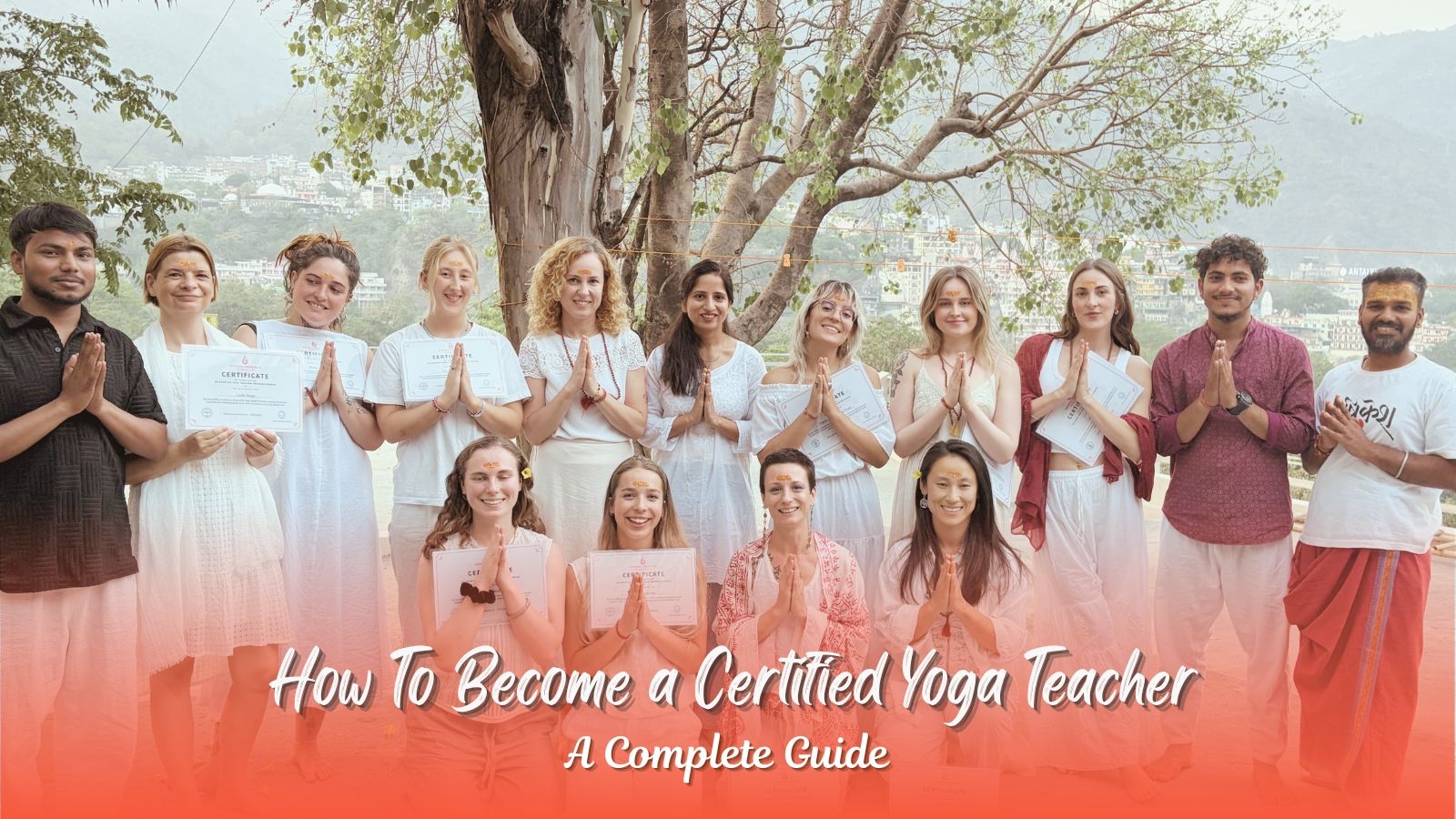
How to Become a Certified Yoga Teacher: A Complete Guide

If you love yoga, and you have been doing it for some time now; you have probably had the same thought over and over again…what if I could teach yoga? Well, this thought is very valid.

Becoming a certified yoga instructor offers many rewards personally, such as deepening your practice, changing how you look at/feel about yourself and learning to help others through yoga (by teaching them). These things make becoming a Certified Yoga Instructor very rewarding.

So now what? How do you get started? What does it mean to be certified? What type of certification is right for me? You can find all the answers you need in this guide, which is designed to be straightforward and helpful.

Why Yoga Teacher Certification Matters

First, let’s talk about the significance of being a certified yoga teacher.

The roots of yoga go back thousands of years, but in today’s world, when a student enters the yoga studio, they have the right to know that their instructor has completed appropriate training. Health and fitness certifications provide an established standard to the student, the studio, and the employer, giving everyone the confidence that the teacher is knowledgeable about the subject matter.

A fact worth considering is that there are over 100,000 yoga teachers around the world who are presently registered with Yoga Alliance, and the demand for certified yoga instructors continues to grow every year. The global yoga industry is estimated to be worth an estimated $80 billion and continues to grow. Becoming certified will not only create a stronger foundation for your practice, but it will also create long-term, legitimate career opportunities.

Step 1 – Build Your Personal Practice First

You need to have solid personal practice before you start teaching. While this may seem obvious, many teachers overlook this fact.

Building up a substantial personal practice is essential to having awareness in your body, being disciplined and having an actual understanding of what it feels like to do yoga from the inside out. It’s not important to be perfect at each pose; actually, teachers that have had challenges and worked through them tend to relate better to students than those who have found everything easy.

Most teacher training programs require that you have practiced at least six months to a year before going through the program. Some programs do require this. Regardless, it is on the mat where the journey begins.

Step 2 – Understand the Certification Levels

There are varying levels of the yoga alliance teacher training. So being aware of these levels will give you the best idea of how to plan your progression.

200-Hour Yoga Teacher Training – This is where it all starts. It is the minimum needed in order to become registered as a teacher with the Yoga Alliance (RYT 200). This program will introduce you to asanas, pranayama, meditation, anatomy, yoga philosophy and the fundamentals of teaching methodology. Most people start here and many teach successfully at this level for many years.

300-Hour Yoga Teacher Training – This is the next step for teachers who have already taken the 200 hours and are ready for advanced practice. It includes more in depth asana, philosophy, specialization including anatomy and refining teaching skills. You are considered an RYT 500 once you have completed the 200 and 300 hours.

500-Hour Yoga Teacher Training – Other schools have a 500-hour integrated program which combines the 200- and 300-hour levels for a 500-hour journey. This is perfect for those who already know from day one that they want to teach at an advanced level.

Step 3 – Choose the Right School

Many aspiring teachers have difficulty choosing a yoga school. This decision is one of the most important choices an aspiring teacher can make. Here are some things to look for in your choice of yoga school:

1) Accreditation: Make sure that the school you choose is accredited by a governing body called Yoga Alliance. Only institutions with Registered Yoga School (RYS) status can issue certifying transcripts. Verify that this is true prior to registering for any classes.

2) Experience: Look for schools whose instructors have decades of experience with yoga and/or have been practitioners and teachers of other modalities. The quantity of experience possessed by your instructors will determine the level of depth from which you learn.

3) Balance of Curriculum: In a well-rounded teacher training program, you will learn about all aspects of yoga, such as philosophy, anatomy, breathwork, meditation, teaching methods and ethics. If the majority of your course will consist of postures, you should select another place to study.

4) Location and Setting: The location and setting of where you train is important. People typically do not recognize how place impacts their ability to deepen the understanding of the practice.

Which brings us to Rishikesh.

While many aspiring teachers travel to India for an authentic, traditional experience, training abroad isn’t the only path – some students prefer to explore programs closer to home before making their decision. If you’re weighing different options, it may help to compare yoga teacher training courses available through All Yoga Training as part of your research. 

Step 4 – Consider Training in Rishikesh

Rishikesh is truly the pinnacle of serious yoga teacher training courses. Rishikesh is home to many yogis, sages and seekers from around the world, who have been coming there for thousands of years – so, if you are seeking a true “yogic” experience, look no further than Rishikesh. The methodology and philosophy of these teachings are authentic, and the “in the moment” nature of your experience when trained there is often unexplainable. The daily experience of living in an ashram (waking up at 4:30 am, eating sattvic food, listening to evening satsangs, being exposed to the natural healing powers of the sacred Ganga River, etc.) provides a foundation of support for the development of a true yoga teacher’s journey.

At Gurukul Yogashala (a top-rated yoga school in Rishikesh, India), you will have the exact type of yogic experience that was mentioned above. Gurukul Yogashala has over 30 years of combined experience in the field and is rooted in the Vedic tradition, and they currently provide training in multiple disciplines and levels of yoga.

The Gurukul Yogashala offers a 200 hour yoga teacher training in Rishikesh that lasts 22 days and provides participants a comprehensive view of disciplines such as Hatha Yoga, Ashtanga, Vinyasa, Yin Yoga, and Ayurvedic practices along with yogic philosophy as well. This course will give future teachers an excellent foundation to begin teaching with confidence.

In case you are looking to take your practice to the next level, the Gurukul Yogashala provides a  300 hour yoga teacher training in Rishikesh  that is 28 days long. This program offers an advanced course (taught in accordance with Iyengar Yoga principles) that builds on the foundation developed during the 200-hour course and includes advanced techniques in Hatha Yoga, Vinyasa, and deeper Ayurvedic practices. This program is specifically designed for those who are already certified as teachers and want to take their practice to a higher-level.

The Gurukul Yogashala also offers a 500 hour yoga teacher training in Rishikesh which is an all-inclusive course that supports you from beginning fundamentals through to advanced mastery allowing you to learn everything you need to become a complete professional.

Step 5 – Know What You Will Learn

Learning the poses of yoga is only one aspect of a high-quality Teacher Training Program. A comprehensive Teacher Training Program will include the following core components: 

  • Safe Asana Practice and Mastery – Safe alignment, effective adjustment & modification, and how to effectively sequence different bodies and levels (Anatomy & Physiology) 
  • Pranayama Techniques/Uses – How breathing techniques affect our nervous system; breed breath techniques are used in the form of teaching breathing techniques. 
  • Various Forms of Meditation – Types of meditation, guidance in meditation for others and associated science around stillness. 
  • Anatomy & Physiology of Movement – Movement of bones, where and how injuries occur and how to ensure students are safe when practicing yoga. 
  • Teaching Methodology – Sequencing classes, using your voice, giving proper adjustment, organizing a room, and developing a relationship with students.

Step 6 – Register and Start Teaching

After finishing a program that is certified by the Yoga Alliance, you can sign up as a Registered Yoga Teacher (RYT) on their site, and this is your global certification that is accepted by studios, gyms, wellness centres, retreats and other companies that support wellness.

After getting registered, the rest of your journey is up to you to take it wherever you want. Many teachers initially are offering classes to friends and family, or volunteering at community centres or maybe helping out at the school they completed their training in. Building an active teaching practice takes time but the base of quality training will help you to build on that base. 

How to Become a Certified Yoga Instructor: The Short Version

For those people skimming, the following is the fast overview of the process. Practice consistently for 6 to 12 months. Choose a school with Yoga Alliance accreditation. Complete 200 hours of teacher training and consider if you want to take 300/500 hours of training. Register with the Yoga Alliance. Start teaching and continue with your education.

Yoga Teacher Training in Rishikesh remains as one of the best and most respected places in the world to become certified, with a very good reason, as the level of pure tradition, the quality of instructors, and the experience in the area are all very difficult to find anywhere else. 

Final Thoughts

Choosing to become a yoga instructor will affect everything about how you live your life… Where you live, how you move through your days, and the way that you connect with your community.

At Gurukul Yogashala, Rishikesh, we will assist with this transformation. Our teachers are trained in the authentic lineage of yoga and facilitate your learning beyond receiving a certificate; they will provide you with a blueprint for life-long practice. This is your classroom; the mountains, the river, and the thousands of years of history associated with them are your teachers.

Answer the call and begin your journey.

Frequently Asked Questions

1. What qualifications do I need to become a certified yoga teacher? 

In order to become certified as a yoga instructor, you do not need to have any type of college degree; however, you must have a continuous personal yoga practice, an honest motivation for teaching the practice of yoga, and to enroll in an accredited teacher training program through Yoga Alliance. Most teacher training programs will take applicants from any background. 

2. How long does it take to become a certified yoga instructor? 

The time it takes for you to complete your training depends on whether you are taking an intensive or part & parcel approach. A 200 hr course typically takes between 22 & 28 days in an intensive residential programme or several months in a part time programme. The 300 hour advanced course typically takes another 28 days or longer to complete. You can factor in the timing of your final level and type of training when you are thinking about your time-line. 

3. What is the best certification for yoga teachers? 

The most recognized yoga certification for teachers around the world is from the Yoga Alliance (USA). When choosing a school, you want to ensure they are registered as a RYS200 or RYS300 (Registered Yoga School). A Yoga Alliance certification can be used in any studio or gym or other wellness facility in most countries in the world. 

4. Can beginners become yoga teachers? 

Yes, but you will need to plan ahead! Most schools recommend having an established personal practice for at least six to twelve months prior to enrolling in their teacher training course to give you a sense of body awareness and a base foundation of experience to help you understand the training you will receive more fully and completely. 

5. How much does yoga teacher training cost? 

Courses for teacher training vary depending on the location and level of the programme. A 200 hr yoga teacher training programme in India (specifically in Rishikesh) that is residential and includes accommodation and food will range from $700-$1500 (USD) which is much less expensive than in most parts of the world.

6. Is online yoga teacher training valid? 

Online teacher training has been accepted by the Yoga Alliance, but many people who want to learn the most possible, especially through hands-on adjustments, the sense of community, and the immersion into the training, would do better to go to an in-person residential training program, such as one in Rishikesh, India – an experience that cannot be duplicated with online teacher training. 

7. What will I learn in a yoga teacher training course? 

The types of things you will learn in the course are: physical yoga asanas and how to align your body while doing the asanas, pranayama, meditation, your physical anatomy and physiology as it relates to yoga, yoga philosophy, how to teach, how to sequence classes, how to do hands-on adjustments, and how to behave as a yoga teacher according to the ethical guidelines of a yoga teacher. A full training program covers both the physical and the philosophical aspects of yoga. 

8. Can I teach yoga immediately after certification? 

You can begin teaching yoga as soon as you have completed the (200-hour) RYT 200 yoga teacher training and have registered with Yoga Alliance. Many new teachers will teach to small groups in the community, do private sessions, and/or assist more seasoned teachers while gaining confidence and experience. 

9. How much do certified yoga teachers earn? 

Earnings depend on where you teach, in which format and your experience. In India, the salary of yoga teachers ranges from 30,000 – 1,00,000 per month. In western countries a studio yoga teacher usually earns between 30$ – 100$ per class while private teachers and retreat instructors earn much more. Many seasoned teachers also make online courses, retreats and teacher training courses.

Dirgha Pranayama

Dirgha Pranayama: Meaning, Benefits, Technique & Yogic Wisdom

Breath is the most vital force in yogic philosophy. The quality of your breath directly influences your physical health, emotional balance and mental clarity. Among the many pranayama techniques practiced in traditional Hatha Yoga, Dirgha Pranayama, also known as Three-Part Breath, is one of the foundational and most transformative techniques.

At Gurukul Yogashala, a traditional yoga school in rishikesh, Dirgha Pranayama is taught with precision, anatomical awareness and spiritual depth during all levels of yoga teacher training in rishikesh, including the globally recognized 200 hour yoga teacher training in Rishikesh.

This complete guide explores:

  • What is Dirgha Pranayama
  • How to do Dirgha Pranayama (step-by-step)
  • Dirgha Pranayama benefits
  • Contraindications
  • Difference between Dirgha Pranayama and Ujjayi Pranayama
  • Advanced tips from yoga experts
  • Scientific & spiritual perspective

Let’s dive deeper.

What Is Dirgha Pranayama? (Meaning & Yogic Background)

Dirgha Pranayama comes from the Sanskrit words:

  • “Dirgha” — long, deep, complete
  • “Pranayama” — breath expansion, regulation of life force

Thus, Dirgha Pranayama means “the practice of long, complete and controlled breathing.”

It involves consciously expanding the breath into three parts:

  1. Belly / Diaphragm
  2. Ribs / Thoracic Region
  3. Chest / Clavicular Region

This makes Dirgha Pranayama a full-lung breath, enhancing both oxygen absorption and energy flow (Prana Vayu).

Traditionally, Dirgha Pranayama is practiced:

  • at the beginning of yoga sessions
  • before meditation
  • during stress
  • for grounding emotional turbulence
  • to correct dysfunctional breathing patterns

The Science Behind Dirgha Pranayama (Physiological Explanation)

Most people breathe using only the upper chest, which restricts oxygen intake and puts the body into a state of subtle stress. Dirgha Pranayama reverses this dysfunctional breathing pattern by training the diaphragm—the body’s primary breathing muscle—to work efficiently.

When you practice Dirgha Pranayama:

  • The diaphragm moves downward properly

This creates more space in the lungs, allowing maximum oxygen absorption.

  • The vagus nerve activates

This nerve triggers the parasympathetic nervous system, immediately creating a sense of relaxation.

  • Heart rate and blood pressure reduce naturally

Deep breathing improves cardiovascular function without strain.

  • Lymphatic detoxification improves

Breath-driven diaphragmatic movement supports the lymphatic system, helping flush toxins from the body.

  • Brain receives more oxygen

This improves concentration, clarity, decision-making and memory.

This scientific foundation is why Dirgha Pranayama is often prescribed for people with stress-related health conditions, anxiety, high blood pressure, digestive problems and emotional imbalance.

Dirgha Pranayama & Emotional Healing

In yogic philosophy, emotions are stored in the body—particularly in the solar plexus (Nabhi), chest (heart center) and throat.
The three-part breath gently massages these regions, helping dissolve emotional blockages.

How it supports emotional wellness:

  • Belly breathing relaxes survival-based fears and anxiety
  • Rib expansion releases tension from suppressed emotions
  • Chest breathing opens the heart space, promoting compassion
  • Slow exhalation clears emotional heaviness

This is why Dirgha Pranayama is often used in:

  • Trauma-sensitive yoga
  • Meditation for emotional healing
  • Yoga nidra
  • Inner child therapy
  • Stress management programs

At Gurukul Yogashala, teachers guide students with compassion, grounding and ancient yogic wisdom to help release emotional holding patterns.

Dirgha Pranayama & Meditation (Why It Strengthens Mindfulness)

Before meditation, the mind is usually restless due to irregular breathing. Dirgha Pranayama anchors the mind by stabilizing the breath.

Benefits for meditation practitioners:

  • Increases mental stillness
  • Reduces internal chatter
  • Improves awareness of the present moment
  • Helps hold longer meditation sessions
  • Makes transitions from asana to meditation smoother

This is why many meditation teachers recommend practicing Dirgha Pranayama for 3–5 minutes before beginning meditation.

Dirgha Pranayama in Yoga Philosophy

Traditional scriptures like the Hatha Yoga Pradipika and Gheranda Samhita emphasize the importance of long, controlled breathing. According to yogic wisdom:

“The breath is the bridge between the mind and the body.”

Dirgha Pranayama embodies this philosophy by teaching practitioners to breathe consciously from the lower, middle and upper regions of the body.

According to ancient teachings:

  • Belly breath activates Apana Vayu (elimination energy)
  • Rib breath activates Samana Vayu (digestive & balancing energy)
  • Chest breath activates Prana Vayu (upward-moving life force)

Practicing Dirgha Pranayama harmonizes these pranic energies, creating balance and steadiness.

How to Do Dirgha Pranayama (Step-by-Step Instructions)

Here is a simple and effective method taught at Gurukul Yogashala:

Step 1: Sit in a comfortable position

Choose Sukhasana, Vajrasana or sit on a cushion. Keep spine lengthened.

Step 2: Relax your shoulders

Let the chest soften and jaw loosen.

Step 3: Place one hand on the belly and one on the chest

This increases awareness.

Step 4: Inhale into the belly

Feel it expand outward (diaphragmatic breathing).

Step 5: Continue the inhale into the ribcage

Allow the ribs to widen like wings.

Step 6: Draw the last part of the inhale into the upper chest

The collarbones gently rise.

Step 7: Exhale slowly in reverse

Chest → ribs → belly.

Step 8: Repeat for 5–10 minutes

Keep breath smooth, long and unforced.

This technique teaches you to utilize the entire lung capacity consciously and efficiently.

Dirgha Pranayama Benefits (Deep Yogic & Scientific Advantages)

1. Improves Lung Capacity

Dirgha Pranayama trains the lungs to expand completely, increasing oxygen intake and respiratory efficiency.

2. Reduces Stress & Anxiety

Deep breathing activates the parasympathetic nervous system, calming the mind and lowering cortisol levels.

3. Enhances Emotional Stability

This breath cultivates grounding and reduces emotional reactivity, making it ideal for anxiety, grief or overwhelm.

4. Improves Posture & Spinal Alignment

When practiced correctly, the spine elongates and the diaphragm moves freely, improving overall posture.

5. Supports Digestion

Deep abdominal breathing stimulates digestive organs and enhances circulation in the gut.

6. Boosts Concentration & Mindfulness

Slow, intentional breathing helps quiet the mind—perfect for meditation or yoga nidra.

7. Helps Correct Shallow Breathing Patterns

Many people have stress-induced chest breathing. Dirgha Pranayama retrains the body to breathe deeply.

8. Improves Sleep Quality

Practicing before bed reduces restlessness and relaxes the nervous system.

9. Enhances Prana Flow

In yogic philosophy, full breathing enhances life-force energy, improving vitality and spiritual awareness.

10. Creates a Strong Foundation for Other Pranayama

Dirgha is the base for advanced breathwork such as:

  • Ujjayi
  • Nadi Shodhana
  • Bhastrika
  • Kapalbhati

At Gurukul Yogashala, this pranayama is introduced early to create a strong foundation.

Dirgha Pranayama Contraindications

Avoid or modify if you have:

  • Severe asthma flare-ups
  • COPD (chronic obstructive pulmonary disease)
  • Recent chest or abdominal surgery
  • Heart disorders (consult a physician)
  • Severe vertigo
  • Pregnancy (practice only under guidance)

Practitioners at Gurukul Yogashala learn modifications to ensure safety.

How Is Ujjayi Pranayama Different Than Dirgha Pranayama?

FeatureDirgha PranayamaUjjayi Pranayama
PurposeFull lung expansionBreath control + throat contraction
Technique3-part breathingOceanic breath sound
ThroatRelaxedGentle constriction
Breath SoundSilentAudible
Best ForBeginners, groundingAdvanced focus, vinyasa, Ashtanga
Energy EffectCalmingHeating + energizing

Conclusion:
Dirgha Pranayama is foundational, whereas Ujjayi is more advanced and requires throat engagement.

Why Dirgha Pranayama Is Essential for Yoga Students & Teachers

Dirgha is the first pranayama taught in yogic tradition. For teachers-in-training, it builds:

  • breath awareness
  • anatomical understanding
  • emotional grounding
  • the ability to guide others safely
  • the base for all advanced pranayama

This is why Dirgha is practiced in every 200 hour yoga teacher training in Rishikesh at Gurukul Yogashala.

Advanced Dirgha Pranayama Tips

  • Practice with eyes closed
  • Count inhalation and exhalation (4–4 or 4–6)
  • Visualize breath filling 3 chambers
  • Keep shoulders soft
  • Avoid overexpansion of the chest
  • Use Ujjayi breath after mastering Dirgha
  • Practice early morning or before meditation

Spiritual Significance of Dirgha Pranayama

In yogic scriptures, the three-part breath symbolizes:

  • Belly — grounding, security, Muladhara + Swadhisthana
  • Ribs — expansion, vitality, Manipura
  • Chest — compassion, Anahata

As the breath travels upward, it awakens the pranic currents and harmonizes the body with consciousness.

FAQs on Dirgha Pranayama

1. What is Dirgha Pranayama?

It is a three-part deep breathing technique involving belly, rib and chest expansion for full-lung breathing.

2. What are the benefits of Dirgha Pranayama?

It reduces stress, improves lung capacity, enhances digestion, supports emotional balance and deepens meditation.

3. How do you practice Dirgha Pranayama?

Sit comfortably, inhale into belly → ribs → chest, and exhale chest → ribs → belly.

4. Are there any contraindications?

Avoid during severe asthma, heart conditions or after abdominal/chest surgery unless guided by professionals.

5. How is Ujjayi different from Dirgha Pranayama?

Dirgha focuses on full lung expansion, while Ujjayi uses throat constriction to create a soft oceanic sound.

6. Can beginners practice Dirgha Pranayama?

Yes, it is one of the safest and most beginner-friendly pranayamas.

7. Is Dirgha Pranayama good for sleep?

Absolutely. It relaxes the nervous system and improves sleep quality.

8. Can I practice Dirgha Pranayama every day?

Yes, daily practice for 5–10 minutes is highly recommended.

Conclusion

Dirgha Pranayama is one of the most essential breathing practices every yogi should master. It strengthens the lungs, calms the mind, supports emotional balance and deepens self-awareness. When practiced regularly, it becomes a powerful tool for physical health, mental clarity and spiritual development.

At Gurukul Yogashala, a traditional yoga school in rishikesh, Dirgha Pranayama is taught with proper guidance, anatomical precision and yogic philosophy. Whether you join our yoga teacher training in rishikesh or enroll in the foundational 200 hour yoga teacher training in rishikesh this pranayama technique becomes a pillar of your personal and teaching journey.

Master your breath and you master the path of yoga.

Rocket Yoga: Meaning, Sequence, Benefits & Training

Rocket Yoga: Meaning, Sequence, Benefits & Training

Yoga has evolved over centuries, but certain styles have earned global popularity due to their unique approach, intensity and transformative power. Rocket Yoga is one such modern yet deeply rooted yoga system inspired by traditional Ashtanga Vinyasa yoga. Known for its dynamic pace, playful transitions and strength-building poses, Rocket Yoga is widely practiced by students who enjoy a fast, energetic and exhilarating flow.

At Gurukul Yogashala, a traditional yoga school in Rishikesh, Rocket Yoga is taught with precision, safety and ancient yogic wisdom. Combining the structured approach of Ashtanga with the freedom of modern Vinyasa, Rocket Yoga offers practitioners a balance of discipline and creativity.

This comprehensive guide covers:

  • What is Rocket Yoga
  • Rocket Yoga sequence (beginner + advanced)
  • Rocket Yoga vs Ashtanga
  • Rocket Yoga vs Vinyasa
  • Benefits of Rocket Yoga
  • Rocket Yoga training and teacher training
  • Whether Rocket Yoga is suitable for beginners
  • Expert insights from Gurukul Yogashala teachers

What Is Rocket Yoga? (Origin, Philosophy & Method)

Rocket Yoga is a fast-paced, contemporary version of Ashtanga Yoga created by Larry Schultz in the 1980s. Schultz trained with Pattabhi Jois for years and later designed a more accessible version of the traditional Ashtanga Primary and Intermediate Series.

Key Features of Rocket Yoga

  • Faster transitions
  • Creative variations
  • Strength and flexibility training
  • Inversions and arm-balancing emphasis
  • No strict sequence—more freedom
  • Encourages personal expression and exploration

Rocket Yoga was named by Bob Weir of the Grateful Dead, who said:
“It gets you there faster.”

While rooted in tradition, Rocket Yoga gives students the freedom to modify, adapt and explore poses that might feel restrictive in classical Ashtanga.

Rocket Yoga Sequence

Rocket Yoga has three primary sequences, each targeting different aspects of the body.

1. Rocket 1 Sequence (Based on Ashtanga Primary Series)

This sequence emphasizes strength, balance and foundational postures.

Common Poses in Rocket 1

  • Sun Salutations A & B
  • Standing sequence
  • Seated forward bends
  • Arm balances
  • Basic inversions
  • Rocket pose yoga variations
  • Finishing sequence

Best for: Beginners and intermediate practitioners.

2. Rocket 2 Sequence (Based on Ashtanga Intermediate Series)

This focuses on deeper backbends, twists and more complex transitions.

Common Poses in Rocket 2

  • Kapotasana preparations
  • Advanced arm balances
  • Backbend variations
  • Strong hip-opening asanas
  • Forearm balances

Best for: Intermediate to advanced practitioners.

3. Rocket 3 Sequence (The “Full Rocket”)

A combination of Rocket 1 and 2, often the most challenging.

It includes:

  • Advanced balances
  • Handstands
  • Jump-through transitions
  • Float-backs
  • Strength drills

Beginner Rocket Yoga Sequence

Many students ask, “Is Rocket Yoga for beginners?”
Yes—when guided by an experienced teacher, Rocket Yoga is accessible and safe for beginners.

A beginner-friendly Rocket flow may include:

  • Cat-Cow
  • Downward Dog
  • Modified Chaturanga
  • Low Lunges
  • Warrior I & II
  • Chair Pose
  • Boat Pose
  • Crow Pose (optional)
  • Supported Headstand (optional)

This simplified sequence builds confidence while maintaining the playful spirit of Rocket Yoga.

Rocket Yoga vs Ashtanga Yoga

Rocket Yoga

  • Flexible sequence
  • Faster, more dynamic
  • Includes modifications
  • More accessible for beginners

Ashtanga Yoga

  • Fixed series
  • Strong discipline + strict order
  • Requires years of practice
  • Traditional and structured

Conclusion: Rocket Yoga is “Ashtanga for everyone,” making challenging postures accessible through variations.

Rocket Yoga vs Vinyasa Yoga

Rocket Yoga

  • Based on Ashtanga structure
  • Emphasis on arm balances & inversions
  • Consistent pattern and rhythm
  • Strength-focused

Vinyasa Yoga

  • Free-flowing
  • Creative and varied
  • Breath-led movement
  • More fluid, less strength-heavy

Conclusion: Rocket Yoga is more structured and strength-oriented than Vinyasa.

Rocket Yoga Benefits

Rocket Yoga is famous for its strength, speed, balance, creativity and transformational nature. Below are the most detailed benefits you can use for your article, website, or training manual.

1. Builds Exceptional Upper-Body Strength

Rocket Yoga includes:

  • arm balances
  • handstands
  • forearm stands
  • jump-backs & float-backs
  • chaturanga repetitions

This strengthens:

  • wrists
  • shoulders
  • triceps
  • core
  • upper back

Why this matters:
Most traditional yoga styles don’t offer as much upper-body strength training. Rocket Yoga fills that gap, making practitioners strong, stable and confident in advanced postures.

2. Develops Deep Core Activation & Balance

Every transition in Rocket Yoga—like floating forward, jumping through, L-sits, or handstands—requires:

  • deep abdominal engagement
  • pelvic floor stability
  • spinal alignment

This leads to:

  • better posture
  • stronger lower back
  • enhanced athletic performance
  • reduced risk of injuries

In Gurukul Yogashala, Rocket Yoga classes emphasize mindful core activation rooted in traditional yogic anatomy.

3. Increases Flexibility Faster Than Other Styles

Rocket Yoga combines:

  • dynamic stretching
  • active mobility
  • deep hip-openers
  • flowing sun salutations

Areas that dramatically open:

  • hamstrings
  • hip flexors
  • shoulders
  • spine
  • calves

Because Rocket Yoga warms the body rapidly, muscles become more pliable, making flexibility gains much quicker.

4. Strengthens the Cardiovascular System

Rocket Yoga is an intense, fast-paced practice that elevates the heart rate like cardio.
This improves:

  • circulation
  • lung capacity
  • endurance
  • metabolic rate

Regular practice makes your stamina significantly stronger—useful even outside yoga.

5. Boosts Mental Focus & Concentration

The quick pace requires:

  • presence
  • sharp awareness
  • breath control
  • mind–body coordination

As a result:

  • concentration improves
  • reaction time sharpens
  • the mind becomes disciplined

This mental sharpness is similar to the focus gained in athletes and meditators.

6. Reduces Stress & Anxiety Through Breathwork

Even though Rocket Yoga is dynamic, it follows:

  • Ujjayi breath
  • slow exhalations
  • breath-led transitions

This activates the parasympathetic nervous system, leading to:

  • calmness
  • emotional stability
  • mood balance
  • improved sleep

The combination of movement + breath creates a powerful meditative flow state.

7. Builds Confidence Through Achieving Hard Postures

Rocket Yoga is full of:

  • inversions
  • arm balances
  • strength holds
  • creative transitions

As students learn these step-by-step, they experience:

  • confidence
  • courage
  • emotional empowerment
  • trust in the body

At Gurukul Yogashala, teachers guide beginners using safe, supportive progressions.

8. Improves Mobility & Functional Strength

Rocket Yoga trains real-life movement patterns:

  • pushing
  • pulling
  • balancing
  • twisting
  • jumping
  • stabilizing

This improves:

  • agility
  • joint mobility
  • coordination
  • injury prevention

It’s not just about yoga; it enhances your ability to move better in daily life.

9. Enhances Inversion Skills

Many students struggle with inversions because traditional classes avoid them.
Rocket Yoga includes them in every sequence.

This improves:

  • circulation
  • lymphatic drainage
  • brain oxygenation
  • balance
  • body awareness

Teachers at Gurukul Yogashala break down inversions safely for all levels.

10. Encourages Creativity & Playfulness

Unlike strict Ashtanga, Rocket Yoga:

  • encourages modifications
  • allows freedom of movement
  • supports personal expression

This makes yoga enjoyable, especially for students who feel restricted by rigid sequences.

11. Faster Muscle Building (Compared to Traditional Yoga)

Rocket Yoga acts like yoga + calisthenics.

It tones:

  • arms
  • abs
  • shoulders
  • glutes
  • legs

Practitioners notice physical transformation within weeks.

12. Supports Weight Loss & Improved Metabolism

Due to its intensity, Rocket Yoga:

  • burns calories quickly
  • boosts metabolism
  • reduces belly fat
  • improves digestion
  • supports detoxification

A 60-minute class can burn 600+ calories depending on intensity.

13. Strengthens the Breath–Movement Connection

Rocket Yoga teaches you to:

  • move on breath cues
  • control pace
  • maintain Ujjayi breath

This improves pranayama skills and deepens meditative awareness.

14. Enhances Emotional Release & Healing

Dynamic flows break down:

  • emotional blockages
  • mental stiffness
  • suppressed energy

Students often feel lighter, happier, and more grounded after class.

15. Builds Discipline Without Rigidity

Ashtanga is strict.
Vinyasa is free-flowing.
Rocket Yoga blends both beautifully.

You get:

  • discipline
  • structure
  • creativity
  • strength
  • freedom

This balance makes Rocket Yoga sustainable for long-term practice.

At Gurukul Yogashala, our traditional approach blends Rocket Yoga with breathwork, alignment training, and yogic philosophy to ensure safe, mindful practice.

Rocket Yoga Teacher Training (What to Expect)

A structured Rocket Yoga teacher training typically includes:

  • Ashtanga-based sequences
  • Rocket 1, 2 & 3 breakdown
  • Arm-balancing & inversion workshops
  • Anatomy of strength & flexibility
  • Sequencing strategies
  • Yoga philosophy & meditation
  • Hands-on adjustments
  • Teaching methodology

Whether you’re joining rocket yoga training in 2025 or exploring it as part of a 200 hour yoga teacher training in Rishikesh, Gurukul Yogashala offers the right blend of traditional and modern techniques.

Is Rocket Yoga Suitable for Beginners?

Yes—with proper guidance.

Beginners can practice Rocket Yoga safely if they:

  • learn under trained teachers
  • modify poses
  • focus on breath
  • avoid pushing beyond limits

At Gurukul Yogashala, teachers ensure that every student—beginner or advanced—practices with safety, alignment, and mindful awareness.

Experience at Gurukul Yogashala – Why Learn Rocket Yoga in Rishikesh?

Gurukul Yogashala brings together:

  • Experienced, traditionally trained teachers
  • Authentic yogic philosophy
  • Scientific understanding of movement
  • Safe, structured Rocket Yoga training
  • A peaceful learning environment in Rishikesh

Students from over 35+ countries join our 200 Hour Yoga Teacher Training in Rishikesh, where Rocket Yoga is taught alongside Hatha Yoga, Ashtanga Yoga, Pranayama and Meditation.

Our emphasis on experience, expertise and lineage makes us one of the most trusted yoga schools for Rocket Yoga training.

FAQs on Rocket Yoga

1. What is Rocket Yoga?

Rocket Yoga is a fast-paced, accessible version of Ashtanga Yoga designed to make advanced postures more achievable.

2. Is Rocket Yoga good for beginners?

Yes, beginners can practice Rocket Yoga with proper modifications and guidance from trained yoga teachers.

3. What are the benefits of Rocket Yoga?

It improves strength, flexibility, balance, focus, cardiovascular endurance and emotional well-being.

4. How is Rocket Yoga different from Ashtanga?

Rocket Yoga is more flexible, creative, and accessible, while Ashtanga follows strict traditional sequences.

5. Is Rocket Yoga similar to Vinyasa Yoga?

Both are dynamic, but Rocket Yoga is more structured and includes advanced postures and inversions.

6. What happens during Rocket Yoga teacher training?

You learn sequences, anatomy, adjustments, philosophy, meditation, alignment and teaching methodology.

7. Can Rocket Yoga help with weight loss?

Yes. Its fast pace increases heart rate, supporting fat burn and muscle toning.

8. What is the Rocket Yoga sequence?

There are three main sequences: Rocket 1, Rocket 2, and Rocket 3.

9. Do I need to be flexible for Rocket Yoga?

No. Flexibility develops gradually with consistent practice.

10. Where can I learn Rocket Yoga in India?

Gurukul Yogashala in Rishikesh offers structured training rooted in tradition and modern practice.

Conclusion

Rocket Yoga is an empowering, dynamic, and transformative yoga style that blends the discipline of Ashtanga with the creativity of modern movement. Whether you practice for strength, flexibility, balance or mental clarity, Rocket Yoga takes your practice to the next level.

At Gurukul Yogashala, a traditional yoga school in Rishikesh, we teach Rocket Yoga with precision, safety, and authentic yogic wisdom. Students who join our yoga teacher training in Rishikesh, including the internationally recognized 200 hour yoga teacher training in Rishikesh, gain the confidence and skill to practice and teach Rocket Yoga effectively.

If you are ready to elevate your yoga journey with movement, mindfulness and mastery—Rocket Yoga at Gurukul Yogashala is the perfect path.

Chest Breathing vs Belly Breathing

Chest Breathing vs Belly Breathing: Understanding the Difference for Better Health

Breath is life. Every yoga practitioner, from beginners to advanced students, eventually discovers that the quality of breath determines the quality of mind, movement and overall health. At Gurukul Yogashala, one of the most traditional yoga school in Rishikesh, breathwork (Pranayama) forms the foundation of every training program—including the 100, 200, 300 and 500 Hour Yoga Teacher Training Courses.

Among the most important concepts in yogic breathwork lies the distinction between chest breathing vs belly breathing. Although both occur naturally, they have dramatically different effects on the nervous system, posture, focus, and emotional balance.

  • This in-depth guide will help you understand:
  • What is belly breathing
  • What is chest breathing
  • Belly breathing vs chest breathing (scientific + yogic perspective)
  • Benefits of deep belly breathing
  • Why most people are chest breathers
  • How to retrain yourself for diaphragmatic breathing
  • Techniques to practice daily
  • Yogic insights from Gurukul Yogashala faculty

Let’s begin the journey toward deeper breath awareness and healthier living.

What Is Belly Breathing? (Diaphragmatic Breathing Explained)

Belly breathing, also known as diaphragmatic breathing or abdominal breathing, is the natural and efficient way humans are supposed to breathe. Babies instinctively breathe with their bellies rising and falling—but adults gradually lose this pattern due to stress, poor posture and sedentary habits.

How Belly Breathing Works

During belly breathing:

  • The diaphragm contracts and moves downward
  • The lungs expand naturally
  • The belly rises as air fills the lower lungs
  • The breath becomes slow, deep, and steady
  • The nervous system shifts into relaxation mode (parasympathetic)

This is why belly breathing is often recommended for anxiety, stress relief, meditation and asana practice.

Deep Belly Breathing Benefits

Some major belly breathing benefits include:

  • Reduced stress and anxiety
  • Lower heart rate and blood pressure
  • Improved digestion
  • Enhanced lung capacity
  • Better mental clarity
  • Increased oxygen supply
  • Stronger mind–body connection
  • Improved posture and spinal alignment

At Gurukul Yogashala, belly breathing is taught in all Pranayama classes as a foundational skill for meditation, Hatha Yoga, Ashtanga Yoga and Yin Yoga.

What Is Chest Breathing? (Shallow Thoracic Breathing)

Chest breathing or thoracic breathing involves lifting the chest and shoulders while taking air only into the upper part of the lungs. This is common in people experiencing stress, anxiety, or poor posture.

How Chest Breathing Works

During chest breathing:

  • Only the upper lungs fill with air
  • The chest and shoulders rise
  • The diaphragm barely moves
  • Breathing becomes shallow and fast
  • The nervous system shifts into fight-or-flight mode

Chest breathing is not “wrong,” but when it becomes the default breathing pattern, it contributes to stress, fatigue, and emotional imbalance.

Chest Breathing vs Belly Breathing: Key Differences

Below is a clear comparison of belly breathing vs chest breathing:

FeatureBelly Breathing (Diaphragmatic)Chest Breathing (Thoracic)
Lung ExpansionLower lungsUpper lungs
Diaphragm UseStrongWeak
Nervous SystemRelaxation responseStress response
Breathing RateSlow & deepFast & shallow
Energy LevelBalanced, calmDrained, anxious
Best ForYoga, meditation, relaxationIntense activity, emergencies

Conclusion:

Belly breathing is ideal for health, emotional balance, and yoga. Chest breathing is only useful during high-intensity physical demands.

Why Do Most People Become Chest Breathers?

According to yoga anatomy teachers at Gurukul Yogashala, adults unconsciously shift to chest breathing due to:

1. Chronic Stress

Stress causes the body to trigger a fight-or-flight response—leading to shallow chest breathing.

2. Poor Posture

Slouching, working on laptops, and forward-head posture collapse the diaphragm.

3. Tight Clothing

Tight belts or high-waist clothing prevent abdominal expansion.

4. Emotional Suppression

People unconsciously restrict belly movement to “hold in emotions.”

5. Lack of Breath Awareness

Without guidance, most people never learn correct breathing techniques.

This is why breathwork training at a traditional yoga school like Gurukul Yogashala can correct patterns formed over years.

How to Practice Belly Breathing: Step-By-Step Technique

Here is a simple belly breathing exercise you can start now:

Step 1: Sit comfortably or lie down

Relax your shoulders and place one hand on the chest and one on the belly.

Step 2: Inhale slowly through the nose

Your belly should rise as the diaphragm expands. The chest should stay still.

Step 3: Exhale gently

Let the belly fall naturally, releasing all tension.

Step 4: Repeat for 5–10 minutes

Perfect for before yoga, meditation, or sleep.

At Gurukul Yogashala, students learn advanced variations during Pranayama sessions, including:

  • Nadi Shuddhi with belly breathing
  • Ujjayi breath
  • 3-part yogic breath
  • Diaphragm strengthening drills

Advanced Belly Breathing Techniques Taught at Gurukul Yogashala

1. Dirgha Pranayama (Three-Part Breath)

Teaches abdominal, thoracic and clavicular expansion in sequence.

2. Ujjayi Breathing

Enhances focus and oxygen efficiency.

3. Bhastrika with Diaphragmatic Emphasis

Strengthens lung capacity.

4. Meditation With Breath Awareness

Stabilizes the mind and enhances emotional balance.

These methods help practitioners transition from chest breathing to belly breathing with ease and proper guidance.

Belly Breathing vs Chest Breathing in Yoga Practice

During meditation:

Belly breathing is essential to keep the mind calm and grounded.

During asanas:

Slow diaphragmatic breathing improves alignment, endurance and flexibility.

During Pranayama:

Most classic pranayama techniques require complete control of the diaphragm.

During strenuous postures:

Chest breathing may occur temporarily, but awareness brings you back to breath control.

Yoga masters at Gurukul Yogashala emphasize that “breath leads the body—never the other way around.”

How to Transition from Chest Breathing to Belly Breathing

  • Practice daily for 10 minutes
  • Keep awareness on the belly
  • Fix posture during sitting and walking
  • Practice lying-down breathing drills
  • Keep the jaw relaxed
  • Meditate for 5 minutes after practice
  • Join a proper Pranayama/Yoga TTC program for deeper learning

Most trainees at Gurukul Yogashala report improved mental clarity, reduced anxiety and better sleep within 10 days of consistent practice.

FAQs on Chest Breathing vs Belly Breathing

1. What is belly breathing?

Belly breathing is diaphragmatic breathing where the abdomen rises during inhalation. It improves oxygen flow, reduces stress and enhances calmness.

2. What is the difference between chest and belly breathing?

Chest breathing is shallow and fast, while belly breathing is deep and slow. Belly breathing activates the parasympathetic nervous system and promotes relaxation.

3. Is belly breathing better for anxiety?

Yes. Belly breathing reduces cortisol, slows the heart rate and relaxes the nervous system—making it highly effective for stress and anxiety.

4. Can chest breathing cause stress?

Chronic chest breathing can keep the body in fight-or-flight mode, increasing anxiety and muscle tension.

5. How can I switch from chest breathing to belly breathing?

Practice daily diaphragmatic breathing, correct posture and join a guided breath awareness or Pranayama class at best yoga school in Rishikesh.

6. Is belly breathing good for sleep?

Absolutely. Deep belly breathing calms the nervous system and helps improve sleep quality.

7. Why is my chest rising instead of my belly?

This happens due to stress, habit, weak diaphragm muscles or poor posture. With training, the pattern can be corrected.

8. Can belly breathing improve digestion?

Yes. Diaphragmatic movement massages internal organs and boosts digestion.

Conclusion: Why Breath Awareness Matters

Breath is the bridge between body and mind. Understanding chest breathing vs belly breathing helps you regain control over stress, emotions and overall well-being. While chest breathing activates the body’s emergency systems, belly breathing restores calmness, clarity and balance.

At Gurukul Yogashala, we teach authentic breathing techniques rooted in classical Hatha Yoga and ancient yogic scriptures. Our certified teachers guide students through diaphragmatic awareness, pranayama methods, meditation, yogic science and spiritual philosophy. Whether you join the 100, 200, 300 or 500 Hour Yoga Teacher Training in Rishikesh, breathwork remains the heart of your transformation.

Master your breath—and you master your life.