
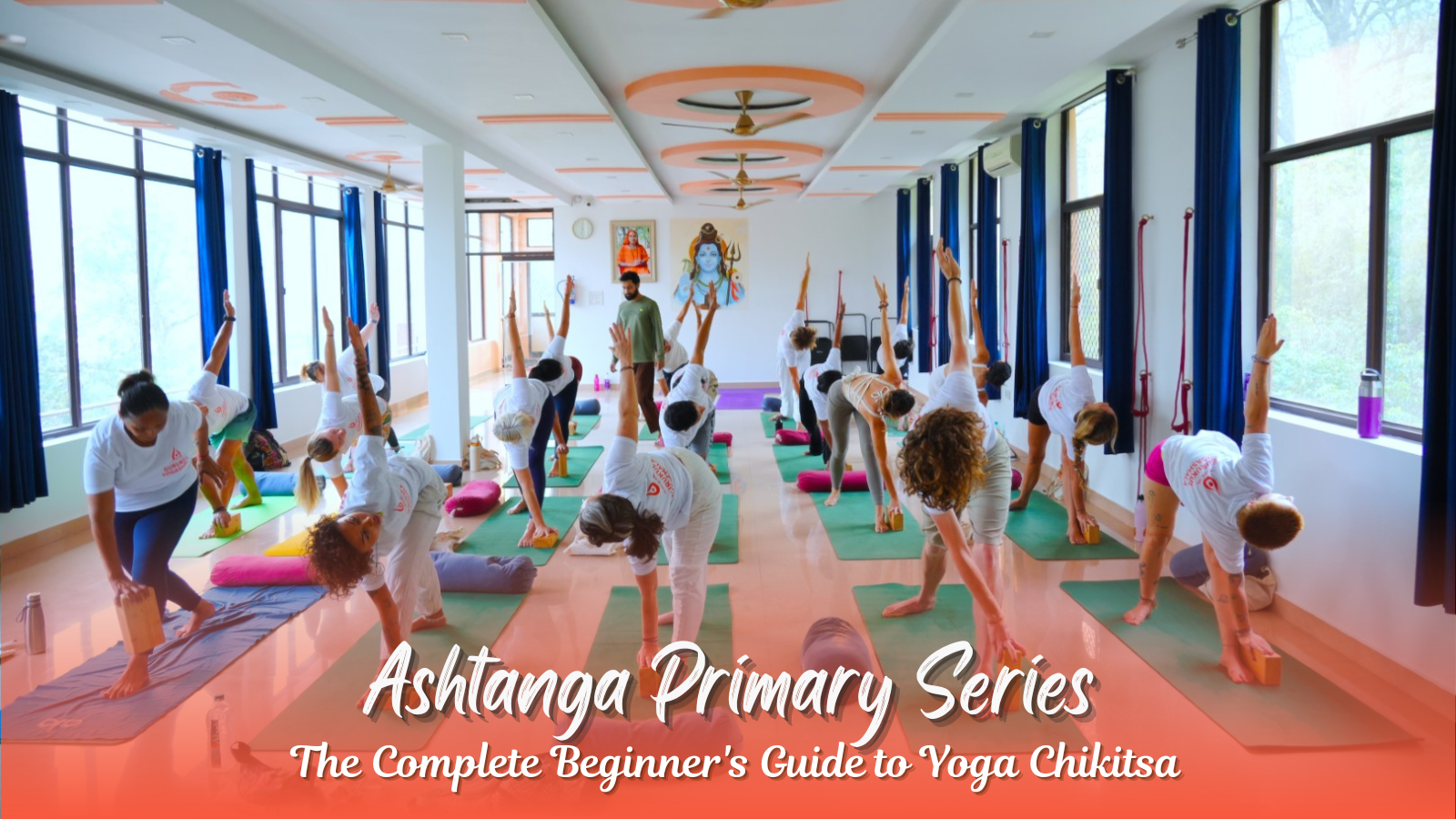
If you have stepped into one of our Mysore-style rooms at 6 in the morning and watched rows of students perform the same sequence almost silently while breathing nearly identically, then you got to observe this fixed sequence in action. It is considered one of the most rigid, misunderstood, yet transformative practices in contemporary yoga. From the entrance, it may even appear rather daunting for a beginner. The content of this guide, created based on the knowledge that we impart to students at Gurukul Yogashala, will give you the answer to the question of what the Ashtanga Primary Series means, why it is called Yoga Chikitsa, how to perform it, and how to start your journey of mastering this practice.
What Is the Ashtanga Primary Series?
Ashtanga Primary Series is the first sequence out of six within the Ashtanga Vinyasa system – a system of yoga that was defined in Mysore, India, by the famous K. Pattabhi Jois in the 20th century, following the teachings of his own guru Krishnamacharya. Unlike many modern yoga classes, during which the sequence is changed every day, the Ashtanga primary series is not variable, meaning that the same postures are performed every day.
The fixed system is not arbitrary in nature. Every pose used in the primary series of Ashtanga Vinyasa Yoga is meant for the preparation of the body for the next pose in the series. This allows heat to build in the body and the hips and hamstrings to be released while slowly progressing through the spine in a typical series of movements, including forward bends, back bends, and twists. Some students also know the sequence by its search-friendly nicknames – primary series Ashtanga or Ashtanga Primary Series -, but it’s all the same set of postures underneath the spelling variations.
What Is Yoga Chikitsa, and Why Is the Primary Series Called That?
In the Sanskrit language, “Chikitsa” signifies “therapy” or “healing” in English, meaning Yoga Chikitsa represents “yoga therapy.” This name has been derived from the ability of this series to detoxify the body, the effects of which are also taught in detail in our residential programs. The structure of the series, along with its combination of the deep forward bends, twists, and heat produced in the body, enables the body to flush out the stagnant energy and also bring about the correction of postural problems that have accumulated over time.
It is important to keep in mind that “therapeutic” should not be confused with “easy.” In fact, many experienced practitioners will affirm the irony that it is one of the six series that requires a lot of commitment and energy, for it asks the body to transform itself by stimulating the hamstrings, making the spine more agile, and enduring stressful moments for at least 90 minutes.
How Many Poses Are in the Ashtanga Primary Series?
In terms of the number of asanas in the complete sequence of Ashtanga yoga, traditional references suggest that the number of asanas can be pegged around 41; that said, the actual figure may differ based on how transitional postures are counted in the calculation and whether you consider one side of an asymmetrical pose. The Ashtanga poses in the primary series have specific features.
Among the mentioned poses, we can identify:
- The opening sequence and the Sun Salutations – five sets of Surya Namaskara A and three to five sets of Surya Namaskara B to warm up
- Seated postures including Trikonasana, Parsvakonasana, Prasarita Padottasana, and balancing poses like Utthita Hasta Padangusthasana
- Seated postures which have a greater number than the mentioned ones, including sitting forward bends with Paschimottanasana, various twisting poses, hip openers, and the pose in which the legs are behind your head
- The closing poses include backbends, inverted poses like Sarvangasana, and the final meditation sitting down.
- All parts of the Ashtanga yoga primary series are connected with vinyasa.
The Role of Breath, Bandha, and Drishti
Three components unite the entire Ashtanga Primary Series. It is important to know about these three elements rather than learn the sequence of all postures.
- Ujjayi breathing is a type of breathing that is produced such that it resembles ocean waves, helps calm the nervous system, and regulates the tempo.
- Bandhas are the name of the muscle locks, which include mainly the Mula Bandha (the pelvic floor) and the Uddiyana Bandha (the abdomen). This element helps support the spinal column and creates inner heat.
- Dristhi is the point you focus on while performing each posture. It also helps in learning how to concentrate.
All in all, these three elements integrate the idea of doing a physical workout and meditating at the same time. No wonder our teachers always tell us how useful this practice is for the body and mind.
Benefits of Practicing the Primary Series
In addition to conventional claims about yoga therapy, there is now a vast number of studies confirming its healing properties. According to the National Center for Complementary and Integrative Health, many studies find evidence that yoga is useful for stress relief. For example, a 2020 review article looking at many studies on yoga indicates that each of the twelve studies examined confirms that yoga practice leads to improvement in perception of stress.
Other reviews point to the relationship between yoga and improvement in mental wellness and resilience. The findings of a 2020 review of twelve research papers on all kinds of yoga for healthy adults prove that every study supports the idea that yoga is efficient in improving perception of stress. In addition, findings of a 2018 review focusing on yoga and positive effects on mental health show that yoga improves resilience of an individual and improves mental welfare.
Is the Ashtanga Primary Series Good for Beginners?
Yes – if you have the right mindset. The name is a bit misleading. In this context, “Primary” does not mean “easy” but rather “the first in the sequence.” However, beginners are encouraged to attend primary classes, and most Mysore-style teachers (including ours) only give some asanas at a time and introduce new ones as soon as your body and breathing allow. You should not expect to complete the full series on your very first day (or even in the very first months). The method is supposed to be learned gradually with the help of instructors.
Led Class vs. Mysore-Style Class: What’s the Difference?
- Led class: In this style of yoga practice, the instructor guides the students through the poses and counts aloud. This approach is beneficial for beginners because it simplifies the learning of the sequence and counting system (traditionally in Sanskrit) in a group environment.
- Mysore-style class: In this style of yoga practice, the student practices independently at their own pace and is given individualized attention by the instructor. This approach allows for personal development without the hindrance of group practice.
Most practitioners at our school choose to do Mysore-style yoga for their daily practice and go to take a led class once a week, usually on a Friday or Saturday, to keep in touch with the counting system.
How Often Should You Practice the Primary Series Each Week?
Ashtanga Yoga usually involves training five times a week, with weekends resting, as well as on the day that comes with an optional led class. However, for a beginner, it’s neither a comfortable nor a practical routine to stick to. Ideal practice sessions will take place at the rate of approximately 3-4 per week, which will leave some time for recovery after training.
Where to Learn: Yoga Teacher Training in India
If you want to move beyond practicing yoga at home and actually grasp the theory of anatomy, philosophy, and teaching methodology concerning it, formal yoga teacher training in India remains the best option – which is exactly what Gurukul Yogashala provides in its programs. It offers a 200-hour yoga training in India for people who wish to receive full certification or the 100-hour yoga teacher training India program for those who just want to start learning yoga but are not ready for a full commitment. If your main interest is Ashtanga, you can sign up for our Ashtanga Yoga teacher training in Rishikesh that is based entirely on this tradition.
India remains the most immersive place where this tradition can be actually lived out, and especially Rishikesh. A yoga retreat rishikesh program combines a daily practice of pranayama, meditation, and Vedic philosophy, all amid the breathtaking scenery of the Himalayan foothills and the Ganges – the very place where our ashram is situated on Laxman Jhula Road. Rishikesh is well-known around the globe for being the center of yoga, having attracted yogis, sadhus, and spiritual seekers over the ages.
The famous band The Beatles popularized the little town of Rishikesh in 1968 with their visit to the ashram of Maharishi Mahesh Yogi. Recently, this sacred city on the banks of the Ganges has also become renowned for its outdoor recreation. Presently, yoga training in Rishikesh provides everything from short retreats to advanced certification courses, making it a famous tourist destination for people who want to practice yoga more seriously.
Ashtanga Primary Series PDF: Should You Use One?
A downloadable printable chart is an excellent resource to refer to when you already know yoga practices. This can help you to double-check the order of poses before practicing at home or remind you of the names in Sanskrit. An Ashtanga Yoga Primary Series PDF is the first thing a beginner usually looks for, but it should never be considered as an alternative to practice with a teacher in the beginning stages. Indeed, some poses, for example, Marichyasana D and Supta Kurmasana, can be difficult to perform correctly without an instructor overseeing you. We give our students an Ashtanga primary series PDF after they have completed training with a teacher.
Final Thoughts
Practicing yoga requires one to be patient. This is a sequence that doesn’t give results quickly. You won’t master this practice in a month or even a year. The practice progresses into a routine, posture by posture and breath by breath. It begins with something you have never tried, but gradually turns into something that you already know. It becomes a kind of routine you can come back to at any moment, be it in good or bad times. You can learn yoga in a local studio, during a certified 200-hour yoga teacher training course, or even during dedicated yoga retreats. The principle remains the same: come, breathe, and let the practice do its magic.
If you are serious about mastering yoga the right way with true yoga professionals, feel free to visit Gurukul Yogashala in Rishikesh.
Frequently Asked Questions
What is the Ashtanga Primary Series?
It is considered the first of six series in the Ashtanga Vinyasa sequence, which consists of the Sun Salutation A and B, the standing postures, the seated postures, and a final sequence of poses, which are practiced in an ordered manner.
How long does it take to learn the full Primary Series?
This could differ a lot from student to student. In general, it would take individuals one to three years to work through the whole Primary Series. New poses can only be learned when one has mastered the previous ones.
What is Yoga Chikitsa and why is the Primary Series called that?
The term ‘Yoga Chikitsa’ means ‘yoga treatment’ in Sanskrit. The title is given to the series because a variety of poses help to detoxify and restore the body.
How many poses (asanas) are in the Ashtanga Primary Series?
Normally, the Primary Series consists of about 41 asanas, including the Sun Salutations, the standing poses, the sitting postures, and the closing poses.
Is the Ashtanga Primary Series good for beginners?
Yes. Beginners start here by design, typically learning a few postures at a time under teacher guidance rather than attempting the full sequence immediately.
What’s the difference between a led class and a Mysore-style class?
In a led yoga class, students follow their instructor, who tells them what to do. Conversely, in a Mysore class, although the instructor teaches the class, students practice independently based on their preferences.
How often should you practice the Primary Series each week?
It is recommended to practice every day except on moon days, although beginners might start with three to four times a week and build their practice thereafter.