
Modern life has become increasingly fast-paced, and stress has silently taken over people’s physical, mental and emotional well-being. Even when we understand that worrying about uncontrollable things adds no value, most of us struggle to calm the mind. This is exactly where timeless yogic wisdom becomes your strongest ally. At Gurukul Yogashala, Rishikesh, we preserve and teach ancient meditation practices that bring peace, clarity, balance and inner stability.
One such powerful technique is Breath Awareness Meditation (Prana Dharana)—a simple yet transformative practice that helps release stress and anxiety and harmonize the body–mind connection. Whether you are a beginner or an advanced yoga practitioner, cultivating breath awareness is one of the most effective ways to realign your inner world.
In this detailed guide, you will learn:
- What Breath Awareness Meditation is
- How it works to reduce stress
- Step-by-step instructions
- Expert-recommended tips
- Benefits supported by yogic science
- Why Gurukul Yogashala is the best place to learn meditation in Rishikesh
Understanding Breath Awareness Meditation (Prana Dharana)
Breath Awareness Meditation—traditionally known as Anapanasati—is the yogic practice of observing the natural flow of breath without trying to control it. Breath and mind are deeply interconnected; when the breath is calm, the mind naturally becomes still.
At Gurukul Yogashala, our lineage masters teach this meditation as a foundational practice because it:
- Reduces mental clutter
- Activates the parasympathetic nervous system
- Restores emotional balance
- Improves clarity, focus, and inner peace
Stress and anxiety originate in the mind, but their symptoms appear in the body. Breath becomes shallow, the heartbeat increases and the mind enters survival mode. Through breath awareness, you learn to reverse this pattern, allowing the mind to relax effortlessly.
Power Breathing Awareness Meditation (Traditional Yogic Method)
Power Breathing Awareness Meditation is a deeper form of breath observation, where you consciously detach from distracting thoughts and anchor your awareness to your inhalations and exhalations. When practiced correctly, this technique slows down the mental fluctuations (chitta vritti) and creates a sense of grounding and calm.
At Gurukul Yogashala, our experienced meditation teachers guide students through both beginner and advanced variations of Power Breathing Awareness Meditation during our 200 Hour Yoga Teacher Training in Rishikesh and meditation electives.
Psychologically, breath awareness reduces emotional turbulence. Spiritually, it creates a doorway to self-awareness and inner silence. Yogic scriptures like the Hatha Yoga Pradipika teach that “when the breath wanders, the mind wanders; when the breath is steady, the mind is steady.”
This is why breath awareness meditation is one of the first practices taught in our Yoga Teacher Training Courses in Rishikesh, especially the 100 Hour, 200 Hour and 300 Hour YTTC in Rishikesh at Gurukul Yogashala.
Step-by-Step Technique for Practicing Breath Awareness Meditation
Follow these traditional steps to practice Breath Awareness Meditation safely and effectively:
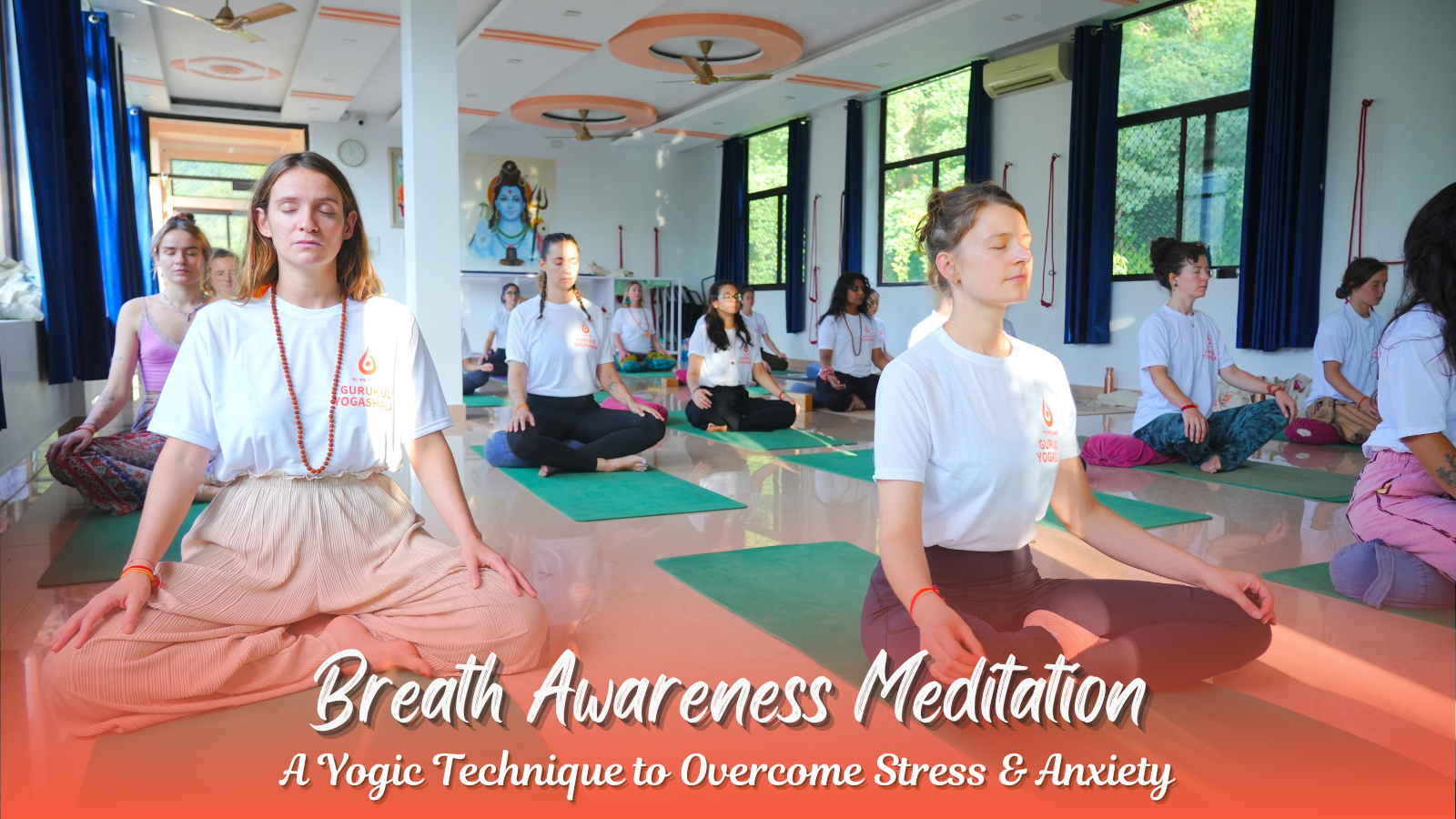
1. Get Into a Comfortable Sitting Position
Comfort is essential for meditation. Sit on the floor with a cushion or on a chair if required. Keep your:
- Spine naturally straight
- Shoulders relaxed
- Hands resting gently on your lap
This posture supports the energy flow in the body and helps prevent restlessness.
2. Gently Close Your Eyes and Relax
Closing your eyes helps reduce external distractions. Take a few deep breaths and allow the body to settle. Release tension from:
- Neck
- Jaw
- Shoulders
- Abdomen
Meditation begins with relaxation, so allow yourself to settle.
3. Shift Your Focus Toward the Breath
Now begin to observe the natural breath. Notice:
- The temperature of the air
- The rise and fall of the diaphragm
- Movements of the nostrils
- Subtle sensations in the chest and abdomen
Do not force the breath—simply observe.
4. Observe Without Judging
Thoughts will come. This is normal.
Whenever the mind wanders, gently bring your attention back to the breath. Witness your thoughts like clouds passing in the sky—without reacting.
This is the heart of meditation.
5. Continue for 5–15 Minutes
Beginners can start with 5 minutes and gradually increase to 15–20 minutes. With time, the breath becomes softer, the mind becomes calmer and emotional stability improves naturally.
Ayurvedic Perspective on Breath Awareness
Ayurveda teaches that breath awareness pacifies Vata dosha, the dosha responsible for movement, anxiety and nervous system imbalance. When Vata is high, the mind becomes restless.
Breath meditation helps:
- ground Vata
- regulate digestion
- stabilize emotions
- improve sleep quality
This is why breath awareness is a core practice in Ayurvedic healing retreats at Gurukul Yogashala.
Tips for Incorporating Breath Awareness Meditation Into Daily Life
Building a meditation habit requires patience and consistency. Here are expert yogic tips taught at Gurukul Yogashala:
1. Start Gradually
Small, sustainable steps are better than sudden drastic changes. Begin with 3–5 minutes and extend the duration as your mind adjusts.
2. Stay Consistent
Meditation should be practiced at the same time every day. Morning meditation is ideal because the mind is naturally quieter. Consistency strengthens the mind-body connection.
3. Explore Different Sensory Focal Points
If observing your breath feels difficult on some days, try shifting awareness to:
- The movement of the diaphragm
- The feeling of air at the nostrils
- The expansion of the lungs
4. Practice at the Same Time Daily
Morning is the best (Brahma Muhurta), but practicing before bed can significantly improve sleep.
Each of these anchors supports mindfulness.
How Breath Awareness Meditation Benefits the Body & Mind
With regular practice, breath awareness can transform your physical, mental and emotional well-being. Yogic science explains the following benefits:
1. Reduces Stress Naturally
Breath meditation activates the parasympathetic nervous system, lowering cortisol and calming the mind.
2. Relieves Anxiety & Emotional Turbulence
By slowing down the mind, meditation reduces anxious thoughts and brings emotional clarity.
3. Enhances Concentration and Mental Focus
Consistent practice stabilizes attention and improves cognitive function—making it beneficial for students, professionals, and spiritual seekers.
4. Increases Self-Awareness
Breath is a mirror of the mind. Observing it daily deepens awareness of emotions, triggers and thought patterns.
5. Strengthens Mind–Body Connection
Meditation regulates breathing patterns, balances the nervous system and improves overall health and energetic alignment.
Who Should Practice Breath Awareness Meditation?
Breath Awareness Meditation is safe for:
- Students
- Working professionals
- Parents
- Senior citizens
- Beginners in yoga
- People experiencing stress, anxiety, or sleep issues
It is gentle, accessible, and beginner-friendly.
Why Learn Breath Awareness Meditation at Gurukul Yogashala?
Gurukul Yogashala is one of the most traditional, authentic yoga schools in Rishikesh. Our teachings are rooted in the classical Gurukul system, integrating:
- Traditional Hatha & Ashtanga Yoga
- Meditation & Pranayama
- Ayurveda-based lifestyle practices
- Yogic philosophy, alignment & ancient techniques
Our yoga teacher training courses in Rishikesh (100, 200, 300 & 500 Hours) are designed to help students adopt yogic practices as a lifestyle—not just a routine.
Our lineage teachers bring decades of experience, ensuring you receive guidance backed by tradition, knowledge and real-world mastery.
Breath Awareness Meditation at Gurukul Yogashala
At Gurukul Yogashala, every meditation technique — including breath awareness — is taught with:
- Experienced teachers with decades of yogic training
- Authentic teachings from Hatha Yoga & Pranayama scriptures
- Safe and structured guidance
- Personalized corrections & support
- Traditional Himalayan yogic lineage
We integrate meditation with:
- Yoga Philosophy
- Pranayama
- Mantra Chanting
- Asanas
- Yogic Psychology
- Ayurveda
This holistic approach makes Gurukul Yogashala one of the best traditional yoga school in Rishikesh for those seeking stress relief, spiritual growth and yogic understanding.
Frequently Asked Questions (FAQs)
1. How does Breath Awareness Meditation reduce stress?
Breath Awareness Meditation activates the relaxation response, slows down the nervous system, reduces cortisol levels and brings calmness to the mind—making it highly effective for stress relief.
2. Can beginners practice Breath Awareness Meditation?
Yes. It is one of the simplest forms of meditation for beginners. Start with 5 minutes and increase gradually.
3. How long should I practice daily?
For best results, practice 10–15 minutes daily. With consistency, even 5 minutes can create noticeable changes.
4. Can meditation help with anxiety?
Absolutely. Breath meditation slows down overwhelming thoughts, improves emotional balance, and reduces anxiety naturally.
5. Why learn meditation at Gurukul Yogashala?
Gurukul Yogashala offers traditional, lineage-based meditation training guided by expert teachers in Rishikesh—the yoga capital of the world.
Conclusion
Breath Awareness Meditation is one of the most powerful yogic tools to manage stress, reduce anxiety, improve focus, and elevate overall well-being. With consistent practice, the mind becomes calmer, emotions become balanced and the practitioner develops excellent mental clarity.
If you wish to deepen your understanding of meditation, yoga philosophy and traditional breathwork, Gurukul Yogashala in Rishikesh offers transformative yoga teacher training india based on authentic Vedic principles.
Begin your journey into mindfulness and traditional yoga wisdom with Gurukul Yogashala—where ancient knowledge meets modern practice.