

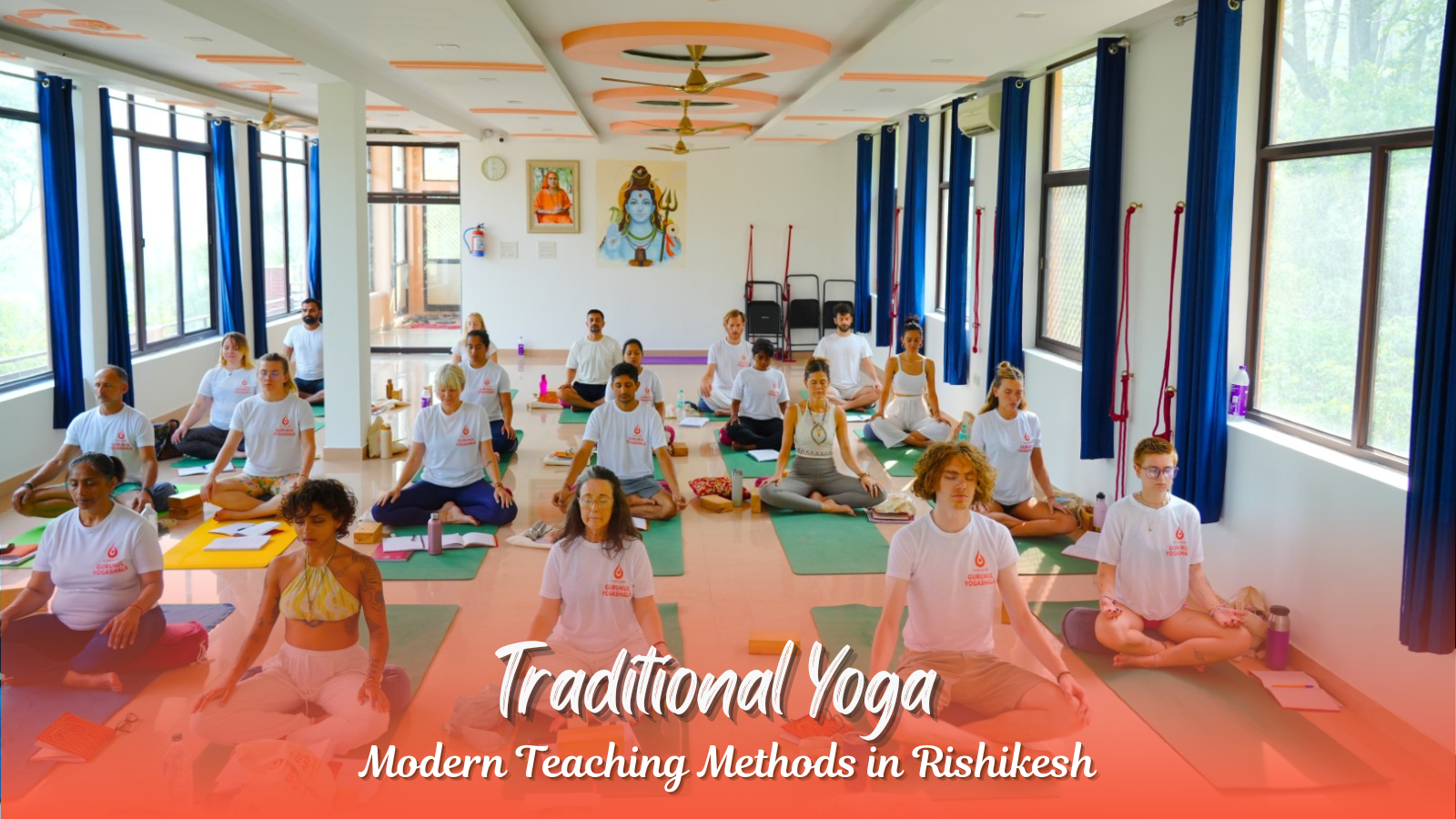
When you set out to find a quality school for yourself, one of the most common questions that you will encounter is: “Will I learn yoga at this place or will I simply be going through the motions?” It is a legitimate question, given that there are so many different types of yoga classes and countless locations offering them. The majority of these establishments possess only one element of both ancient wisdom and contemporary knowledge.
At Gurukul Yogashala, located in the center of Rishikesh’s spiritual community, the blending of the two is not merely part of their advertising hype; it is the very premise from which they construct each class, each lecture, and each student’s growth.
With this article, we will take a closer examination of how Gurukul Yogashala offers a combination of these two worlds, and why this combination is essential for anyone interested in learning how to practice yoga correctly.
What Does “Gurukul” Actually Mean?
Gurukul is made up of 2 Sanskrit words: Guru (teacher) and Kul (family), so a Gurukul was a school, but much more than that; This was a way of life. Students learned in person with their teacher, and through doing things daily, they created actual connections with others and gained knowledge through lived experiences instead of receiving it passively (i.e., by listening).
The traditional Indian educational system indicates that in a Gurukul, education was complete, and there was no longer a distinction (boundary) between “class time” and “life.” Rather than taking courses, you became another type of person.
The same spirit of the Gurukul tradition is alive and well at Gurukul Yogashala in Rishikesh. Here, yoga is less about being studied as a subject and more about becoming the essence of who you are.
The Traditional Roots: Why They Matter
In its original Vedic context, yoga has always been much more than just exercise. Yoga was designed to develop all three aspects of a person simultaneously (mind, body, and spirit) as part of an integrated whole. This complete and integrated model of development through yoga was emphasized by the Gurukul system in ancient India.
The Gurukula system of education, which forms the basis for yoga training today, was based on the strong bond between teacher and student. This student-teacher relationship provided the foundation for the development of the student’s mind, body, and spirit, in addition to simply being educated academically. While being trained academically, students also learned how to live a disciplined life. They were taught moral principles and the skills necessary to survive in society, all while practicing yoga as an integral aspect of providing mental clarity, physical well-being, and spiritual growth.
At Gurukul Yogashala, the yoga training offered is based directly on the principles established by the Gurukula system. Hatha Yoga, Ashtanga Yoga, Vinyasa, Pranayama, Meditation, Mantra chanting, and Philosophy of Yoga are taught in an integrated way, totally connected to the practice of yoga – just as they were originally intended to be taught.
Immediately, students will understand that getting up early in the morning to do their practices, eating Sattvic diet in the group, and being consistent with their daily schedule are not obstacles to their learning or personal development- rather, they are key components of their education. The structure is considered the curriculum.
The Modern Layer: Teaching That Works Today
To honour a tradition is not to deny what we have learned from science, but rather to give an even greater respect for the ancient ways in which yoga has been used based upon the results of modern studies.
Recently published studies in the Journal of the National Institutes of Health and PLOS ONE have shown that persons who participate in a residential Yoga Teacher Training Program demonstrate improvement in the following areas related to Memory and Mindfulness:
1. Observation;
2. Awareness;
3. Non-Reactivity (not reacting to your feelings and emotions).
This suggests that practitioners of yoga develop a more refined skill for paying attention to their own inner experiences through intensive practice.
Also, a study comparing the Gurukula Education System (GES) and modern education (MES) using PubMed as the source demonstrated that students who receive education using GES have demonstrated superior visual and verbal memory scores than those taught under MES; thus validating what teachers of ancient times have taught regarding the process of deep learning.
Traditional practices are combined thoughtfully with modern teaching tools at Gurukul Yogashala. These include anatomy and physiology sessions that describe the reasons each asana has its effect on the body, methodology classes that teach students about sequencing, cuing, adapting poses for different bodies, and creating a functioning classroom environment, and an evidence-based approach to pranayama in terms of both the Vedic interpretation of breathing techniques and their neurological effects.
Thus, it is not a matter of separating traditional yoga from modern science, but rather a combination of both together.
How This Shows Up Across Every Programme
100 Hour Yoga Teacher Training in Rishikesh
Yoga Teacher Training in Rishikesh, India is available in a variety of formats: 100 hours, 200 hours, and 300 hours. A 100 Hour Yoga Teacher Training in Rishikesh is an entry-level program that provides an introduction to Yoga according to Gurukul traditions while teaching Asana, Pranayama, and Yoga Philosophy in a structured way.
200 Hour Yoga Teacher Training in Rishikesh India
The 200 Hour Yoga Teacher Training in Rishikesh, India is an internationally recognised course and is designed to provide students with an understanding of how to teach Yoga effectively. It combines traditional styles of Yoga (Hatha and Ashtanga) with modern Anatomy, Teaching Practicum and Professional Development to teach students how to teach Yoga classes. The 200 Hour Yoga Teacher Training is the most popular Yoga certification in India, and for good reason: this is where the immersion, depth and practical readiness come together.
200 Hour Yoga TTC Rishikesh India + Prenatal Combo
The 200 Hour YTTC + Prenatal YTTC in Rishikesh, India Combo is a specially designed course for those who have completed their 200 Hour Yoga Teacher Training and would like to further their studies in Prenatal Yoga. In today’s world, Yoga teachers need to be capable of providing services to different populations.
300 Hour Yoga Teacher Training in Rishikesh
The 300 Hour Yoga Teacher Training in Rishikesh is tailored for you if you have completed your additional 200 hour training program and wish to continue studying Yoga. We study Advanced Asanas, the Subtle Body, and advanced philosophy of yoga, as well as Advanced Teaching Skills.
500 Hour Yoga Teacher Training in Rishikesh
A definitive path is offered to dedicated students pursuing mastery of all facets. 500 Hour Yoga Teacher Training in Rishikesh is intended to guide you towards your highest potential by providing you with a solid foundation of knowledge and an environment in which to cultivate those principles.
Prenatal-Post Natal Yoga Teacher Training in Rishikesh
A unique combination of traditional yogic principles and contemporary reproductive health concepts will provide you with the resources necessary to support women during eight different kinds of pregnancy and postpartum experiences.
Sound Healing Yoga Teacher Training in Rishikesh
This advanced course takes an old practice, sound, and combines it with current research on vibrational therapy, including how it can affect the nervous system, and provides you with a variety of tools to use in your healing work.
14 Days Yoga Retreat in Rishikesh India
14 Days Yoga Retreat in Rishikesh immersion experience that allows you to relax, recharge, and reconnect to yourself through daily yoga practices (including asana and meditation), philosophy, as well as time spent among like-minded individuals. You will return refreshed with a newfound understanding of yourself and how to integrate the teachings of yoga into your daily life.
The Role of Rishikesh Itself
Rishikesh is actively involved in the process of learning rather than simply providing a backdrop.
The location of Rishikesh, on the banks of the Ganges and surrounded by the lower Himalayas, has been a source of knowledge about yoga for thousands of years. The sacred landscape and the sound of the river, along with the morning mist and the distant temple bells, combine to create an environment that provides the perfect natural container to facilitate deep learning. This cannot be accomplished inside an urban studio.
Traditional gurukuls were often located in natural settings, such as forests, mountains, or by rivers, as they understood that nature is the ultimate teacher. Therefore, an environment conducive to learning provided students with opportunities to learn by observing directly and to create their own understanding of concepts through direct experience.
Gurukul Yogashala, located on Laxman Jhula Road in Rishikesh, continues in this tradition.
Why the Combination Matters More Than Ever
Modern students enter into yoga after leading very busy lives filled with busy jobs, high stress levels from city life, a lot of time spent looking at screens, and their attention is therefore very scattered as a result. They don’t just need stretching routines but rather what the Gurukul tradition has always provided-an opportunity for students to completely transition/reset themselves from these high-demand lives; the structure required to create a successful learning environment; an opportunity for students to create a supportive teacher-student relationship; and a daily practice that truly transforms one’s ability to think, as well as how they live.
At the same time, they also want to develop practical skills to carry with them out into the world: knowledge about anatomy so they can teach safely; linguistic skills so they can clearly articulate postural instruction to students; confidence required to lead a class of students; and lastly the certification necessary to pursue a career as a yoga instructor.
Gurukul Yogashala embodies both of these truths at once-great depth of experience from the traditional perspective and enormous reach beyond its traditional methods.
The Bottom Line
When you want to learn yoga, there is only one way to do it: by living it-not just studying it. This has been the Gurukul way for thousands of years and is now supported by modern-day science. At Gurukul Yogashala in Rishikesh, Indian yoga teachers use a combination of traditional knowledge and modern techniques to train people using both methods at once; thus allowing them to combine authentic tradition with contemporary methods of training.
This allows trainees to experience a complete balance of these two forms of yoga training. No matter whether you are just starting with a 100 hour program; looking for a more challenging 500 hour training series; need assistance with healing techniques through sound; pregnant and wanting to support your developing child; wanting to experience an authentic retreat style training (14 days) or want an opportunity to help you rediscover who you are through this journey-Gurukul’s system will meet you where you are now and take you far beyond where you thought possible.
Frequently Asked Questions (FAQs)
1. What makes Gurukul Yogashala different from other yoga schools in Rishikesh?
The Gurukul Yogashala combines the traditional Gurukul model of immersive, relational, and holistic instruction with modern structured pedagogy, modern and traditional anatomy science, and a Yoga Alliance-accredited curriculum, providing the deepest traditional and the greatest amount of professional training for any student in a single course.
2. Do I need prior yoga experience to join a course at Gurukul Yogashala?
Beginner students are welcome to the 100 hour and 200 hour programs, but it is helpful if they can do some physical practice before beginning the course (i.e., commit to learning). When assessing the students, the teachers will determine the appropriate level of support for the student based on where they are when starting.
3. Is the teaching at Gurukul Yogashala Yoga Alliance certified?
Yes, courses at Gurukul Yogashala are Yoga Alliance accredited (students who complete the program can be registered with the International Yoga Alliance as an RYT) and are therefore available for teaching all over the world.
4. How does the traditional Gurukul method improve learning outcomes?
Research has shown that students who learn using the Gurukula Education System show improved retention, attentiveness, and overall well-being compared to those who have learned using the conventional education model. In this way, living the practice and not just studying it leads to greater integration of what was learned into the student’s life.
5. Can I take a short course or retreat if I am not ready for teacher training?
Yes, you can take a mini course or retreat at Gurukul Yogashala if you are not ready to commit to teacher training yet; a 2-week-long Friday to Sunday yoga retreat is suitable and provides an experience in connection with the teachings of yoga without the same level of commitment as part of a teacher training course. Also available are sound healing and prenatal courses for individuals wishing to train in specialised fields.
6. What is a typical day like at Gurukul Yogashala?
Typically at Gurukul Yogashala, the day starts with pranayama and morning asana followed by philosophy, anatomy lessons, teaching practicum, meditation, and evening Satsang. The daily rhythm contributes to your training by developing those habits of discipline and consciousness that characterise yogic living.
7. How does Gurukul Yogashala incorporate modern science into its curriculum?
Gurukul incorporates modern science into its program by offering both traditional texts on anatomy, physiology, and biomechanics (of yoga postures) and the latest evidence-based findings confirming the neurological, physical, and psychological effects of the various techniques taught in all classes, thereby providing a comprehensive understanding of all areas of what is taught in class.